No More Sacrifice for Sins

or Limited Redemption
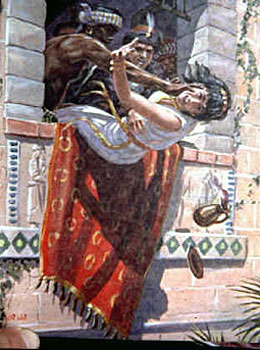
throwherdown

“For if we sin wilfully after that we have received the knowledge of the truth, there remaineth no more sacrifice for sins” - Hebrews 10:26

Did Christ die for all? If Jesus’ blood was not shed for all, how can it possibly be a sin to “trample it underfoot” as the unbelieving Jews did? (Hebrews 10:29)

Elijah set up a 12 stone altar as a substitute for Israel. The sacrifice ascended to the Lord (goat #1) and the prophets were slain (goat #2). Thus, the Baal worship was atoned for.

But Jezebel trampled this sacrifice underfoot, and continued in sin. In retaliation, she slew the prophets that Obadiah had hidden. Consequently she was trampled underfoot. (2 Kings 9:33).

The New Testament history, including the Revelation, follows this pattern. Jesus set up a new 12 apostle priesthood and Israel slew Him and them. Consequently, Israel was slain, as Jezebel. That is the context of the Hebrews passage, and the meaning of the harlot of Babylon.

But since the atonement for the Land in AD70 this applies to the world. Christ atoned for all, but not all will be redeemed. Loraine Boettner writes:

“The question which we are to discuss under the subject of ‘Limited Atonement’ is, Did Christ offer up Himself a sacrifice for the whole human race, for every individual without distinction or exception; or did His death have special reference to the elect? In other words, was the sacrifice of Christ merely intended to make the salvation of all men possible, or was it intended to render certain the salvation of those who had been given to Him by the Father? Arminians hold that Christ died for all men alike, while Calvinists hold that in the intention and secret plan of God Christ died for the elect only, and that His death had only an incidental reference to others in so far as they are partakers of common grace. The meaning might be brought out more clearly if we used the phrase ‘Limited Redemption’ rather than ‘Limited Atonement.’ The Atonement is, of course, strictly an infinite transaction; the limitation comes in, theologically, in the application of the benefits of the atonement, that is in redemption. But since the phrase ‘Limited Atonement’ has become well established in theological usage and its meaning is well known we shall continue to use it.”[1]

I’m not sure what James Jordan thinks about Limited Atonement (he is a Calvinist, as am I), but he writes:

“…when we study Leviticus 16, we find that the Day of Coverings [Atonement] required the attendance and participation of gentile sojourners. It was done by the Great Priest on behalf not only of Israel but on behalf of the whole world.

First, blood was taken in and sprinkled upon the cover of the Ark, covering it. The Ark-Cover (mistranslated “mercy-seat”) symbolised the firmament between heaven and earth. God and the warrior cherubim looked down from heaven and saw the earth covered with propitiatory blood. Thereafter, the High Priest removed his bloodied white garments and put on his garments of glory and beauty, this being the second covering of the Day of Coverings. As Romans 8:30 says, “whom He justified, them He also glorified.” Those garments symbolised the nation of Israel and also the whole world gathered around and upon him. They were made of animal wool coloured thread, vegetable linen white thread, and gold and precious stones. The High Priest carried the whole world.

Jesus is now the firmament between heaven and earth. Romans 3:25, “[Him] God displayed publicly as an Ark-Cover by His blood.” That’s the literal translation, and what we should insist upon. Yes, it is a propitiation because the blood on the Ark-Cover was propitiatory. But if we translate Romans 3:25 using an abstract theological term, we miss the fact that Jesus is the New Bloody Firmament between heaven and earth. When God looks at the earth, He sees it through the lens of Jesus and His blood. Jesus’ death covers the whole world. It covers everybody. It covered Hitler as long as Hitler was living in this world under the firmament. It does not cover Hitler any longer, of course, and Hitler has lost all protection from the wrath of God…

With this understood, we can see that those of us baptized into Jesus’ mediatorial priesthood must join in union with His praying for the whole world… We do know how to pray with Jesus practically. Jesus is the Greater David, and Jesus as Firmament is singing the psalms before the Father. Right now. If we sing the psalms, all of them, we can be sure that we are praying for all the world in exactly the right way… Worship is not a cozy time with Jesus. Worship is a ritual act that involves bringing all creation into God’s presence and asking Him to change it.” [2]

Full Atonement
1 John 2:2 - ”And He [Christ] Himself is the [covering] for our sins, and not for ours only but also for the whole world.

Limited Redemption
John 17:9 - “…I do not pray for the world but for those whom You have given Me, for they are Yours.”

So perhaps arguing about whether Christ died for all or some is a false dichotomy. Full Atonement understood as full covering, is a present reality in this life. Limited Atonement, limited covering, would better be called Limited Redemption. Salvation is most certainly offered to all, but we know there is always a division on the Day of Covering. Those who reject the covering of Christ’s blood will be finally un-covered. For those, like Jezebel, like the Judaisers, there is no more sacrifice for sins.

Switching to a postmillennial thought, since half the people who have ever lived are alive today, perhaps, by the end of history, more people will be saved than lost.

_____________________________
[1] Loraine Boettner, Limited Atonement.
[2] James B. Jordan, The Offertory, RITE REASONS No. 97. Available from www.biblicalhorizons.com. The debates about whether the Ark-cover was for propitiation or expiation miss the point.

P.S. The expressions on the faces of the servants in the image above indicates that the artist thought they were believers, not just obedient servants. Now that is an excommunication. Perhaps they feared an evaluation by the Lord such as in Revelation 2:20: “Nevertheless I have a few things against you, because you allow that woman Jezebel, who calls herself a prophetess, to teach and seduce My servants to commit sexual immorality and eat things sacrificed to idols.”


Leave a Reply