Oct
4
2019
When a paedocommunionist tells his fellow paedobaptists that the Bible trumps tradition, he has shot himself in the foot.
Peter Leithart recently published a paper entitled “Paedocommunion, the Church, & the Gospel.” As always, he is worth engaging with. The problem I have with doing so is that his arguments are sound but his fundamental assumptions are not. This means that the house which he builds is constructed with great wisdom but is also, unfortunately, located on the sand of the sea. Not only is the tide coming in, but there is also a Jonahic storm on the horizon.
Continue reading
Comments Off | tags: Baptism, Covenant Theology, Peter Leithart | posted in Biblical Theology
Mar
10
2018
Leithart and the whale.
or Do You Really Want A Real Debate?
Another response to a post on baptism, “Baptists Are Right, Almost,” by my friend Peter Leithart.
Continue reading
Comments Off | tags: Baptism, Peter Leithart | posted in Biblical Theology
Jul
22
2017
What sort of question is the question of paedocommunion?
Peter Leithart just reposted the first part of a series on paedocommunion. Since many people (most of them far more godly, educated and well-read than I am) have expressed how helpful they have found my posts on baptism, I figured I would offer some responses. Leithart is passionate about baptism, and expresses his conviction that the stakes are high. I agree with him about the stakes, which is why I oppose his errant position. In biblical theology, there is a place for everything and everything should be in its place. The question of paedocommunion in Reformed circles is the sacramental equivalent of those who promote child marriage arguing over the age at which their (perversion of) marriage can be physically consummated. That is, it is the wrong question.
Continue reading
Comments Off | tags: Baptism, Peter Leithart | posted in Biblical Theology
Apr
17
2017
“Martyrdom is more than a sign of impending doom. Martyrs are agents of apocalypse.”
Continue reading
Comments Off | tags: Peter Leithart | posted in Biblical Theology, Quotes, The Last Days
Aug
8
2016

Christ’s Claim Upon Us, Or Our Claim Upon Him?
I am not worthy to untie the shoelaces of my theological betters, but it is my duty to point out to them when they have tied them together.
Continue reading
Comments Off | tags: Baptism, Peter Leithart | posted in Biblical Theology, Christian Life
May
5
2016
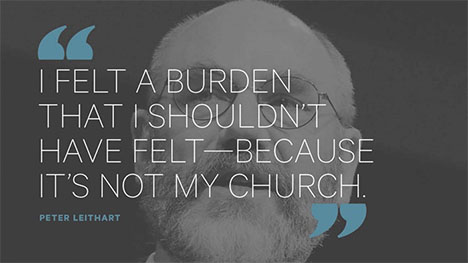
How the prolific theologian learned to face down failure.
Continue reading
Comments Off | tags: Peter Leithart | posted in Biblical Theology
Mar
26
2016
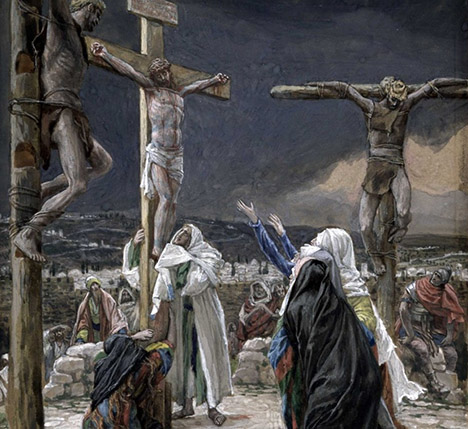
The abandonment of the Son by the Father is made palpable not in the crucifixion of His body, since He willingly laid down His life, but in the darkness which covered the Land for three hours. But perhaps this darkness was a sign of the Father’s nearness rather than His distance.
Continue reading
Comments Off | tags: Acts, Babel, Babylon, Crucifixion, Exodus, Ezekiel, Herod, James Jordan, Judas, Leviticus, Peter Leithart, Revelation, Tabernacle | posted in Biblical Theology, The Last Days
Mar
17
2016
“The telos of baptism is not faith but resurrection.” Bull vs. Leithart again, this time a response to The Ambivalence of Baptismal Theology.
Modern individualism has resulted in a dislocated society, but ancient or medieval corporatism is not the solution to it. The Bible deals with people as individuals and as groups, so neither “ism” is a solution to the other. An understanding of the one and the many based on biblical theology reveals both “isms” to be unnecessary enemies. So then, what accounts for the fundamental difference in baptismal theologies? The answer is that history is chiastic. Circumcision was a corporate sign whose telos was the personal faith of each Jew, making him or her a “Jew indeed.” Baptism is the opposite. It begins with the believer as a “Jew indeed,” the individual with the circumcised heart, and gathers them into a prophetic body. The telos of circumcision was faith, conversion. The telos of baptism is not faith but resurrection.
Continue reading
2 comments | tags: Baptism, Circumcision, Peter Leithart | posted in Biblical Theology
Dec
3
2015
Peter Leithart - CPT Conference, November 3, 2015
Comments Off | tags: Peter Leithart | posted in Biblical Theology
Nov
21
2015

Peter Leithart believes that baptism is the ground for Christian education. I agree with him. But when it comes to whose baptism, I think it can be demonstrated that he departs from the biblical pattern.
Continue reading
2 comments | tags: Baptism, Education, Federal Vision, Peter Leithart | posted in Bible Matrix, Biblical Theology