Nov
21
2015

Peter Leithart believes that baptism is the ground for Christian education. I agree with him. But when it comes to whose baptism, I think it can be demonstrated that he departs from the biblical pattern.
Continue reading
2 comments | tags: Baptism, Education, Federal Vision, Peter Leithart | posted in Bible Matrix, Biblical Theology
Jul
7
2015
“In the days when our courts are declaring that good is evil and evil is good, the recovery of baptism as a delegation of divine legal authority rather than a sign of ‘limited Covenantal obligation’ is crucial.”
Every biblical Covenant is a word from heaven designed to bring a response from the earth. When the laws in the Ark of the testimony were given to Israel, the response of a legal oath was required, intended to culminate in the legal witness of Israel to the nations. Thus, every biblical Covenant is also a process which leads to maturity, beginning with cultivation and ending in representation.
A child must be schooled before he can be employed. A man must be a disciple before he can be an apostle. Adam was to be qualified before he could represent God as a just and merciful judge on earth. But the difference between cultivation and representation is the difference between circumcision and baptism, and this facet of the biblical Covenants is something paedobaptists are unable to accept, at least in its full glory.
Continue reading
Comments Off | tags: Baptism, Circumcision, Covenant Theology, Exodus, Federal Vision, Genesis, Joshua, Moses, Peter Leithart | posted in Bible Matrix, Biblical Theology, Quotes
Apr
11
2015
Doug Wilson’s Imaginary Covenant

Wilson: Who’s Harvey?
Miss Kelly: A white rabbit, six feet tall.
Wilson: Six feet?
Elwood P. Dowd: Six feet three and a half inches. Now let’s stick to the facts.
(Harvey, 1950)
It is a pity that this imaginary Covenant-of-obligations cannot be photographed and fingerprinted, let alone identified in the New Testament. Oh wait, it is mentioned in the New Testament. It is called the Law.
The best place to learn about biblical Covenants—what they are, what they look like, and how they operate—is the hallowed halls, past and present, of Reformed Theology. Strangely, this is also the worst place to learn about the New Covenant. It seems somebody did not get the system upgrade.
Continue reading
2 comments | tags: Baptism, Covenant Theology, Doug Wilson, Federal Vision | posted in Biblical Theology, Christian Life
Apr
7
2015

…all of the Old Covenant sacraments, like the flood, were future tense and testified to the destruction of the flesh.
[A report from our London correspondent, Chris Wooldridge:]
A week ago, I attended two conferences delivered by Peter Leithart on the subject of the Sacraments. The first one was aimed at anyone interested; the second was addressed more to ministers and theological students.
Continue reading
Comments Off | tags: Baptism, Chris Wooldridge, Communion, Covenant Theology, Federal Vision, Peter Leithart | posted in Biblical Theology, Quotes
Mar
6
2015
Since Jesus loves little children, and Jesus is the Great Shepherd, our little children must therefore be His lambs.
About whom was Jesus speaking when He asked Peter to feed his “lambs”? John 21 is used in support of the practice of paedocommunion, but such an argument sees only what it is looking for. If we allow the passage to speak for itself, what is it saying?
Continue reading
Comments Off | tags: Baptism, Communion, Federal Vision, Tim Gallant | posted in Bible Matrix, Biblical Theology, The Last Days
Jan
12
2015
“Paedofaith is like the New Testament, but with midichlorians.”
Doug Wilson likes to quote the Proverb that says God draws straight with crooked lines, so my post title is a little cheeky. Anyhow, I thought it would be helpful, for myself at least, to work through his thoughtful list with a red marker. A red, permanent marker. Continue reading
Comments Off | tags: Baptism, Circum, Doug Wilson, Federal Vision | posted in Biblical Theology
Oct
18
2014

“A baptism which does not discern between the fruit of the womb and the fruit of the tomb is anti-Christ, denying He has come in the flesh.”
This post follows on from Exposed To The Elements.
An online paedobaptist friend commented that he had never heard sacred architecture offered as an argument for credobaptism before. My experience with the brilliant Bible teaching by the various Federal Vision gents is that I get a principle under my belt, then automatically begin to see its implications for all of Scripture. But then numerous times I would be surprised when no one had thought of applying it consistently. The main offender is paedobaptism. Despite their claims, it is a rite that does not spring naturally from Scripture. In fact, it has to be protected from Scripture, from the very principles I have been taught by paedobaptists.
Continue reading
6 comments | tags: Abraham, Baptism, Circumcision, David, Federal Vision, Genesis, James Jordan, John the Baptist, Peter Leithart, Tabernacle, Toby Sumpter | posted in Biblical Theology
Jan
29
2014
Looking God in the Eye

The history of mankind is one of good gifts turned into idols. Blessings abused become curses in the hands of those who won’t look God in the eye.
For those of us who know the Bible, the idolatries become more subtle. This was the case for the Pharisees. The exile had purified Israel of old-school idolatry, so she invented a new school: an elitism bound by an Abrahamic heritage and energized by the abuse of Moses and the Law as a means of salvation: heritage instead of faith; obligation instead of salvation. The good things given as gifts once again became the gods.
Continue reading
2 comments | tags: Baptism, Communion, Covenant Theology, Federal Vision | posted in Biblical Theology, Christian Life, The Last Days
Jan
16
2014
or Baptism into Baal

Then you shall say to Pharaoh,
‘Thus says the Lord,
Israel is my firstborn son,
and I say to you,
“Let my son go that he may serve me.”
If you refuse to let him go,
behold,
I will kill your firstborn son.’”
(Exodus 4:22)
My Federal Vision friends believe baptism is an important subject, from both theological and pastoral points of view. I agree, but for me it is also an issue of aesthetics. The Bible has a wonderfully consistent internal logic, and paedobaptism crunches the gears at every turn.
Peter Leithart just posted something concerning baptism, and it’s worth answering, not only “because somebody on the internet is wrong,” but also because it is an issue I’ve just finished dealing with in The Shape of Galatians. It should be noted that Trinity House is hosting some lectures on sacraments by a baptist, so Dr Leithart and his colleagues have a spirit that should be imitated by theologians everywhere. My own posts here are always bait in the hope of a bite, a friendly disputatio, so don’t take them the wrong way. If a friend has soup on his tie, or wax in his ear, or a fertility rite in his sacrament, what sort of friend isn’t going to point it out!?
Continue reading
4 comments | tags: Abel, Abraham, Baptism, Cain, Federal Vision, Galatians, Genesis, Numbers, Paul, Peter Leithart, Romans, The Shape of Galatians | posted in Bible Matrix, Biblical Theology, Quotes
Nov
11
2013
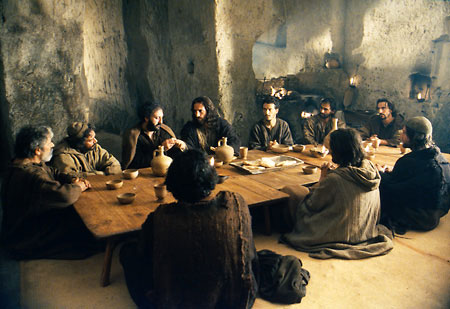
“The Lord’s Table is for dangerous people.”
If you are going to baptize infants, it makes sense that you would also allow them to take Communion. Baptism brings one into the priesthood (through the Laver) to the court of God, and Communion is fellowship in the priestly kingdom. To unite the two is consistent—as consistent as the two pillars flanking the threshold of Solomon’s Temple.
Continue reading
Comments Off | tags: Baptism, Circumcision, Communion, Ecclesiology, Federal Vision, God's Kitchen, James Jordan, John, Lampstand, Passover, Sacraments, Tim Gallant | posted in Biblical Theology