Sep
19
2014
Alpha and Omega
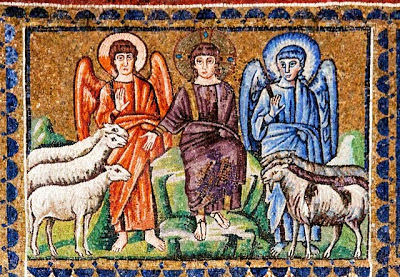
Since the sacred architecture of the Jew-Gentile social structure set up in Daniel was a spiritual expansion of the previous physical sanctuaries, we should not be surprised to find its shape serving as the foundation for the New Testament. Since the Holy Place symbolised the court of the King of Heaven, the Tabernacle sheds some helpful light on Jesus’ cryptic description of judgment from His throne in Matthew 25. It not only becomes clear why the Lord uses sheep and goats as symbols for Gentile nations, but their locations and destinies bring to an end a narrative thread which can be traced back to Genesis 4.
Continue reading
Comments Off | tags: Cain, Jacob, Jeremiah, Leviticus, Matthew, Peter Leithart, Zedekiah | posted in Bible Matrix, Biblical Theology, The Last Days, The Restoration Era
Sep
10
2014
This post has been slain and resurrected for inclusion in my 2015 book of essays, Inquietude.
Continue reading
2 comments | tags: Abraham, Absalom, Baptism, Cain, Circumcision, David, Deuteronomy, Esau, Genesis, Jacob, Joseph, Laban, Lamech | posted in Bible Matrix, Biblical Theology, The Last Days
Jul
25
2014
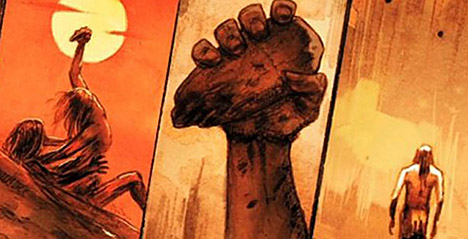
In a Land from which Cainites were being dispossessed, Israel herself would not only judge between the manslayer and the avenger of blood, but provide cities of refuge to the “firstborn” Levites as a gift.
The Avenger of Blood
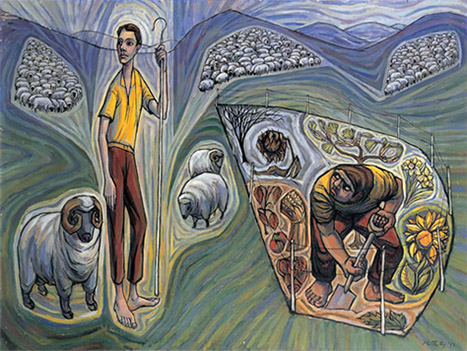
Like Adam, Cain would not “bear” his sin. But unlike Adam, Cain was rejecting the covering of animal substitutes. As the “offspring” of the serpent (kinghood without priesthood), he only understood law as tyranny. There was no place for mercy (Atonement) because mercy required Covenant confession.
Continue reading
Comments Off | tags: Abel, Cain, Genesis, High Priest, Levites, Numbers | posted in Biblical Theology
Jul
2
2014
Raising Cain
“Just as Circumcision made impossible a global corruption,
so paedobaptism makes impossible a global Gospel.”
Part 1 here.
With so many young people leaving the Church, it is no wonder that there is a push to renew an understanding of biblical Covenant. Giving our children a profound sense of their “Covenant identity” is a crucial means of re-establishing the Covenant framework which has been neglected. Unfortunately, those pushing for these things are going about it in entirely the wrong way, because they are re-establishing the wrong Covenant.
Continue reading
12 comments | tags: Abel, Abraham, Babel, Baptism, Cain, Circumcision, Covenant Theology, Genesis, Jonah | posted in Biblical Theology
Jan
16
2014
or Baptism into Baal
Then you shall say to Pharaoh,
‘Thus says the Lord,
Israel is my firstborn son,
and I say to you,
“Let my son go that he may serve me.”
If you refuse to let him go,
behold,
I will kill your firstborn son.’”
(Exodus 4:22)
My Federal Vision friends believe baptism is an important subject, from both theological and pastoral points of view. I agree, but for me it is also an issue of aesthetics. The Bible has a wonderfully consistent internal logic, and paedobaptism crunches the gears at every turn.
Peter Leithart just posted something concerning baptism, and it’s worth answering, not only “because somebody on the internet is wrong,” but also because it is an issue I’ve just finished dealing with in The Shape of Galatians. It should be noted that Trinity House is hosting some lectures on sacraments by a baptist, so Dr Leithart and his colleagues have a spirit that should be imitated by theologians everywhere. My own posts here are always bait in the hope of a bite, a friendly disputatio, so don’t take them the wrong way. If a friend has soup on his tie, or wax in his ear, or a fertility rite in his sacrament, what sort of friend isn’t going to point it out!?
Continue reading
4 comments | tags: Abel, Abraham, Baptism, Cain, Federal Vision, Galatians, Genesis, Numbers, Paul, Peter Leithart, Romans, The Shape of Galatians | posted in Bible Matrix, Biblical Theology, Quotes
Dec
20
2013
God loves His architecture. The first chapter of the Bible is architecture. The books of Moses and the book of Revelation are filled with architecture, and the same floorplan underlies every book in between. Most Christians don’t understand the Bible’s architecture and modern Christians not only do not understand it, they do not care for it. But God loves His architecture. To love the Bible one must love its architecture. To understand the Bible, one must let the architecture inform one’s understanding.
Continue reading
Comments Off | tags: Abel, Baptism, Cain, Circumcision, Covenant curse, Covenant Theology, Genesis, High Priest, Numbers, Peter Leithart | posted in Biblical Theology, Quotes
Mar
5
2013
 Were the Nephilim in Genesis 6 angels or aliens?
The Nephilim (“great” or “amazing”) were the first “mighty men” of the Bible. They were the result of the intermarriage between the priestly sons of Seth and the rebellious Cainite kings. The text gives us a split genealogy after the murder of Abel, priests serving God outside the garden, and Cain’s false kingdom (Cain went and built a “fortress” to protect himself). So, humanity was divided into two camps: those who served God as their king and those who rebelled against Him.
Continue reading
17 comments | tags: Cain, Compromise, Genesis, James Jordan, Nephilim | posted in Biblical Theology, Creation, Q&A, The Last Days
Jan
19
2013
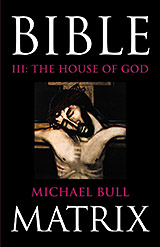
An excerpt from Bible Matrix III:
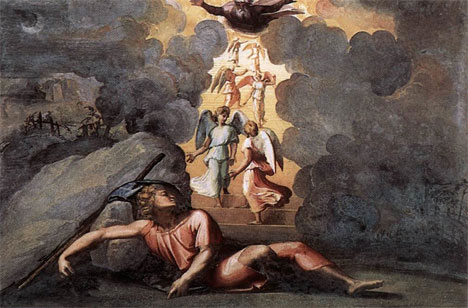
Just as Esau was the line of Cain rolled into one, so Jacob was a true son of God. In fact, being blameless as Noah was, the Lord granted him a vision of the true Gate of God, a tower reaching to heaven.
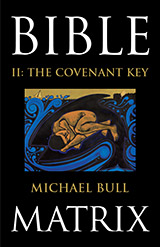
In Bible Matrix, we mentioned the significance of Jacob’s “ziggurat” vision as it relates to the mountain of God. [1] Jacob was laid out on the ground like Adam. His slumber brings a “Bridal” vision.
Continue reading
Comments Off | tags: Baptism, Bible Matrix III, Cain, Esau, Genesis, Jacob, Literary Structure, Tabernacle | posted in Bible Matrix, Biblical Theology
Nov
21
2012
 A while ago, Angie Brennan posted a quote from a Touchstone article on God’s apparent wastefulness when it comes to our natural talents:
Continue reading
Comments Off | tags: Babylon, Cain, Church History, James Jordan | posted in Bible Matrix, Biblical Theology, Quotes
Mar
16
2012
 Douglas Wilson writes:
“What is the meaning of ”one is taken and the other left’? This is commonly thought to refer to the rapture — one taken up into heaven, and the other left on earth to kick himself for not praying the sinner’s prayer when he had a chance. On the bright side, there will be a lot of free, unmanned cars available” (Heaven Misplaced, p. 104).
Matthew 24 is a prediction of the Covenant curses falling upon Judah for the last time. One being taken and the other left has to do with displacement. Titus enslaved the best Jews and took them in ships to Egypt.
“And the Lord will take you back to Egypt in ships, by the way of which I said to you, ‘You shall never see it again.’ And there you shall be offered for sale to your enemies as male and female slaves, but no one will buy you.” (Deuteronomy 28:68)
It’s one thing to get the historical fulfilment correct, but there’s a whole lot more going on here. In His speech, as the fulfilment of Israel, Jesus is working through the Bible Matrix, a combination of the Creation week, the weekly and annual Feasts, and the process of Dominion. This means that He is using examples of all the previous historical Covenant structures to make His point. The Covenant cycle has snowballed through history and picked up a lot of events on its way.
Continue reading
1 comment | tags: Abel, Atonement, Cain, Covenant Theology, Deuteronomy, Doug Wilson, Esau, Feasts, Genesis, Jacob, Lamech, Literary Structure, Matthew, Systematic typology | posted in Against Hyperpreterism, Bible Matrix, Biblical Theology, The Last Days