May 18 2013

Baptism for the Dead

or A Ripsnorter Ritual

Ritual is powerful stuff. Much of modern evangelicalism prides itself in rejecting liturgy and being “open to the Spirit,” and then turns this “openness” into an uninspired (and very uninspiring) human formula, in place of the inspired Divine one. Instead of following a pattern found in every part of the Bible (worship is literary architecture), we are stuck with either erroneous traditions or off-the-cuff rambles which, although “open to inspiration,” somehow sound exactly the same each week. Human beings love repetition in every area of life, and ritual is a prime method of teaching truth and holiness.

Continue reading

Share Button


May 13 2013

Living Menora

The letters to the pastors of the seven churches in Asia are a prophecy of the history of the Church, according to dispensationalist Bible teachers. For interpreters who are committed to a “literal” hermeneutic, this is bending the rules in the direction of a “literary” hermeneutic, which is excellent. However, they apply the letters to the wrong future, and overlook the obvious allusions to the past.

Continue reading

Share Button


Apr 23 2013

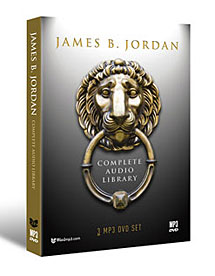
144 Hours of Heaven

James Jordan’s must-have Revelation lecture series


What Is Revelation Really About?

Continue reading

Share Button


Apr 17 2013

Ephesians 7

Priests and Levites of All Nations

Part 1 | Part 2 | Part 3 | Part 4 | Part 5 | Part 6

In this final post on the structure of Ephesians, we will cover stage 6 (Conquest/Atonement) and stage 7 (Glorification/Booths). (Unfortunately, I can’t refer to them as cycles because there are 8 cycles, as previously discussed.)

A common interpretation of the “armor of God” relies on the assumption that Paul is using the kit of a Roman soldier as a metaphor. This shows how fragmented is our understanding of the Bible, an organic text which is not fragmented at all, and not reliant upon the various contemporary cultures anywhere near as much as we assume. The armor in Ephesians 6 is that of a priest, a priest with a sword, fulfilling his guard duty at the gate of God.

Continue reading

Share Button


Mar 27 2013

Hermeneutical Polytheism

“For thus says the Lord of hosts: ‘Once more (it is a little while) I will shake heaven and earth, the sea and dry land…”
(Haggai 2:6)

Many modern commentators hamstring various parts of the Bible so they don’t run against the grain of modern scientism and historical revisionism. They do this by “classifying” the bits of Scripture that offend modern theory into neat literary genres. “If Genesis is poetry, it can’t be historical,” and other stupidities. Nice try. Another one is “apocalyptic,” a genre which, to the eye of unbelief, might appear to actually exist.

Continue reading

Share Button


Mar 13 2013

Ephesians 3


Part 1  |  Part 2

The first cycle of Ephesians expressed the call and adoption of God’s sons as a new Creation (Sabbath). At its very centre was the phrase, “the forgiveness of our trespasses.” At the centre of the second, which concerned the removal of the Veil of Moses, was “the sons of disobedience,” a Division between the sons of the promise and the sons of the flesh (Passover). This division was obviously no longer founded on genealogy but began with voluntary allegiance to Jesus. Circumcision or uncircumcision became irrelevant.

Continue reading

Share Button


Mar 6 2013

Ephesians 2

Part 1 here.

Bible commentators will tell you that Paul’s epistle to the Ephesians contains great riches. Unfortunately, without any reference to its Mosaic literary structure, it comes across as a jumble of jewels in a treasure chest. However, analysis of the structure allows us to appreciate the fine networks and chains of thought in the literary architecture — and also the clever allusions contrasting old Israel with the New. It also demonstrates Jesus’ fulfillment of the Mosaic Law.

Continue reading

Share Button


Mar 4 2013

Ephesians 1

or the Covenanto-Architecturo-Historico-Grammatico-Muso Method

“A seal is meant to be broken.”

During the first of his recent lectures in London, James Jordan tore a page out of his Bible. It was the page announcing the New Testament as a separate book with its own pagination. It is one thing to interpret the New Testament in the light of contemporary literature and history, but their importance pales in comparison to the texts being recognized as a continuation of the Scriptures.

Continue reading

Share Button


Feb 13 2013

The Ethical Nude

“Picasso did not paint for the eyes but for the gut. He painted for the gut that the eyes might be opened.”

One only has to compare a portrait of Picasso’s wife to that of one his lovers to prove that his strange perspective on reality worked from the inside out. What we feel as we observe his works is what he feels about his subjects as he paints them. The spirit and desire which animate man and beast not only move flesh but, in Picasso’s world, distort reality. Time and history without fail reveal the true character of objects, people and ideologies. A Picasso is often the exterior of a person or event shaped or distorted by the spirit and emotion within. It is a history in a single frame, an X ray that discovers not the bones but the heart. Emotional reality is revealed in shape and color. In these cases, his subjects are possibly “ethical nudes.”

Continue reading

Share Button


Jan 13 2013

The Black Lodge

The Most Unholy

Fans of the (rather sick) TV series Twin Peaks have a lot of fun trying to figure out the meaning of the many symbols and clues left by series creator David Lynch. But his apparent originality isn’t that original. His inspiration is the occult. The funny thing is that the occult itself isn’t all that original. It is simply an inversion of many things in the Bible, which is also filled with strange symbols and clues. It is no coincidence that Twin Peaks was the product of a culture that was once soaked in the Bible.

Continue reading

Share Button