A Diatribe on Genesis One

by James B. Jordan | Biblical Horizons No. 255, August 2015
On what grounds do men reject the historicity of Genesis 1?
Just as the majority of evangelical Christians in America today are Arminian and Baptist, so the majority do not believe in a creation around 4000BC. I don’t expect any of these three situations to change anytime soon. Powerful presuppositions are at work in all three instances.
To cut it down to the most basic: It is clear that Genesis 1 narrates the creation of the world in six quite ordinary days, each day having a quite ordinary evening and morning, the days following one another to form a week. It is also clear that Genesis 5 and 11 form a chronology from creation to Abram. That’s the prima facie obvious reading of the text, and so the text was read by the Jews and by Christians for 3000+ years.
On what grounds do men reject the historicity of Genesis 1? One can assert simply that we now know that the world is older than 4000 years, and that the universe did not come into existence in six days; and then on the basis of such assumptions reinterpret Genesis 1. It is to the credit of most evangelical and Reformed expositors that such an argument is not satisfactory. The only possible Biblical argument for taking Genesis 1 in some other way must arise from the text itself, or other places in the Bible that rather clearly indicate that Genesis 1 is not to be taken as an historical account.
Thus, it is asserted that there are indications in Genesis 1 itself that the passage is not to be taken “literally,” indications overlooked by previous generations because they were not giving full attention to the text. The asseverations of “modern science” have forced us to look at the text anew, and now we find contradictions in the text that indicate that it is not to be taken as an historical account.
We can summarize these evidences of ahistoricality as follows. First, it is said that the creation of light on the first day contradicts the creation of the sun on the fourth. This argument cannot stand since the Bible presents the Shekinah light of God as the archetype of which the sun is but a copy. The light that was “let be” on the first day was the light of the Spirit. There is no Biblical ground for asserting a conflict between day 1 and day 4.
Second, it is said that all the plants were made on the third day, while at the time Adam was created there were still plants to be made. This contradiction is again illusory. Genesis 1 very carefully states only that grain plants and fruiting trees were made on the third day. Genesis 2:5 states that at the time Adam was created certain other plants had not yet been created, and that the grain plants had not yet sprouted ears of grain. There is no contradiction in the text.
Third, it is said that the sixth day involves too much activity for one mere day. Not so. All the events could easily have been finished by noon.
Fourth, it is said that the sabbath day is unending. Here again, this is a mere assertion. The notion that the seventh day is unending has no support in the Bible. The Bible often speaks of “eighth” days. In any event, this has nothing to do with the lengths and character of the other days, which are specified as having mornings and evenings.
Finally, it is asserted that the firmament of the second day must be a hard shell over the earth, which we now know does not exist, and thus must be symbolic. This assertion ignores the facts (a) that a firmament in Hebrew is not always a hard shell, and (b) that the Bible often speaks of the firmament as a chamber as well as a layer, which comports perfectly with the statement that on day 4 God placed the sun, moon, planets, and stars within the firmament chamber.
These five asserted problems in Genesis 1 are then supplemented by observations on the literary structure of the passage, as if literary structure were somehow in conflict with historicity – an assumption so preposterous that it is never baldly stated.
In conclusion, the supposed indications that Genesis 1 is not to be taken historically prove on scant inspection to be chimaeras.
But what difference does it really make? I submit that ultimately the entire Christian faith stands or falls on how Genesis 1 is interpreted, and that the guardians of the Church must take an unequivocal stance on this matter.
The issue is hermeneutics and religion. Since these “contradictions” in Genesis 1 serve to indicate that this passage is not to be taken historically, the only alternative is to take the passage as giving some kind of archetype for creation by God. It is a foundational “myth,” expressing in “human language” matters that cannot be expressed any other way. It is a true myth in that the ideas taught in Genesis 1 are true.
And this is where the shift from true religion to gnosticism comes in. History has been replaced by ideas.
Now, with the care of a man selecting a meal from a smorgasbord, evangelicals who reject the historicity of Genesis 1 insist on the historicity of later passages in the Bible. In this happy inconsistency they rest – but for how long?
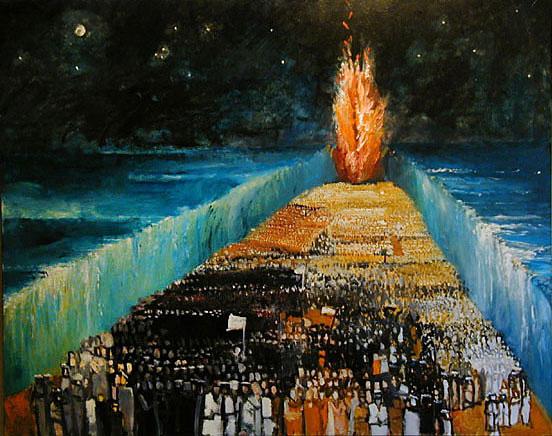
Let us turn to two other seemingly historical events in the Bible and apply the hermeneutical principles of our gnostic-influenced brethren. The first to which we turn is the ten plagues visited on Egypt.
First of all, we note that 20th century historians of the ancient world cannot find any evidence of a vast host of people leaving Egypt at the time the Bible says it happened. Moreover, according to the text of Exodus, all the Egyptian crops and cattle were destroyed, along with the Egyptian army and a large number of Egypt’s sons. Modern “scientific” archaeology and history finds no such event. Therefore, we have to look at the text of Exodus anew. Maybe these events never really happened. Maybe they are just a “true myth,” providing archetypical “ideas” that undergirded God’s relationship with Israel.
Well, do we find any indications in the text that the ten plagues are only a story, that they never really happened? Yes, we do. According to Exodus 9:6, all the livestock of Egypt died in the 5th plague, but according to 9:19, there were still more livestock to be killed in the 7th plague. Also, according to Exodus 8:22, the insects destroyed all of Egypt, clearly including the plants, while in 9:31, the flax and barley were destroyed later on in the 7th plague, and then in 10:15, the locusts ate all the remaining plants. These are much clearer contradictions than anything found in Genesis 1. And to these we may add that repeatedly Pharaoh says he will let the people go, and then changes his mind. How likely is this?
Well, since we have found such clear indications that these plagues are not to be taken as real history, do we find a literary framework to posit as some kind of alternative? Certainly. There are three groups of three plagues, and then a 10th. The first plague in each cycle begins with a command to go to Pharaoh in the morning. The second in each cycle begins with a command simply to go to Pharaoh. The third in each cycle is not announced to Pharaoh at all. The first three plagues are brought by Aaron’s staff, while the last three are brought by Moses’ hand. Etc. So, we have a clear literary structure.
Of course, traditional expositors have suggested ways around the “contradictions” in the historical narrative of the ten plagues, but if we are going to let the interpretation of Genesis 1 be our guide, we may not try to get around these contradictions. Rather, we must let them be indicators that these events never really happened. The plagues on Egypt were not historical events, but are a foundational and archetypal myth for the nation of Israel, just as the six days of Genesis are a foundational and archetypal myth for the whole universe.
Now let us turn to the resurrection of Jesus Christ. Repeating our Genesis 1 procedure, we note first of all that “scientific” historians can find no evidence that Jesus rose from the dead. Josephus says nothing about it, and neither does any other “unbiased” source. So, maybe it never happened. We must inspect the text anew.
Do we find contradictions that indicate that the resurrection never happened? Of course we do! The four gospels are in obvious conflict with one other regarding the events of Easter morning. Of course, traditional expositors try to harmonize these four accounts, as John Wenham does in his book Easter Enigma, but we should let the contradictions stand as they are, for they indicate to us that we are not dealing with what we think of as history at all. Only someone afflicted with “common sense realism” would think that these are historical accounts.
So, seeing that there are contradictions in the text, do we find literary structures that indicate the real meaning of the text? Certainly. In John, for instance, Jesus’ tomb is presented as a holy of holies with the slab on which He lay as an Ark-cover with two angels at either end. Moreover, Jesus appears as Gardener in a new Edenic garden in John. Thus, John is giving us theology, ideas, not history. It has been argued that the resurrection of Jesus differs from creation events in that the Bible presents human witnesses and testimony (1 Corinthians 15:5-8). Well, the creation events were witnessed by the angels (Job 38:4-7), and what we have in Genesis 1 and the rest of the first creation is the testimony of angels (Hebrews 2:2; Acts 7:53; Galatians 3:19; 4:1-7). The angels were there during creation week. They saw it happen. They, or one of them, or the Angel of Yahweh, revealed this information to whoever wrote Genesis 1, perhaps Noah.
And here my essay concludes. If we approach the Bible the way the ahistorical interpreters of Genesis 1 want us to, the Christian religion eventually disappears into gnosticism. By the same token, if we take other passages of the Bible in their obvious historical sense, and resolve seeming contradictions in the way the Church has always done, then we must do the same with Genesis 1.
The “framework hypothesis” and its brethren import to the Bible a hermeneutics completely alien to the Christian religion. Our faith is based in facts, historical facts: the acts of God in history, in creation, redemption, and new-creation. The faith of the gnostic is in ideas about eternal matters.
Our conclusion is that these modern approaches to Genesis 1 are badly wrong. Not that those advocating them are heretics, for they with happy inconsistency retain most of the Christian religion. But if their hermeneutical procedure is allowed standing within the Church, their disciples will in time carry forth their error consistently, and the faith will be lost. Thus it has ever been.
__________________________________
Photo by Brian Moats, Theopolis Institute.