Apr
8
2015
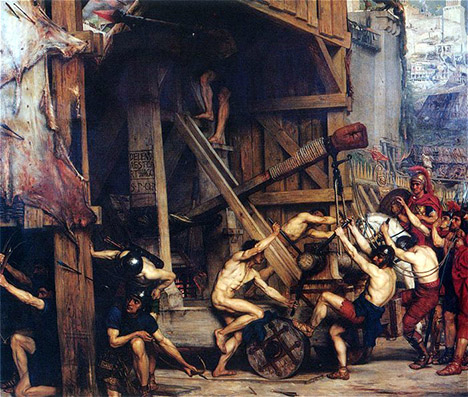
Sin City – 1 | Sin City – 2
When was “The First Resurrection”?
At the end of what we call the Old Covenant, the long history of sacrificial “ascensions” also came to an end. Along with this, all the Old Covenant saints ascended to heaven in what the Revelation calls “the first resurrection.” However, it seems to me that the sacrificial rites themselves indicate that the saints did not ascend in AD70 but instead just prior to the beginning of the Roman siege.
Continue reading
Comments Off | tags: AD70, Feasts, Luke, Revelation | posted in Bible Matrix, Biblical Theology, The Last Days
Mar
17
2014
“Modern commentators seem to overlook the promise of children in Genesis 1, and how these unmentioned ‘innocents,’ yet in Adam’s loins, are silent but crucial characters in Genesis 3.”
When Paul refers to Abraham as the father of all who believe, the one through whom all nations would be blessed (Romans 4:9-22), we must be prepared to interpret his inspired words through the lens of the House of God, the ever-present architecture of Eden.
The Name of the Father
God’s household in heaven was a tent of servants—the angels—but there was only one Son, through whom came all Creation. This means that the first verses of John’s Gospel, which describe the pre-incarnate Word, can tell us a great deal about God’s intentions for Adam, the incarnate image of God. All that Jesus was in heaven, Adam was to be on earth:
This post has been slain and resurrected for inclusion in my 2015 book of essays, Inquietude.
Continue reading
Comments Off | tags: Abraham, Covenant Theology, Feasts, Genesis, Literary Structure, Tabernacle | posted in Bible Matrix, Biblical Theology
Dec
16
2013
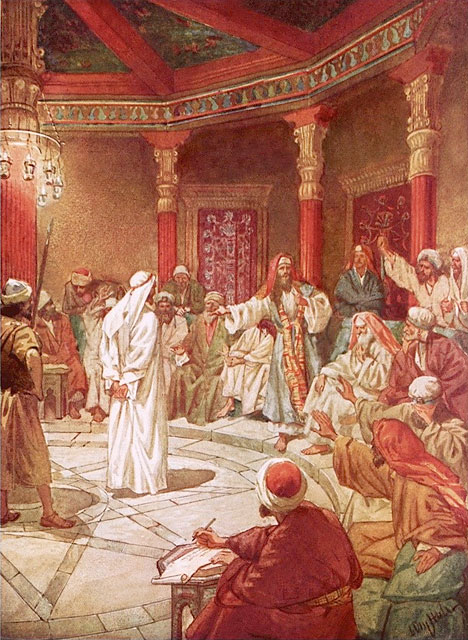
“Sanctions corresponds to the Day of Atonement. One goat goes to heaven (as fragrant smoke) and the other goes to hell, carrying the sins of the people into the wilderness, to be eaten by the birds and beasts. The difference here is that we have not two goats, but two High Priests…”
Matthew 26-27: SANCTIONS
The fourth major cycle moves us from the Covenant Ethics to the Covenant Sanctions. This concerns the pouring out of blessings and curses for obedience or disobedience to the Covenant, and the cleansing of the Land from the guilt of sin and the ensuing barrenness.
Aligning this pattern with its corrupted prototype in Eden, the “war of words” between Adam (Jesus) and the serpent (the Jewish rulers) is over, and it is time for some face to face combat, and a reckoning.
Continue reading
Comments Off | tags: Feasts, Fractals, High Priest, Literary Structure, Matthew, Peter | posted in Bible Matrix, Biblical Theology
Nov
19
2013
 Part III – The Feast of Clouds
“But Peter said, ‘I have no silver and gold, but what I do have I give to you.”’ (Acts 3:6)
Israel consistently failed to keep the final feast, the Feast of Sukkot, because she took her calling to be elitist rather than priestly. She thought her calling, gifts and purification were for herself, rather than for the healing of the nations.
Continue reading
Comments Off | tags: Acts, Babylon, Baptism, Covenant Theology, Daniel, Esther, Feasts, Lampstand, Paul, Pentecost, Tabernacles | posted in Bible Matrix, Biblical Theology, The Last Days, The Restoration Era
Nov
7
2013
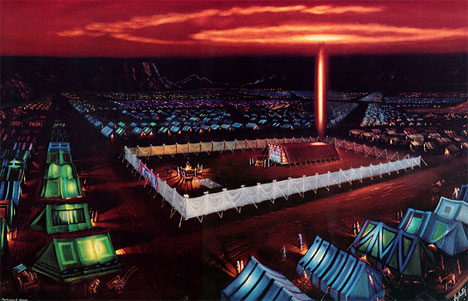
Part II – The Black Sabbath
“For the cloud of the Lord was on the tabernacle by day, and fire was in it by night,
in the sight of all the house of Israel throughout all their journeys.” (Exodus 40:8)
Continued from The Household of Faith – 1
“You shall kindle no fire in all your dwelling places on the Sabbath day.” (Exodus 35:3)
Israel took the man who was collecting kindling on the Sabbath and nipped his sin in the bud. His intentions were plain, so they wanted to know what should be done with him. It sounds brutal, but Exodus and Leviticus give us a plethora of strange laws for Israelites. At least, they seem strange until we understand that not only was Sinai replicated in the Tabernacle, the Tabernacle was to be replicated in every Israelite tent, and indeed in every Israelite. Every household was a tent of God, a cloud, and every Israelite a burning star in the sky. The tribes were, after all, arranged around the tent in military “constellations.” This new Black Sabbath was to reconnect every tent with its source, the tent of God.
Continue reading
1 comment | tags: Exodus, Feasts, Moses, Tabernacle, Tabernacles | posted in Bible Matrix, Biblical Theology, Creation
Oct
28
2013
 Born from Above
I’m currently working hard on Bible Matrix III: The House of God. This third volume is bigger on the inside than it is on the outside. It really is. Being so engrossed in the shape and processes of the Bible (yes, even more than usual), it has struck me how foreign the various theological schools’ thinking and speech is to the actual text.
The debates about “Pauline Theology” are the perfect example, especially the focus on narrow (yet important) topics such as justification. An academic divides and redivides the text in the way an expert in any science overspecializes. He ends up knowing everything about nothing. After spending a few hours each day wandering and describing the halls of biblical architecture, I am more convinced than ever that the only way to fully understand Scripture is architecturally. This is because, for our glorious God, architecture is ethics, and ethics is architecture. Divorced from the biblical mud map, the Edenic grid, modern theologians are discussing less than a dim distorted reflection of the book God has given us. They are feeling their way around the house with their eyes shut. Continue reading
Comments Off | tags: Abraham, Baptism, Circumcision, Covenant Theology, Deuteronomy, Exodus, Feasts, Galatians, Genesis, Literary Structure, Moses | posted in Bible Matrix, Biblical Theology
Oct
24
2013
“Once the architecture is taken into account, the text is not ridiculous but terrifying. It marches inexorably through the deep rhythm of the seven days with laser precision, stately deliberation, and omniscient vision. These words were breathed by the source of all breath.”
Part I – Picking Up Sticks
“You shall kindle no fire in all your dwelling places on the Sabbath day.” (Exodus 35:3)
Many Christians ignore, and atheists poke fun at, the weird bits of the Bible, as though these texts are primitive, distorted, or contrived. Nothing could be further from the truth. The truth is that these texts are designed to choke the faithless, and to be chewed over, meditated upon by the faithful, that we might be changed.
Why was fire forbidden on the Sabbath? The first thing to do with any text is identify its context. No more treating Bible texts like fortune cookies, do you hear me?
Continue reading
Comments Off | tags: Booths, Covenant curse, Covenant Theology, Exodus, Feasts, Literary Structure, Moses, Numbers, Tabernacle | posted in Bible Matrix, Biblical Theology
Oct
1
2013
There are heavenly bodies and earthly bodies,
but the glory of the heavenly is of one kind,
and the glory of the earthly is of another.
(1 Corinthians 15:40)
Did Adam receive the Spirit of God? If he did receive the Spirit, was the Spirit taken away when he sinned?
This post has been slain and resurrected for inclusion in my 2015 book of essays, Inquietude.
Continue reading
Comments Off | tags: AD70, Baptism, Covenant Theology, Feasts, Genesis, Tabernacle, Tabernacle of David | posted in Against Hyperpreterism, Bible Matrix, Biblical Theology, Creation
Jul
29
2013
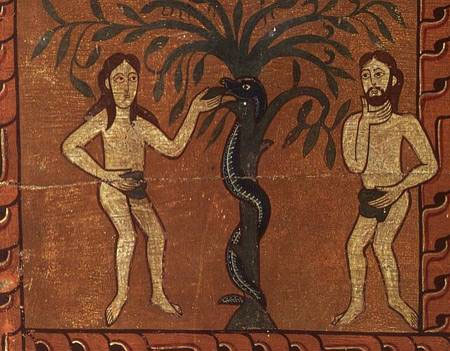
Paul’s Genesis
It’s time to put another epistle under the matrix-scope!
Continue reading
Comments Off | tags: Covenant curse, Covenant Theology, Feasts, Galatians, Literary Structure, Paul | posted in Bible Matrix, Biblical Theology, The Last Days
Jun
24
2013
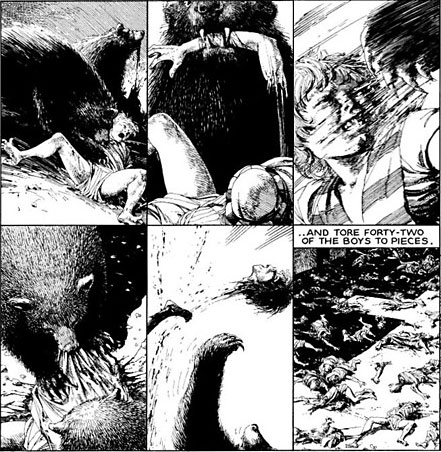
or Who Is The Real Jericho?
Atheists love to embarrass Christians with a snide reference to the story of Elisha setting two bears upon some helpless children. What nobody, even Christians, seem to get is the “Covenant significance” of all the players in the story, harking back to Moses. The prophets were, after all, God’s “repo men.” [1]
[This post has been refined and included in Sweet Counsel: Essays to Brighten the Eyes.]
Continue reading
Comments Off | tags: AD70, Covenant curse, Covenant Theology, Egypt, Elisha, Feasts, Herod, Jericho, Jezebel, Kings, Leviticus, Peter Leithart, Pharaoh, Revelation | posted in Apologetics, Bible Matrix, Biblical Theology, The Last Days