Aug 20 2011

Judicial Maturity

6a00d8341bffb053ef0134818071ae970c-500wi

“…and their eyes were opened, and they knew that they were naked.”
(Genesis 3:7, cf. Matthew 9:30; Luke 24:31; Acts 9:8)

Jesus’ sermons are all literary masterpieces. Perhaps it was not only the explicit content of His speeches that riled the rulers. He not only claimed to be Yahweh, His sermons all follow the structure of the speeches of Yahweh. They are Covenantal not only in content but in form. No other man spoke like this man, except perhaps Moses and the Prophets, who repeated the Words dictated to them by God.

TRANSCENDENCE - Initiation
Do not think
…..that I came to destroy
……….the Law

……….or the Prophets.
…..I did not come to destroy
but to fulfill.

This stanza is deliberately missing its “Pentecost.” It follows the Creation pattern but the Law has not yet been “opened.” As Robert Alter claims, much of the Bible’s communication relies on repetition of establishes forms but with modification, additions, and omissions. Sometimes what is not said is the elephant in the room. Jesus would fulfil the Law at the centre of history and send the Spirit. He would kindle the fire on the Altar of Israel at Pentecost, and it would be totally consumed in AD70. He does it again in stanza 2.

HIERARCHY - Delegation
For assuredly, (Initiation)
…..I say to you, (Delegation)
……….till heaven and [Land] pass away, (Presentation)
……………[No Holy Fire, no Pentecostal Purification]
……….one jot or one tittle (Transformation - Law repeated)
…..will by no means pass from the law (Vindication)
till all is fulfilled. (Restoration)

Notice that heaven and Land are at Day 3,  the Ascension offering. Genesis (Initiation), Exodus (Delegation), Leviticus (Presentation)… All the tribes possessed Land except Levi because the Levites were the holy Firstfruits upon the Altar-Land.

ETHICS - Purification (Israel threshed)
Whoever therefore (Creation)
…..breaks (Division)
……….[of these commandments the least] (ironic Ascension)
…………….(No Testing)
……….and teaches men so, (Maturity)
…..shall be called least (ironic Conquest)
in the kingdom of heaven; (Glorification)

Notice that this stanza follows the Creation week’s 1-2-3 (least), 1-2-3 (least) forming and filling. In this case it is a failure to form and a subsequent failure to fill. It is Adam at Day 6 who is least.

SANCTIONS - Vindication
but whoever (Creation)
…..[shall practise (Division)
..........and teach, (Ascension)
...............this one] (Testing)
……….great (Maturity)
…..shall be called (Conquest - Vindication)
in the kingdom of heaven. (Glorification - Succession)

Finally, we have a Man in the middle.

SUCCESSION - Restoration
For I say (Genesis)
…..to you, (Exodus)
……….that unless your righteousness (Leviticus)
……………exceeds (Numbers - Testing)
……….the scribes and Pharisees, (Deuteronomy)
…..you will by no means enter (Joshua)
the kingdom of heaven. (Wise Judges)

What did Jesus mean in this final stanza? The purpose of the Covenant process is to put Man under God’s eyes at Ethics/Testing, so that Man might become God’s eyes by the end, and initiate the next cycle as God’s tried and tested representative. Adam failed so God moved to the next generation, which also failed. The failures continued (except for Enoch as righteous Firstfruits) until Noah become the first righteous judge, and was handed the sword of judgment instead of being scattered by it.

The scribes and Pharisees came to an end with the Old Covenant in AD70. They were denied Succession. The key is that this entire structure above recapitulates God’s Covenant plan for Adam. Jesus is saying that unless you have eyes that judge righteously between good and evil, by obedience to the Spirit of God, you will be as blind as the Pharisees, who judged according to outward appearances only. The Spirit’s choice of the Son of David was the same as it was for David. The Pharisees were not looking upon Jesus’ heart. But God was, and it pleased Him.

All those who have the Spirit of God are not missing the “Pentecostal” line of the Covenant poem. Obedience to the gospel allows God to pour out the holy fire and transform the sacrifice. Baptism is the vindication of such a person by the Church. At “Sanctions” and “Glorification”, we find robes and wine.

Robes and wine are for those who are spiritually, and judicially mature. But the watershed is one’s own personal Pentecost. The first birth is (fundamentally) about growing in stature, rising like a loaf of bread whose purpose is to be broken. The second birth breaks the bread, and its purpose it that we are to be poured out like wine.

For sure, we are to grow into even greater maturity after conversion, but if we have the Spirit of Christ, we are justified and have the wisdom of Christ guiding us into all truth. Certainly, there are stages of maturity within the regenerate, but the indwelling Spirit of God is quite clearly the baseline, and repentance and baptism are the first “baby” steps of obedience in our new life.

The beginning of this “judicial maturity,” this righteousness that exceeds that of the Pharisees, is someone being cut to the heart, recognizing that they are unrighteous and Jesus is righteous, that light is day and darkness is night. Conversion begins a new creation — in that individual. It is a Covenant process that is both objective and subjective. Jesus calls His sheep and His sheep responds.

Paedobaptists object to credobaptism because it’s hard to tell if a child is ready. And if they are ready at aged 7, how can this be the Maturity that the Covenant process demands. We like to pin maturity down to how old someone needs to be. The Old Covenant pinned everything down so they didn’t have to think. Ages were specified. That’s priestly. It’s childhood. The New Covenant doesn’t do that. We are led by the Spirit, and babies aren’t.

To clarify, the “age in years” is more about the first birth than the second — a maturity that is practical and valuable but nonetheless a carnal wisdom. The wisdom the New Covenant requires is a gift of the Spirit of God. There are certainly overlaps (elders should be elders) but that concerns a maturity that comes with years of rule by the Spirit. A newborn Christian, born by the Spirit, that is, receives a Spirit of judgment far beyond anything the Pharisees could hope to possess. Their eyes were full of darkness, so Jesus fulfilled the Law and became a light to their path. When Pentecost finally came, they continued to blaspheme the Holy Spirit and His conviction of their unrighteousness. The only place for them was outer darkness. But the Spirit-filled man — or child — has wisdom beyond his years: the riches of the wisdom of Christ.

___________________________
See also Matthew’s Literary Artistry.
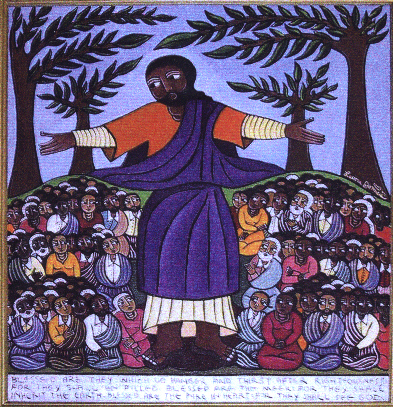
Art: Sermon on the Mount by Laura James.

Jul 14 2011

One Taken, One Left Behind

ivoryjudas

“…falling headlong, he burst open in the middle…”

Todd Robinson commented:

“I’ve enjoyed your particular brand of orthodox preterism. Working through Acts recently, I began to wonder what Michael Bull’s take on Acts 1:11 and 3:19-21 would be… Thanks for any insight.”

Continue reading


Jan 28 2011

Strong Delusion

or Goblet of Fire

waugh-grail-1912

“And the times of this ignorance God winked at;
but now commandeth all men every where to repent…”
Acts 17:30

Reading the Bible without an understanding of Creational and Covenant structures is like watching test cricket without knowing the rules. It’s not unusual for even the best commentators to be distracted by something as inconsequential as a lost seagull. But every moment is part of a bigger picture. Isaiah can seem tedious at times, but it’s a long game. Let’s look at Isaiah 4:2-6, which relates the purging of exiled Israel to the jealous inspection in Numbers 5. In this case, she comes up trumps.

Continue reading


Sep 28 2010

Firmament of Flesh

or The Universe is Flat

omegaratioThe three density ratios (Ω omega) and the corresponding cosmological morphology. (Goddard Space Flight Center WMAP Cosmology)

Therefore, brethren, having boldness to enter the Holiest by the blood of Jesus, by a new and living way which He consecrated for us, through the veil, that is, His flesh, and having a High Priest over the house of God, let us draw near with a true heart in full assurance of faith, having our hearts sprinkled from an evil conscience and our bodies washed with pure water. (Hebrews 10:19-22)

The “firmament” is the most troublesome element of the Creation week. Even when we understand its symbolic counterpart in the Tabernacle (the veil), how do we account for its description as a physical part of the world?

On Day 4, God created the governing lights and put them in the firmament. If this refers to some sort of “water canopy” that later came crashing down in the Great Flood, the language referring to it as a home for stars is then visual. The Adam-to-Noah pattern puts the floodgates of heaven at “Atonement,” which means the opening of this original “proto-veil” brought men face-to-face with the Ark/throne of God and washed away the sin of the world, quite literally. All flesh was cut off. All sin was covered. And it was the end of that Covenant. The sky was rolled up like a scroll. In Noah, God founded a new heavens and a new (mediatory) Altar-Land. Symbolically, the old sun, moon and stars came crashing down. They were the “mighty men” of Genesis 6. Symbolically, God put new rulers in the firmament: a body of men and animals in a covered vessel.

But, of course, the actual governing lights remained. So, there remains something beyond this original watery “sea.” The word translated “firmament” means something flat, beaten out like metal. It is architectural. Cosmologists now tell us that the universe may well be both spherical, hyperbolic and/or “flat,” a bit like the surface of the earth, I guess. [1] God speaks of the mediatory Land as flat because it is an Altar. [2] Space is a veil between men and the throne of God. Filled with lights, it pictures for us the Holy Place before God’s throne, which is populated with angels and the redeemed. This cosmic hall of government resembled a crystal sea.

But there is something strange about the account of the creation of this veil, this dark garment stretched out on Day 2. Like the “waters above” of the original Covenant, space itself has a built-in obsolescence.

Continue reading


Jun 15 2010

Stuff is Good

or There Is No Last Supper

zacchaeusinthesycamore

A quote from N. T. Wright on Pentecost (pilfered from Uri’s blog):

Continue reading


Jun 1 2010

The Cosmic Lawsuit

mockingbird

I said, “You are gods, and all of you are children of the Most High. But you shall die like men, and fall like one of the princes.” Psalm 82:6

As discussed elsewhere here, the five-point Covenant model as it gets played out in history becomes seven-point. The central “Ethics” gets split into three: Law-Testing-Law.

Moses, the Covenant head, ascends and receives the Law. He opens it for Israel as Mediator. Israel, as body, is tested under the Law. The Law is given again to a “resurrected” Israel, the next generation.

In microcosm, we see this in the incident with the golden calf. Moses is given the Tablets, Israel is tested, and the Tablets are broken. Moses brings the Law a second time.

In macrocosm, the Law is given from Sinai, Israel is tested for forty years, and Moses brings the Law again in Deuteronomy to a “resurrected” Israel, the next generation.

Continue reading


May 12 2010

Jars of Clay - 2

solomonsjudgment

Thoughts on 2 Corinthians 4

For God, who said, “Let light shine out of darkness,” made his light shine in our hearts to give us the light of the knowledge of the glory of God in the face of Christ.

The chapter follows the Creation pattern. Here are the governors of Day 4, the people of God filled with the Law of God at Pentecost. They become the eyes of God. (See Eye Spy - 1: The Insiders).

But we have this treasure in jars of clay to show that this all-surpassing power is from God and not from us.

Continue reading


Apr 16 2010

Half the Blood

passover-darleneslavujacthau

“Do not forgive them, Father. They know exactly what they are doing.”

Throughout the Bible there are two doors, or more correctly, a door and a window.

Both of them involve blood. The first takes us out of the world. The second puts us in government. The first is the Passover door, the second is a window in Jericho. One mirrors the other chiastically in the journey from slavery to Sabbath.

Continue reading


Jan 12 2010

Baptism of Fire

pentecost-duccio

“I indeed baptize you with water unto repentance, but He who is coming after me is mightier than I, whose sandals I am not worthy to carry. He will baptize you with the Holy Spirit and fire.” Matthew 3:11 

I remember a scene from X Files where they printed out a binary code and laid the pages out on the floor. When viewed from a distance the ones and zeros made the image of a face. There was a similar scene in one of the Indiana Jones movies, where there was a search for a secret passage and it turned out to be a large X on the floor when viewed from above. This is just my view, but it seems a lot of theologians spend a great deal of time walking in circles in the jungle, lost in the details of prooftexts when we have Old Testament “Google maps” at our fingertips.

Continue reading


Jan 7 2010

Seven Bowls of Wrath

sevenbowls

Revelation can’t be fully appreciated without attention to its literary structure. I’m no expert, but have a gander at this…

Continue reading