Sep
12
2012
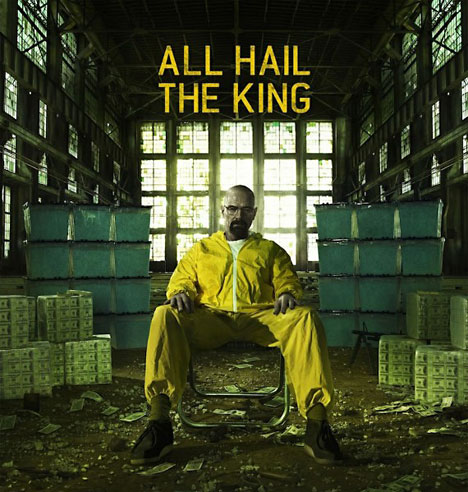
or Mr White and the Black Hat
“There is a way that seems right to a man,
but its end is the way to death.” (Proverbs 14:12)
King David committed far worse sins than did King Saul. Saul was not an evil man, yet his judgments caused the deaths of many people, including Jonathan, his other sons and even the priests of God. Why did a reign that began so well end in such tragedy?
Continue reading
Comments Off | tags: Acts, AD70, Amalek, David, Edomites, Herod, Pentecost, Proverbs, Samuel, Saul | posted in Biblical Theology, Christian Life, Ethics, The Last Days
Dec
18
2009
or The Crash of AD70

Now a river went out of Eden to water the garden, and from there it parted and became four riverheads. The name of the first is Pishon; it is the one which skirts the whole land of Havilah, where there is gold. And the gold of that land is good. Bdellium and the onyx stone are there. The name of the second river is Gihon; it is the one which goes around the whole land of Cush. The name of the third river is Hiddekel; it is the one which goes toward the east of Assyria. The fourth river is the Euphrates. (Genesis 2:10-14)
After the Herod and Shylock post, I had one complaint that the Worship as Commerce tag didn’t really do what it said on the tin, so I hope to capture it (briefly?) here. Now, where to start? As James Jordan explains, the idea begins in Eden.
Continue reading
1 comment | tags: AD70, Amalek, Gehenna, Genesis, Gnosticism, Herod, High Priest, Isaiah, Manna, Moses, Numbers 5, Revelation, Solomon, Temple, Worship as commerce | posted in Against Hyperpreterism, Biblical Theology, Christian Life, Creation, Ethics, Quotes, The Last Days, Totus Christus
Jul
30
2009
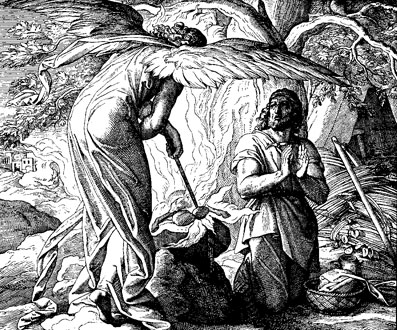
“And the angel of God said unto him, Take the flesh and the unleavened cakes, and lay them upon this rock, and pour out the broth. And he did so.” Judges 6:20
“And I say also unto thee, That thou art Peter, and upon this rock I will build my church; and the gates of hell shall not prevail against it.” Matthew 16:18
NOTE: THIS POST HAS BEEN REMIXED AND INCLUDED IN GOD’S KITCHEN.
Continue reading
Comments Off | tags: Amalek, Gideon, Jacob, Pentecost, Sheol | posted in Biblical Theology, The Last Days
Jul
28
2009
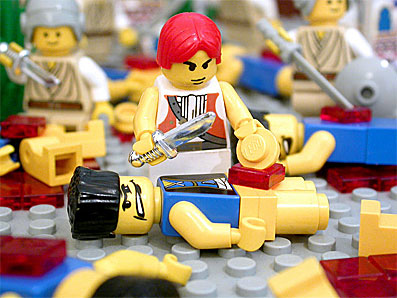
How smart is this Book?
As discussed, if we begin with Saul’s anointing by Samuel, subsequent events follow the Feasts outline. Saul’s failure to kill Amalek is at Pentecost and his failure to defeat Goliath is at Atonement.
BUT… if we begin with David’s secret anointing by Samuel, subsequent events also follow the Feasts. This time, however, David’s slaying of Goliath is at Pentecost (the serpent/beast in the wilderness). Guess what’s at Atonement?
Continue reading
1 comment | tags: Amalek, Bible Matrix, Circumcision, David, Eglon, Ezekiel, Feasts, goliath, High Priest, Saul, Sidon, Systematic typology, Tabernacles, Tyre | posted in Biblical Theology
Apr
16
2009
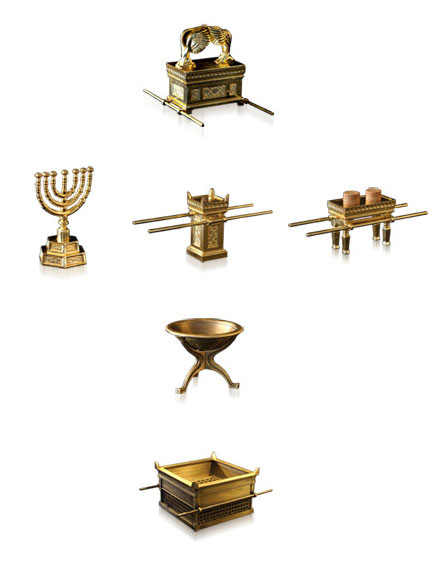
The Tabernacle was not only a “portable Sinai”, the mountain of God laid out across the ground, it was the cruciform Man. We see Jesus, with the Throne of God on His shoulders (the Ark – government), bread and wine in His left hand (the Table - servanthood), the ‘seven stars’ of the Lampstand in His right (dominion), and His feet on the crystal sea (the Laver – resurrection). And He is lifted up “in the air” between heaven and earth (the Altar-Land) as the Mediator Who unites God and man.
As the Ark (Moses), with arms outstretched (Bread – Aaron, and Ruling Lights – Hur), He is the prophet, priest and king Who defeated Greater Amalek at Sinai.
Comments Off | tags: Amalek, Ark of the Covenant, Lamps, Laver, Moses, Revelation, Sinai, Tabernacle, Table of Showbread | posted in Biblical Theology
Apr
11
2009
It was always God’s plan that Israel have a human king:
“When you come to the land which the LORD your God is giving you, and possess it and dwell in it, and say, ‘I will set a king over me like all the nations that are around me,’ you shall surely set a king over you whom the LORD your God chooses; one from among your brethren you shall set as king over you; you may not set a foreigner over you, who is not your brother.” Deut. 17:14-15
Like Adam, this dominion would only come by obedience: by servanthood to God and faithful mediatory witness to the Gentiles. But like Adam, they seized dominion and demanded “a king like the Gentiles.” With Saul, they had a king who palled around with Agag of Amalek whom Moses commanded to wipe from the face of the earth.
Continue reading
Comments Off | tags: Abimelech, Amalek, Babylon, Covenant Theology, Daniel, Exile, James Jordan, Malachi, Mordecai, Temple, Zechariah | posted in Biblical Theology, The Restoration Era
Apr
10
2009
“Are we Western Christians truly suffering because of Christ? Or the lack of us standing up for Christ?”
Good point. Once again I would use the book of Esther. The role of restored Israel was to be witnesses within the world empire, as Daniel had been. It seems Mordecai sought to be like Joseph or Daniel, but by compromising Esther’s witness, Haman ‘usurped’ his role at the right hand of the throne (a pattern begun in the Garden of Eden).
However, God used the situation for good, and Esther provides us with an historical blueprint for events in the first century:
Continue reading
Comments Off | tags: Amalek, Esther, Haman, Mission, Mordecai, Witness | posted in Biblical Theology, The Restoration Era
Apr
10
2009
Attack from the Abyss
As with most things in the Bible the pattern begins in Genesis.
Unlike the serpent’s warriors, who live by the sword, God’s warrior is a father-ruler who fights only to protect those in his care. Nimrod was a serpent-king—a dragon; Abram was a servant-king, God’s answer to Nimrod the ‘rebel’ (most likely Gilgamesh).
Satan’s attack on ‘the offspring of the woman’ through Pharaoh had failed, so he resorted to inciting a conspiracy of nations. The serpent became a dragon. But Abram (as a good Gilgamesh/Nimrod), along with the men of his household, defeated them, rescued Lot and his family, and very importantly, plundered the attackers. The darkest nights that God allows are always opportunities for more glory. And, this being HOLY war, Abram refused the ‘devoted’ plunder.
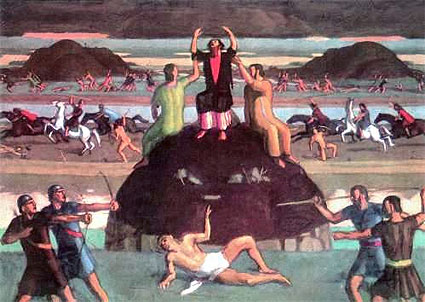
The next instance involves Amalek, who attacked Israel in the wilderness, and mercilessly picked off the stragglers. Once again, God’s man “came down” to fight – in Joshua, at Moses’ command – with Moses, Hur and Aaron as Ark and cherubim on the holy hill, the “garden gate”.
“The Lord will have war with Amalek from generation to generation.” (Exodus 17:16)
This statement about Amalek is more loaded than it seems. Amalek was defeated, and the plunders from the victory were devoted to building God’s house in the wilderness. We will see this pattern again and again. Each time, deliverance for God’s people is on a greater scale, and the defeat more catastrophic for His enemies.
Comments Off | tags: Aaron, Abraham, Amalek, Genesis, Holy war, Moses, Nimrod, Pharaoh, Tabernacle | posted in Against Hyperpreterism, Biblical Theology, The Last Days, Totus Christus
Apr
10
2009
A Conspiracy of Nations
Amalek is the archenemy of the saints. This first Amalek most likely descended from Japheth. Numbers 24:20 paints him as the original great “Sea beast”, and a counterfeit Alpha and Omega.
“Amalek was the first of the nations, but his end shall be destruction.”
Esau moved to Mount Seir and merged with the Horites to become ahybrid part-Canaanite people known as Edomites. One of Esau’s grandsons was named Amalek (Genesis 36:16), which shows a conscious or subconscious alliance between Gentile hatred and false brother hatred of God’s chosen son—a “Land beast”. This has an enormous impact on interpreting the later history of the Bible.1
Continue reading
Comments Off | tags: Amalek, Bible history, Deborah, Edomites, Esau, Jabin, Jericho, Judges, Resurrection, Sisera, Solomon, Typology | posted in Against Hyperpreterism, Biblical Theology, The Last Days