Oct
22
2013
When Moses is given the Ten Commandments they are written on two tablets:
And he declared to you his covenant, which he commanded you to perform, that is, the Ten Commandments, and he wrote them on two tablets of stone. (Deuteronomy 4:13)
Why are the Ten Commandments written on two tablets? Was one tablet not big enough for God’s handwriting? Or did God give Moses two copies of the Law, one tablet being a duplicate of the other?
Continue reading
Comments Off | tags: Aaron, Covenant Theology, Exodus, Literary Structure, Meredith Kline, Moses, Ray Sutton, Ten Commandments | posted in Bible Matrix, Biblical Theology, Q&A
Dec
18
2012

“They shall take up serpents…”
Thoughts on the Covenantal significance and serpentine nature of biblical “leprosy.”
[This post has been refined and included in Sweet Counsel: Essays to Brighten the Eyes.]
Continue reading
Comments Off | tags: Aaron, Acts, Baptism, Exodus, Kings, Leviticus, Miriam, Moses, Revelation | posted in Bible Matrix, Biblical Theology
Oct
18
2012
Part 1 | Part 2 | Part 3
Strange Fire
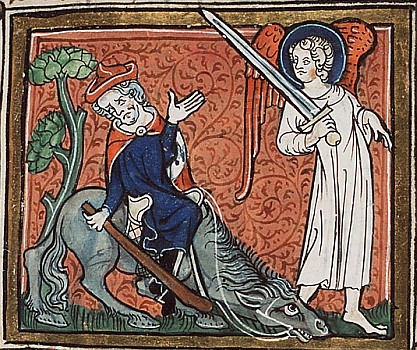
We’ve reach the central “cycle” of the book of Numbers, the attempt by Balak to destroy Israel. To the unbeliever, it is a story about a talking donkey. For believers, it is a story about a wicked prophet and a carnal people. For those with a wide angle “Bible Matrix” lens, the entire landscape suddenly comes into focus as something familiar and terrifying.
Continue reading
3 comments | tags: Aaron, Balaam, Compromise, Covenant curse, Covenant Theology, Joshua, Literary Structure, Lot, Luke Welch, Moses, Numbers, Numbers 5, Phinehas | posted in Bible Matrix, Biblical Theology, The Last Days
Sep
15
2012
Part 1 | Part 2
Lifting up the Best
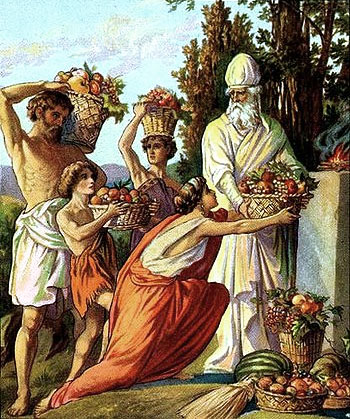
Numbers didn’t seem to be long enough for there to be seven “matrix” cycles, but it seems now that this may be a possibility. For the Covenant “five” to “bloom” into a seven, the “Ethics” of the Covenant structure is split into three: Firstfruits, Pentecost and Trumpets, or “Head,” “Fire’” and “Body.” Since Cycle 3 is “Firstfruits,” we should expect the story to include motifs such as Ascension, the Altar-Land, Levitical ministry, the firstborn, tithing and “devotion.” Hey, guess what comes next in Numbers?
Continue reading
1 comment | tags: Aaron, Firstfruits, Moses, Numbers | posted in Bible Matrix, Biblical Theology, The Last Days
Sep
11
2012
The Holy Herringbone
 Part 1 here.
We’ve covered the first “Covenant cycle” in Numbers, which in theory should set the pattern (fractally) for the remainder of the book. Here’s my go at the second cycle, which (again, in theory, if my suspicions are correct), should be an “exposition” of the second part of the first cycle, which concerned the “military” arrangement of the tribes around the Tent of Meeting (Delegation). So, even though this cycle works through all seven steps, each step should reflect an “Exodus/Hierarchy” or Delegation theme. Each step thus has two literary “spatial coordinates,” an X and a Y. Each step must thus employ a symbol that pertains to two different Covenant steps, or describes the relationship between them.
Continue reading
1 comment | tags: Aaron, Covenant Theology, Fractals, Literary Structure, Miriam, Moses, Numbers, Systematic typology | posted in Bible Matrix, Biblical Theology, The Last Days
Aug
16
2012
“Now therefore fear the Lord (T)
and serve him in sincerity and in faithfulness. (H)
Put away the gods that your fathers served (E)
beyond the River and in Egypt, (O)
and serve the Lord.” (S)
Joshua 24:14
40 Years of Harlotry
Israel famously wandered in the wilderness for forty years. They were tested, offered as a sacrifice and refined with the holy fire of the Law of Moses. This “threshing” process appears at the centre of the Bible Matrix. It is pictured as the time of harvest (Pentecost – the giving of the Law), and as the burning eyes of the Lampstand watching over Israel (sun, moon and five visible planets). In the Covenant pattern it is the “Ethics,” the bit where God lays out the rules for success. Threshing is also a biblical euphemism for sexual relations. At this point, under the Lawful eyes of God, Israel is either shown to be a faithful bride or an adulteress. Is the fire of her desire true or “strange” (foreign). We can see this pattern in James 1:15. It is a sick parody of the Covenant process because it begins with a “false word.”
[This post has been refined and included in Sweet Counsel: Essays to Brighten the Eyes.]
Continue reading
Comments Off | tags: Aaron, Communion, Covenant curse, Covenant Theology, Exodus, James Jordan, John the Baptist, Joshua, Malachi, Moses, Numbers, Numbers 5, Rene Girard | posted in Apologetics, Bible Matrix, Biblical Theology, Christian Life, The Last Days
May
19
2010
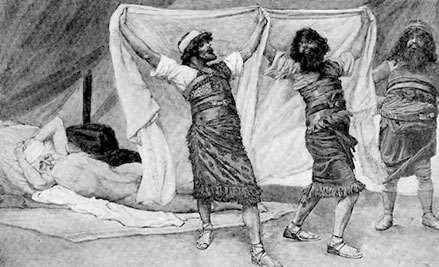
“and their faces were backwards so that they did not see their father’s nakedness” (Gen. 9:23)
James Jordan has some fascinating comments on Ham’s sin in Genesis 19:
Continue reading
Comments Off | tags: Aaron, Atonement, Genesis, Ham, James Jordan, Noah, Priesthood, Tabernacle | posted in Biblical Theology, Quotes
May
18
2010

 .
.
We know from the history of Noah that the rainbow was not a reminder to man of the Covenant but a reminder to God. [1] A subtle parallel is found in Numbers 16. After the rebellion of Korah, Dathan and Abiram, Moses called for a censer showdown between Aaron and the false priests. The rebels were swallowed by the land, and, as usual, the false priests were consumed by the fire of the Lord. [2]
Continue reading
Comments Off | tags: Aaron, breastplate, Esther, Isaiah, Mediator, Moses, Numbers | posted in Biblical Theology, Totus Christus
Mar
15
2010
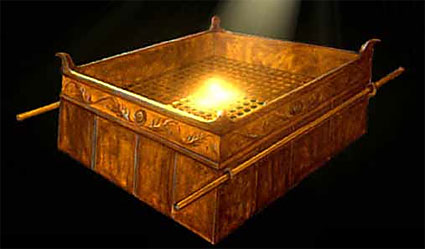
Okay, so The Earth is Flat after all. The Atlar’s being a symbol of the mediatorial Land, (a priesthood between the heavenly sky and Gentile sea) is the key to a fair amount of weird stuff in the Bible. It also means that a lot of what goes on in the Torah is the key to understanding some later enigmatic events.
The Bronze Altar had a grate inside it to support the sacrifice. The ashes would fall through the holes in the grate and the smoke would rise as a pleasing aroma to God.
In Numbers 16, concerning the rebellion of Korah and his sons, after the “censer” showdown between them and Aaron, the ground opened up and swallowed their tents, all their belongings and their families. However, fire consumed the wannabe priests who were offering the “false” incense. Even the rebellion was divided according to the priestly divisions within Israel. Ashes and smoke. [1]
Continue reading
Comments Off | tags: Aaron, Crucifixion, Korah, Liturgy, Revelation, Tabernacle, Zechariah | posted in Biblical Theology, The Last Days
Aug
5
2009

or Daniel’s 70th Week Postponed
“The people that walked in darkness have seen a great light: they that dwell in the land of the shadow of death, upon them hath the light shined.” Isaiah 9:2
A great deal of time has been spent on the chronology concerning Daniel’s seventy sevens. Quite frankly, chronology is not my strong point [1], but perhaps the solution for this enigmatic problem is not chronological but theological.
Continue reading
4 comments | tags: Aaron, AD70, Daniel, Eli, Gehenna, Herd, Herod, Pentecost | posted in Biblical Theology, The Last Days