Feb 6 2010

Bullies and Shrinking Violets

or What’s Wrong with this Picture?

francisdelatour

“When I began to edit the film, something happened. I found I was being educated. And not just with arguments. I was watching a Christian life. I was seeing a Christian man.” —Darren Doane

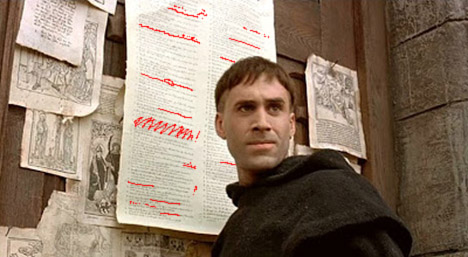
Just watched The History Boys, a film based on an entertaining but self-indulgent West End play by Alan Bennett. Despite the fact that under Course Language and Sexual References it should also have a “gay theme” warning (but I guess that’s not politically correct), the film is hysterical is places and unwittingly highlights a fatal flaw in our culture.

Continue reading


Feb 2 2010

Idolatry

lemonmeter

“Idolatry is the attempt to squeeze out of a finite thing what only  the infinite can provide. When we turn away from what the infinite God has supplied for us, we are forced to try to get more from the rest of  the world than it can possibly provide. This is because God has set eternity in our hearts, and we seek out eternal things wherever we go, whatever we do.”

—Doug Wilson


Jan 26 2010

The Perils of Deep Structure

or James Jordan’s Big Hammer

2001dave“My God, it’s full of stars!” 

One of the reasons I appreciate James Jordan is his ability to identify the “universals” in Scripture. Understanding these recurring themes answers many questions and solves many mysteries. These universal “roles” and events all point forward to the events of the first century. For instance, we cannot understand what the apostles meant by the phrase “the sons of God” without checking its history in the Old Testament. [1]

The danger with dealing in all the “big picture” stuff is that it can become self-serving. The heart is deceitfully wicked, and theology can become a kind of escapism, an ideology. Like the worst of the 20th century’s political ideologies, it can be divorced from reality so that in practice it rides roughshod over people to achieve its goals. Any big theology must maintain a big pastoral heart.

Continue reading


Jan 20 2010

A Figure Transfigured

feastofsimonpharisee

Here’s a charming quote discovered and posted by Doug Wilson over a year ago. Being exactly the opposite of the so-called “party” image portrayed on TV and in glossy mags, it kind of stuck with me. It is not sinful like they are, yet it is so “incorrect” that it must be true.

Continue reading


Jan 20 2010

Consumption and the Covenant

The Bible is full of food and money, and not just because God speaks to us using things we understand. Eating and working and spending wisely are glorifying to God. Our economics flows from our worship. Cultus begets culture, always. Doug Wilson writes:

ishop.
Our nation’s public economists usually refer to you in your capacity as consumer. This is in contrast to previous and wiser eras, when citizens were thought of as producers, and as savers. But we have departed from the way, and when disaster strikes, one of the things we think to do, is spend our way out of it. Republicans want to spend out way out this way, and Democrats that way, but we all think that consumption is king. Our understanding of consuming has become deranged.

Continue reading


Jan 18 2010

Wilson on Romans and Romanism

vatican-treasure
WORDS OF WARNING:
[Romans] is not a letter written to generic Gentiles. These words are given to the saints in Rome. “To all that be in Rome, beloved of God, called to be saints” (Rom. 1:7). When he cautions them against hubris, why would he do this? He did it because he saw the first stirrings of it. Remember that Paul characteristically argues “one of you will say then,” and he does this because he knows how the Q&A sessions usually go. And what happens here? “God cut out the Jews to make way for us Romans” (v. 19). Remember that this was the capital city of the most powerful empire in the world. Anyone who thinks that Christians don’t get caught up by this kind of reflected glory need to ask more pointed questions of their sinful hearts. The Lord spurned the devil’s offer of all the kingdoms of men in their glory—His followers have not always been so successful.
Continue reading


Jan 12 2010

In Defence of Silly Hats

funnyhats

Michael Jensen had a great column published on ABC Unleashed, critical of the religious programme Compass:

Imagine No Religion

If you ever tune in to the ABC’s flagship religious affairs programme Compass after the bonnet drama of a Sunday night, then you could be forgiven for thinking that the group of people labelled ‘the religious’ are those who wear funny hats.

As the opening title sequence of the show scrolls by, viewers are treated to a veritable facebook of curious millinery - along with some impressive facial hair.

To the average ABC viewer, watching as they iron their work clothes, the message is clear: these people are not ‘us’. They are definitely ‘the other’: a group or groups of people to be observed, categorised, wondered at - and sometimes even frightened of. 

But is there such a category as the ‘religious’? Does ‘religion’ even exist? 

Continue reading


Jan 11 2010

Envy


viadolorosa

Some well-grounded thoughts from Doug Wilson and then some wacko comments from me:

And There Slain

When envy has you by the throat, what can you do? It might appear to you in virulent forms, or it might seem almost invisible—camouflaged nicely to fit in with what you have come to call the principle of the thing. Envy is one of the hardest sins to admit, and it is one of the most widespread. So if you struggle with it, or you think you might be struggling with it, what do you do?

Continue reading


Jan 9 2010

Fundamentalism as the Key to Church Unity

A Doug Wilson quote from the recent Auburn Avenue Pastors’ Conference:

“The Apostles’ Creed, the Nicene Creed, are statements of faith that separate Christian from non-Christian. Did you see good old [anti-theist] Christopher Hitchens witnessing to that lady this last week? I’ve gotten to know Christopher pretty well and have really appreciated him. He was interviewed by a Unitarian lady minister. She was complaining in the interview,

Continue reading


Dec 15 2009

The Angels of Death Are We

Blood Shed for Bloodshedders

warriorangel

“Now thanks be to God who always leads us in triumph in Christ, and through us diffuses the fragrance of His knowledge in every place. For we are to God the fragrance of Christ among those who are being saved and among those who are perishing. To the one we are the aroma of death leading to death, and to the other the aroma of life leading to life.”  2 Cor. 2:14-16

For those who questioned whether the image of Day 5’s swarms corresponds to the clouds of incense as armies of God, Paul himself does it in 2 Corinthians 2.[1] The saints are soldiers who wield the two-edged sword of the gospel. It brings both life and death, depending on whether those warned respond like Rahab or not. Which brings me to my point.

Doug Wilson recently posted about the sacraments being promises of salvation.

“Every sacrament, by definition, contains and manifests a promise of salvation. That is what a sacrament is. The sacrament of baptism contains a promise of salvation at its inception, and the Supper contains a promise of salvation related to perseverance. What God began God will complete. These promises are apprehended with the heart, whenever someone receives them in faith.”

There is much he wrote that I agree with, but what he said highlighted the major difference between paedo- and credobaptism. Here’s my response for what it’s worth. It does repeat some things I have posted elsewhere here, but it might make my position clearer to some, and the reasons for it. It’s not an argument I’ve seen used by credobaptists, so it might be of interest to you. Continue reading