Jul
9
2015
The Church and the World
Homosexuality, Abortion, and Race with John Piper and Douglas Wilson
(Recorded October 2013)

(Recorded October 2013)
“What if your gospel-preaching pastor is not as good as one of the great orators of our day? Is it time to sell the house, pack up the family, and change churches? No, I don’t think so. But what should you do?”
The recent Australian federal election resulted in a hung parliament, with the balance of power held by a small number of elected independents. Not being forced to toe the party line, each of these men is free to stand for the needs of his own electorate. This can certainly slow down the process of government in the courts of men, but not in the courts of God.
As Christians, we are taught to toe the party line. This is a false piety. Our Father actually loves a lively, argumentative parliament. The process of maturity is supposed to bring us to the point where we are wise judges whom He can include in His government (pictured in baptism), standing on the crystal sea as joint heirs with His Son, Great Prophets whose very words change history.
Back room deals and bargaining with God are an abuse of prayer. Or are they? Not when those disputing with God are men whose hearts are like those of the Father. Abraham and David did it. God’s desire is that we should be like them. Continue reading
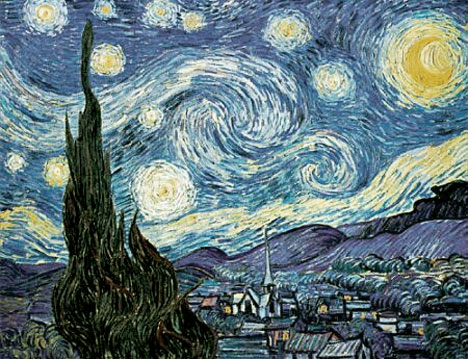
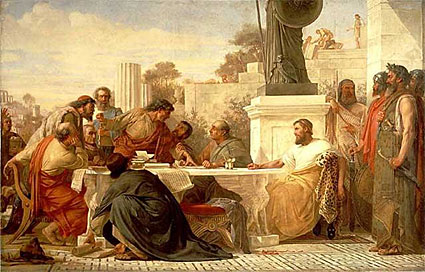
Van Gogh’s work has been regarded by some as “hallucinatory,” however his letters show that few artists were as intelligent and rational. His work was not the product of his dark times but of his struggle against them.
“I am feeling well just now… I am not strictly speaking mad, for my mind is absolutely normal in the intervals, and even more so than before. But during the attacks it is terrible—and then I lose consciousness of everything. But that spurs me on to work and to seriousness, as a miner who is always in danger and makes haste in what he does.” [1]
NOTE: THIS POST HAS BEEN REMIXED AND INCLUDED IN GOD’S KITCHEN.
The Old Testament is a bloody book. Beginning with Adam’s “dissection” to build Eve and the animals the Lord made into tunics, it culminates in Revelation with the massacre of saints under Herod/Nero (Revelation 14) and then the massacre of Jews under Vespasian and Titus.

If you haven’t heard John Piper’s sermons on the importance of baptism and church membership last year, do yourself a favour.
Frank Turk does have an issue with one point, however, which I repost here with his permission:
. . . . . . . . . . . . . . . . . . . . . . . . . .
Dr. Piper opens up the can of worms at his church again by beginning a series on baptism and church membership. The long-time readers of this blog know for a fact that this topic is near to me and dear to me — because it’s one of the topics I have blogged about most often. And in that, I think I am more a Baptist for it today than I was 3 years ago.
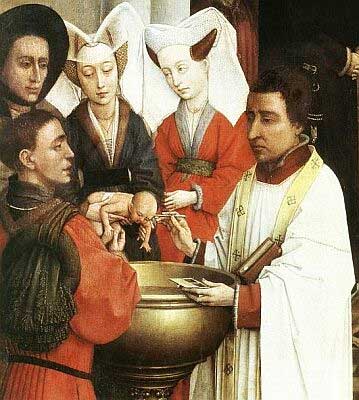
or Why Are We Baptizing the Dead?
Peter Leithart writes concerning baptism:
“In Genesis 9:11, Yahweh promises not to “cut off flesh” by water. That is the covenant with Noah.
A few chapters later, Yahweh tells Abram that he must cut off the flesh of all male children of Israel, not by water but by a knife.
Doug Wilson on Craig Blomberg’s review of N. T. Wright’s book-length response to John Piper’s book (breath):
“Then there is Blomberg’s misunderstanding of the relationship of the Reformers and culture.
‘Fixate on the Reformers’ (understandable) preoccupation with how an individual becomes right with God (crucial in its day against medieval Catholicism) and one may miss the bigger picture, in which the fulfillment of God’s covenant with Abraham through the children of Israel as progenitor of the Messiah looms even larger.’
Notice what is being juxtaposed here. The Reformers had an individualistic fixation on getting individuals into heaven when they die. But we, upon whom the new perspective has shone, now understand that there is a “bigger picture.” I see. And what did the Reformers do with their narrow vision? Well, they toppled kings, transformed laws, overhauled cultures, settled a continent, built nations, founded schools and colleges, inspired musicians and painters, and we could continue in this vein for quite a while. And what do we do, entranced as we are by the new perspective? We write academic papers, download podcasts of academic lectures that we can listen to in the privacy of our ear buds, and we go white in the face if conservative Christians suggest that Jesus might have an opinion about the ongoing slaughter of the unborn. John Piper, with his preaching on the pro-life issue, challenges the principalities and powers. The soft statism that goes with trendy theology these days does nothing of the kind — it simply suggests (but not too loudly) that we need kinder, gentler principalities and powers.”

 Bible Matrix blog