May
15
2012
“What if your gospel-preaching pastor is not as good as one of the great orators of our day? Is it time to sell the house, pack up the family, and change churches? No, I don’t think so. But what should you do?”
Continue reading
2 comments | tags: John Piper, Maturity, Preaching | posted in Christian Life, Quotes
Mar
14
2012
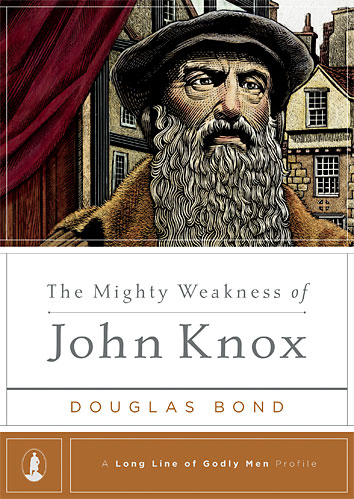 From the recent book by Douglas Bond, pp. 51-53.
Knox reluctantly began his preaching ministry when he was pressed int service as a chaplain during the siege of the Castle of St. Andrews. By popular demand, the private tutorials he prepared for his “bairns” developed into public exhortations from the Word of God. As we have seen, he was, in his flesh, a timid, fearing man; “I quake, I fear, I tremble,” he said. But when he opened his mouth to preach, all timidity vanished.
Continue reading
Comments Off | tags: Church History, John Knox, Preaching, Reformers | posted in Christian Life, Quotes
Feb
22
2012
One problem with modern conservative scholarship is its reluctance to deal with types that are not explicitly described in the text. This means that a lot of what is considered interpretation is merely application.
Aside from those types which are explicitly explained, the typological nature of Biblical history is rejected. Thus most of its “bandwidth” remains unheard. The result of this severe “downsampling” is that a lot of that application is off-the-mark because a clumsy search for a moral to the story has taken the place of the typological message. The principles drawn from the histories are not universals but abstracts, because we are looking for morals, not looking at men made in the image of God.
[This post has been refined and included in Sweet Counsel: Essays to Brighten the Eyes.]
Continue reading
Comments Off | tags: Hermeneutics, James Jordan, Judges, Preaching, Typology | posted in Biblical Theology, Quotes
Aug
30
2011

Years ago, when those “spiritual gift” tests were in vogue, a pastor told he didn’t like them because Christians were using them as an excuse to be slack in the areas where they were not “gifted.”
Continue reading
Comments Off | tags: Church Discipline, Covenant Theology, Preaching, Spiritual Growth | posted in Christian Life, Quotes
Oct
23
2010
“Let’s face it, even daytime television
is more inspiring than your sermons.”
Ray Sutton’s 5-point Covenant model is crucial when it comes to making sense of the judgments of God, both the blessings and the curses. As he says in his book That You May Prosper, “Everyone talks about the Covenant, but nobody does anything about it.”
When I was writing Totus Christus, I thought it was only natural that the 7-point Creation pattern and the 5-point Covenant pattern could be combined. Transcendence is Light. Testing and Ethics matched. The positive and negative Sanctions were quite obviously the two goats on the Day of Atonement (Ebal and Gerizim). So it was only a matter of figuring out how the 5 of Words becomes a 7 in history. [1] Continue reading
7 comments | tags: Covenant Theology, Eric Rauch, James Jordan, Literary Structure, Preaching, Ray Sutton | posted in Bible Matrix, Biblical Theology
Jul
14
2010
or Covenant as Human Shield
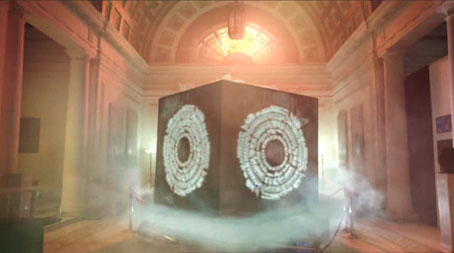
“…woe to you, scribes and Pharisees, hypocrites! For you shut up the kingdom of heaven against men; for you neither go in yourselves, nor do you allow those who are entering to go in.” Matthew 23:13
NOTE: THIS POST HAS BEEN REMIXED AND INCLUDED IN GOD’S KITCHEN.
All Creation is Covenantal, and therefore all relationships within it have a hierarchical structure. God calls a vassal (Creation), separates/sanctifies him as a delegated authority (Division). He gives him a job to do (Ascension), and a period of time to accomplish it.
This Adam, the Covenant Mediator, stands between heaven and earth (Land). The Land was raised out of the Sea, and the Man was raised out of the Land as “grain and fruit.” Then this new house, this body of broken earth, was filled with heaven, with the Spirit of God, sun moon and stars: This Adam was to be a singular prism that expands the white light of God into plural lights, a greater body, the full spectrum of colour. But he was to be a broken man. The light had to pass through him.
Continue reading
Comments Off | tags: Covenant Theology, James Jordan, Pietism, Postmillennialism, Preaching, Tabernacle, Table of Showbread, Totus Christus | posted in Bible Matrix, Biblical Theology
Sep
27
2009
Doug Wilson’s sermon yesterday at John Piper’s Calvin conference:
Continue reading
Comments Off | tags: Calvin, Doug Wilson, Preaching | posted in Biblical Theology
Jul
8
2009
A passage from Why Johnny Can’t Preach: The Media Have Shaped the Messengers, by T. David Gordon:
 “All of their sermons are about Christian truth or theology in general, and the particular text they read ahead of time merely prompts their memory or calls their attention to one of Christianity’s important realities (insofar as they perceive it). Their reading does not stimulate them to rethink anything, and since the text doesn’t stimulate them particularly (but serves merely as a reminder of what they already know), their sermon is not particularly stimulating to their hearers.
Continue reading
Comments Off | tags: C. S. Lewis, Literary Structure, Preaching, T. David Gordon | posted in Quotes
Jun
29
2009
“If you’re a pastor and you want your people to hear the hard things you have to say, you’ve got to give them your flesh and your blood. Jesus gave His to earn the right to a hearing. People will hear what you have to say when they see that you bleed for them and that you give them yourself.”
–James B. Jordan, The Bible as Literature, Basilean Lectures 1990.
Comments Off | tags: James Jordan, Preaching | posted in Christian Life, Quotes
Apr
11
2009
In the New Testament and in the early church, preaching (heralding) was something done to outsiders, persuading them to repent and believe the gospel.

“…we face a situation today in most evangelical and Reformed churches in which the reading and preaching of Scripture is the only way in which the Word is made manifest in the lives of the saints. This is a real loss for the people of God. The result is the primacy of the preacher. The preacher not only does the only really important thing in the service (preach), he also composes (if he even does that) the prayers that are prayed, and he prays them by himself. It boils down very often to worship by proxy, exactly what the Reformation fought against. Only in the Lutheran and Episcopal churches is there more than a minimum of congregational participation, because of the use of prayer books.
Since all that is left is preaching, the act of preaching takes on dimensions foreign to the Bible. Continue reading
3 comments | tags: Communion, Ecclesiology, James Jordan, Preaching, Reformation, Worship | posted in Christian Life