Sep
1
2013
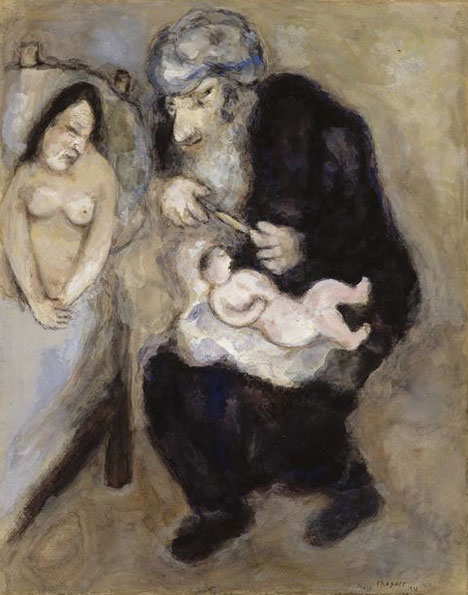
“Leithart’s real problem is that one can tell the difference between a circumcised boy and an uncircumcised one, but a sprinkled baby looks no different to an unsprinkled one.”
Chapter 1 continued
See the Baptism links page for all articles in this series.
Sacraments Are Not Signs, Means Of Grace, Or Symbols
In the next section, Dr Leithart deals with three errors:
1) The tendency to treat signs rationalistically, as nothing more than a means of communicating ideas from one mind to another mind; and,
2) Talking about sacraments as “means” tend to mechanize them, turning the sacraments into machines that deliver grace rather than moments of personal encounter with the living God.
3) Symbolic exchanges (such as language) are not the “real relationship,” which is invisible and could occur just as well without them.
Continue reading
2 comments | tags: Abraham, AD70, Baptism, Circumcision, Pentecost, Peter Leithart, Reformation | posted in Biblical Theology, The Last Days
May
26
2012
“Roman” Catholic is a contradiction in terms. Much like “World Series” Baseball.
The “Too catholic to be Catholic” goodness continues, with Rich Bledsoe and James Jordan pitching in from different angles:
Continue reading
Comments Off | tags: Communion, Compromise, James Jordan, Peter Leithart, Reformation, Rich Bledsoe, Roman Catholicism | posted in Quotes
Apr
20
2011
.
Spotted by Burke Shade:
Does the Bible Matter In the 21st Century? by Vishal Mangalwadi
“The West became great because biblical monogamy harnessed sexual energy to build strong families, women, children, and men.”
“In his quest to change oppressive regimes in Afghanistan and Iraq, President George W. Bush argued, ‘Everyone desires freedom.’ True. Everyone also desires a happy marriage: can everyone therefore have one?
Continue reading
1 comment | tags: Church History, Democracy, Economics, Reformation | posted in Christian Life, Quotes
May
15
2010
“Behold, I make all things new” is not something that
we are allowed to say—and it doesn’t work anyhow.
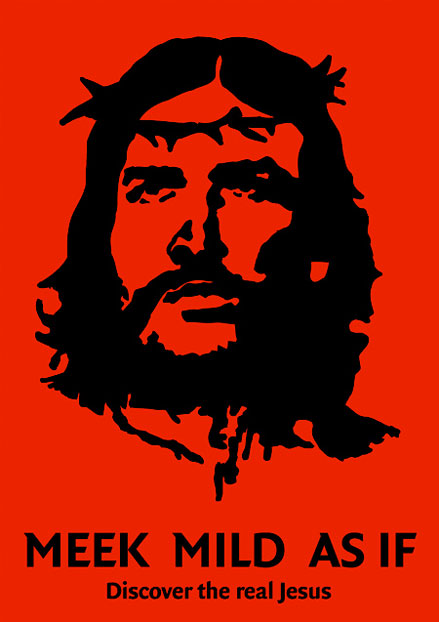
The Sin of the Revolutionary Mind
by Tim Nichols
We worship in heaven, and we are unified with those who join us there in worship—including those believers in other nations, and those who died long before us. This unity surpasses any earthly tie, including ties of where you were born—or when.
The saints of every age and place are Our People, and we should hear the voices of those who have gone before us. They are sinners, and they can be wrong. But so can we, and so we listen to their wise counsel, and—as always—measure everything by Scripture. We cannot be revolutionaries, because we belong to a long line of people from whom we cannot separate, even though we may want to.
Continue reading
3 comments | tags: Communism, Culture, Ecclesiology, Reformation, Revolution, Tim Nichols, Worship | posted in Biblical Theology, Quotes
Apr
10
2010
or The Church with the Big Head

Human talent amazes me. Totally aside from the child prodigies, we are an extremely gifted bunch. After only a couple of decades on the planet, from those who have the opportunity to apply themselves with enthusiasm to their particular area of interest, we see some incredible achievements. For the godless, this should certainly seem miraculous. But for our dark hearts it just proves how smart and wonderful we already are in ourselves. This is the ingratitude Paul speaks of.
For Christians, talent (or beauty or wealth) is just another dead giveaway of God’s existence. And God Himself almost seems to despise this early glory as a short-lived covering of wildflowers that appears suddenly after some long-awaited rain. This is the glory of youth and it is insufferably vain. It exalts itself by calling its competition dumb and ugly.
Continue reading
Comments Off | tags: Barth, Jeff Meyers, Obama, Postmillennialism, Reformation, Roman Catholicism | posted in Biblical Theology, Christian Life, Creation, Quotes
Feb
20
2010
.
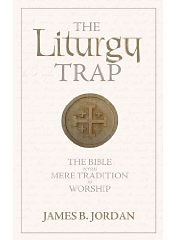
God knows us infinitely better than we know ourselves. God has said that celibacy is “not good.” It is not good for the man and not good for the church. A celibate clergy will distort the gospel in subtle ways without meaning to do so, because they are living in an unsatisfactory situation.
Continue reading
2 comments | tags: Fasting, James Jordan, Marriage, Reformation | posted in Christian Life, Quotes
Nov
18
2009
What was the Reformation?
———————————————————————————
“The unity of Rome is the unity of unbroken Adam and unbroken Saul.
It is a unity that will not go to the cross to be broken and resurrected.
It is a unity that would not confess when confronted by Nathan.”
———————————————————————————
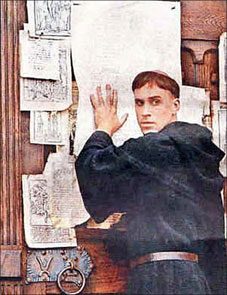 Have been having some debate with Bryan at “Called to Communion” blog on the nature of the church. Was the Reformation a rebellious schism or did the true church outgrow Rome? No guarantees on my scholarship but here’s some large excerpts that might be helpful or at least thought-provoking. Mike in roman type, Bryan in italic.
* * * * *
I agree with you that the Church that Christ founded is not “limited to any human institution”; we believe that it is a divine-human institution, because its founder is both divine and human. But its being a divine-human institution does not mean that it is a “merely human” institution, nor does it mean that it is not a human institution. To deny that it is a human institution is, in that respect, to deny Christ’s humanity. It is to assume (mistakenly) that the only kind of human institution there can be is a merely human institution. That’s like claiming that the only kind of human there can be is a mere human, not a divine human.
Before Jesus ascended, He gave the keys of the Kingdom to Peter. Christ still governs the Church, of course, but He does so through those whom He gave authority. That is why it is right for us to “Obey [our] leaders and submit to them, for they keep watch over [our] souls, as those who will give an account.” (Heb 13:17) That would not make any sense if only Christ governed His Church from heaven.
The church that Christ founded was not limited to any human institution as far as a centralised government goes. With the ascension of Christ, the government of worship by men moved from earth to heaven. It is now out of Satan’s reach and thus incorruptible. Local churches, as in Rev 2-3, are frequently assessed by Christ, and either nursed back to health, or, if consistently rebellious, he “snuffs” them out. Whether or not they remain as institutions, they are no longer part of the body – just as the cicada shell of Judaism is today.
* * * * *
Continue reading
Comments Off | tags: Reformation, Reformers, Roman Catholicism | posted in Biblical Theology, The Last Days
Sep
30
2009
Roman Catholics like to remind us Protestants that the Reformation’s sola scriptura has caused unmitigated doctrinal division. Interpretation must be done in community by people who know what they are talking about.
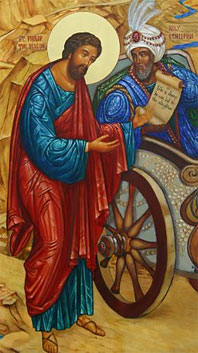
In his talk this week (see previous post Heliocentric Preaching), Doug Wilson humourously described the “just me and my Bible” people who fail to realise that the Bible itself calls us to theology in community. We all need teachers, and the Bible is written the way it is so we are forced into some sort of discipleship. Left alone with our Bibles, we are all Ethiopian eunuchs.
So regarding sola scriptura and interpretive authority, I kind of agree with the Catholics! It has always been something done by the church community.[1]
H O W E V E R . . .
Continue reading
1 comment | tags: AD70, Atonement, Church History, Compromise, Doug Wilson, Ecclesiology, Reformation, Reformers, Roman Catholicism, Tim Nichols | posted in Against Hyperpreterism, Christian Life, The Last Days
Apr
15
2009
Deconstituted Ingredients
“The second ‘zone’ we need to think about concerning gnostic tendencies is the sacraments. God’s affirmation of the material world is seen in the fact that He uses physical water to introduce people into His kingdom; and by the fact that we eat Christ’s flesh and drink His blood in the Lord’s supper. Many Christians, however, cannot embrace such physical ideas. Water baptism is thus reduced to a mere symbol instead of a powerful communication from God. And so are the bread and wine of the supper.
Continue reading
Comments Off | tags: Communion, James Jordan, Protestantism, Reformation, Wine | posted in Biblical Theology
Apr
11
2009
In the New Testament and in the early church, preaching (heralding) was something done to outsiders, persuading them to repent and believe the gospel.

“…we face a situation today in most evangelical and Reformed churches in which the reading and preaching of Scripture is the only way in which the Word is made manifest in the lives of the saints. This is a real loss for the people of God. The result is the primacy of the preacher. The preacher not only does the only really important thing in the service (preach), he also composes (if he even does that) the prayers that are prayed, and he prays them by himself. It boils down very often to worship by proxy, exactly what the Reformation fought against. Only in the Lutheran and Episcopal churches is there more than a minimum of congregational participation, because of the use of prayer books.
Since all that is left is preaching, the act of preaching takes on dimensions foreign to the Bible. Continue reading
3 comments | tags: Communion, Ecclesiology, James Jordan, Preaching, Reformation, Worship | posted in Christian Life