Apr
4
2015
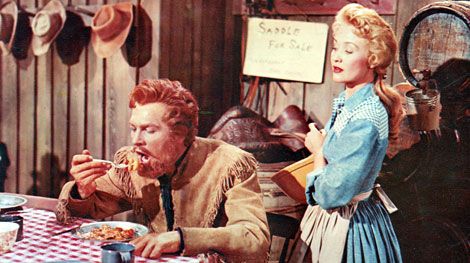
Anyone who has seen the film or the play Seven Brides for Seven Brothers knows that it is about seven wild backwoods men who become civilized through the process of learning to interact with women. But what makes it fascinating, and very biblical, is that it isnʼt just about seven brothers marrying seven women.
A guest post by Steven Opp
Continue reading
Comments Off | tags: Marriage, Masculinity, Steven Opp | posted in Bible Matrix, Biblical Theology
Oct
9
2013
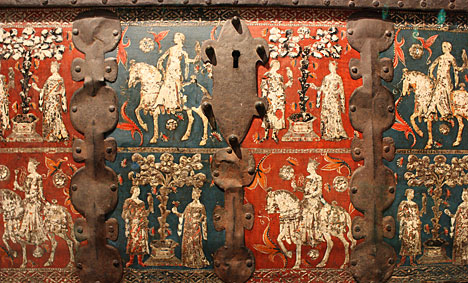
or Marriage is a Glory Box, a Hope Chest
In 1 Peter 3:7, the apostle writes:
Likewise, ye husbands, dwell with them according to knowledge, giving honour unto the wife, as unto the weaker vessel, and as being heirs together of the grace of life; that your prayers be not hindered.
The phrase “according to knowledge” (gnosis) is rendered “in an understanding way” in the NKJV and ESV. But is the exhortation for the husband to understand his wife, or to understand the source of his authority as her husband?
Continue reading
Comments Off | tags: AD70, Evolution, Genesis, Marriage, Totus Christus | posted in Bible Matrix, Biblical Theology, Creation, Q&A, The Last Days
Mar
23
2011
A blog post from my friend Albert Garlando, republished here with his permission.
Marriage, Divorce and the Gospel
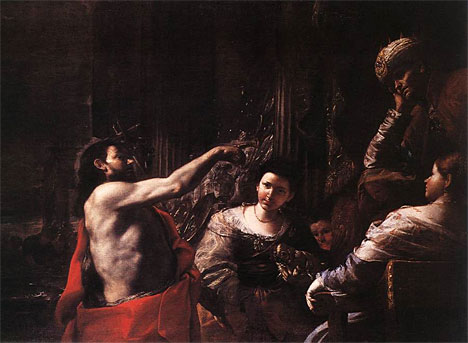
Jesus is interrogated by the religious ‘mob’ concerning his views on divorce (Mark 10:1-12). The mob are trying to get him to make a call on the Old Testament (Deuteronomy 24:1-4) provision for divorce and remarriage. The 1st Century rabbis did not agree in their own interpretations of this, so they pestered Jesus about it.
Their big question was: “What makes divorce OK?”
True to form, Jesus’ response is, “You have missed the point and are asking the wrong question.”
Continue reading
Comments Off | tags: Albert Garlando, Deuteronomy, Divorce, Herod, John the Baptist, Marriage | posted in Biblical Theology, Christian Life, Quotes
Mar
21
2011
Here’s a great post from Doug Hayes’ blog, republished here with his permission.
When Rich Bledsoe was with us at Family Camp he mentioned a paper he wrote: Sex and the City, [PDF] which we have now placed on the RCC website. It is an interesting piece of biblical social commentary worth thinking about.
Bledsoe contrasts the great ancient cities with the great city of God, the New Jerusalem and their respective sexual commitments and activities. At the base of his comments is the presupposition that it is important for us to think about cities because “the entire planet is ‘metropolizing.’ Everywhere, human beings are leaving their rural roots and are moving into the city.”
Continue reading
Comments Off | tags: Babylon, Culture, Doug Hayes, Eschatology, Marriage, New Jerusalem, Postmillennialism, Revelation, Rich Bledsoe | posted in Biblical Theology, Quotes
Dec
16
2010
“Then Jesus told them: You can be sure that tax collectors and prostitutes will get into the kingdom of God before you ever will! When John the Baptist showed you how to do right, you would not believe him. But these evil people did believe. And even when you saw what they did, you still would not change your minds and believe.” (Matthew 21:31-32)
James Jordan teaches you to observe the universals in Scripture. I believe one of the most important is the Totus Christus pattern, head and body, and its counterfeits and distortions.
As mentioned around here a couple times (sorry, a couple of times. I’ve been reading too many Americans), the curse upon Adam concerned his head, and his responsibility to provide for and protect the body. The curse upon Eve concerned her body, her role in producing offspring. Both curses were a limited form of barrenness.
But what of the relationship between head and body? James Jordan writes:
Continue reading
2 comments | tags: Abortion, Altar of the Abyss, Covenant curse, Covenant Theology, Doug Wilson, Genesis, James Jordan, Marriage | posted in Biblical Theology, Quotes, The Last Days, Totus Christus
Oct
6
2010
The Fruitful Field
“For I am jealous for you with godly jealousy. For I have betrothed you to one husband, that I may present you as a chaste virgin to Christ.” 2 Cor 11:2
Women are Complex
In Eden, as priest to Eve, Adam’s role was to continually bring her to the Father. She was put “below” Adam in the hierarchy. As the first approach of the High Priest on the Day of Covering — with the blood of a bull — Adam would present himself, standing before God as Mediator (head):
F A T H E R > < S O N + B R I D E
Adam’s job was to bring Eve “between” as the fruit, the evidence, of Covenant relationship. By being faithful to the law, he would open and maintain a clean, safe, Holy Place — a firmament — a house for the bride. The second approach of the High Priest was to cover the body, the nation. In this, he presented the blood of the first goat as the faithful bride (goat hair, symbolising the Lord’s cloud of “bridal” glory, covered the Tabernacle). Like the glory between the Father and the Son in heaven, a glorious Eve was both the fruit of Adam’s obedience, and her future fruitfulness a gift from Father to Son:
F A T H E R > B R I D E < S O N
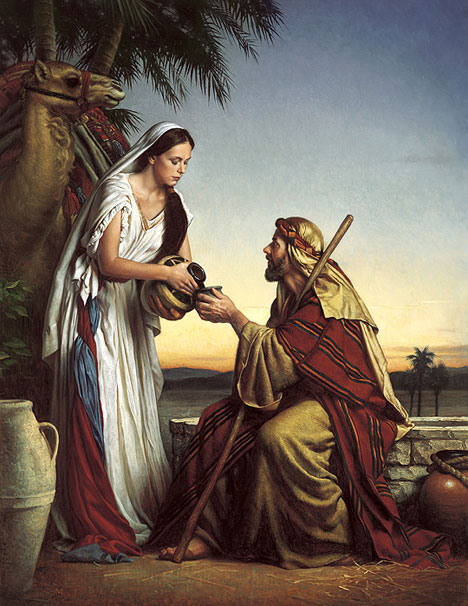
We see this imaged in the search for and presentation of godly Covenant brides in Genesis. Eliezar and Jacob seek brides for presentation to the Covenant fathers.
Continue reading
Comments Off | tags: Ark of the Covenant, Atonement, Baptism, cherubim, Circumcision, Covenant Theology, Genesis, Joshua, Marriage, Revelation, Satan, Systematic typology, Tabernacle | posted in Bible Matrix, Biblical Theology, Creation
Sep
1
2010
From James B. Jordan’s Trees and Thorns: [1]
The water in the ground of the garden is associated with Eve.
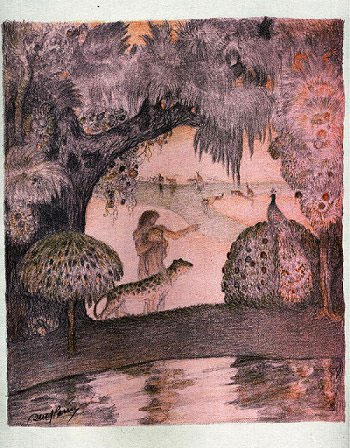
What Adam was to guard was the Garden, and preeminently Eve, its mistress. This is precisely what he refused to do. Later in the Bible, new Adams meet their Eves at wells, and defend them there. Eliezar met Rebekah at a well, and brought her home to Isaac (Gen. 24:11ff.). Jacob met Rachel at a well, and unsealed it for her — a sign as it turned out of his coming marriage to her (Gen. 29:10-11). Good Shepherd Moses met Zipporah at a well and defended her against bad shepherds (Ex. 2:16-19).
Continue reading
Comments Off | tags: Greater Eve, James Jordan, Marriage | posted in Biblical Theology, Creation, Quotes
Feb
20
2010
.
God knows us infinitely better than we know ourselves. God has said that celibacy is “not good.” It is not good for the man and not good for the church. A celibate clergy will distort the gospel in subtle ways without meaning to do so, because they are living in an unsatisfactory situation.
Continue reading
2 comments | tags: Fasting, James Jordan, Marriage, Reformation | posted in Christian Life, Quotes
Jan
15
2010
Personal and structural…
“Jordan’s definition of the covenant is striking. Continue reading
Comments Off | tags: Covenant Theology, James Jordan, Marriage, Ralph Smith | posted in Biblical Theology, Quotes
Nov
25
2009

“If you strike me down, I shall become more powerful
than you can possibly imagine.” —Ben Kenobi
Herod and Vader are maggot-filled men. They are the living dead. Christ and Kenobi are willing to die. They become the dead living.
One factor the Bible matrix continually brings out in its various occurrences throughout Scripture is the transformation of knowledge into wisdom — through death. In some profound way, knowledge is singular but wisdom is plural.
The Lord gives Adam the knowledge of the Law, and Adam is expected to obey and become wise. We can see, in his failure to confess his sin, that he was no wiser than before.
Continue reading
Comments Off | tags: Deuteronomy, Film, Marriage, Moses, Wisdom | posted in Biblical Theology, Christian Life