Apr
12
2012
or The Liturgical Significance of Lot
 Part 1, The Architectural Significance of Lot’s Daughters, is here.
We’ve looked at the three-level Tabernacle structure in Genesis 19. That’s the rooms, and their doors, so what about the furniture?
The events follow the Bible Matrix, so an identification of how each step in the story fulfills the Creation Week might shed some light on the point of the details that the Spirit has included for us. And identifying how each step fulfills the Festal Calendar might also shed some light on the motivations of Lot and his daughters. The prefigurements of events nearly half a millennium in their future are breathtaking.
Continue reading
1 comment | tags: Abraham, AD70, Altar of the Abyss, Covenant curse, Feasts, Genesis, Literary Structure, Revelation, Sodom, Systematic typology, Tabernacle | posted in Bible Matrix, Biblical Theology, The Last Days
Apr
9
2012
or The Architectural Significance of Lot’s Daughters
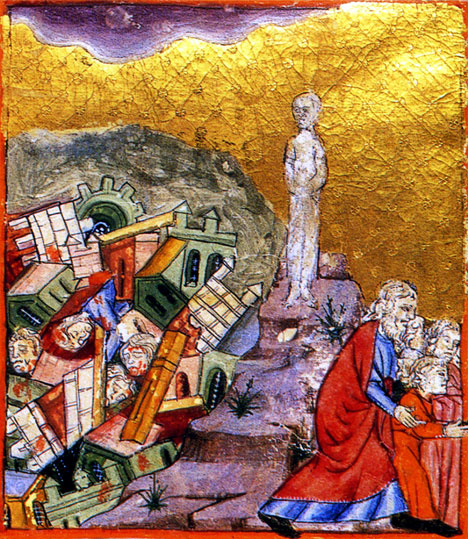
“His eyes [were] like a flame of fire …
[and] out of His mouth went a sharp two-edged sword”
(Revelation 1:14-16)
“I will set My face against you,
and you shall be defeated by your enemies.”
(Leviticus 26:17)
The Tabernacle layout to the Bible narratives is like the Globe Theatre to Shakespeare. [1] If we understand the correspondences we can get the “architectural” relationships worked out. The same blueprint appears again and again, and it explains the motivation of “righteous Lot” in the offering of his daughters to the men of Sodom. Continue reading
1 comment | tags: Abraham, Altar of the Abyss, Genesis, Lot, Sodom, Systematic typology, Tabernacle, Ten Commandments | posted in Biblical Theology, The Last Days
Mar
15
2011
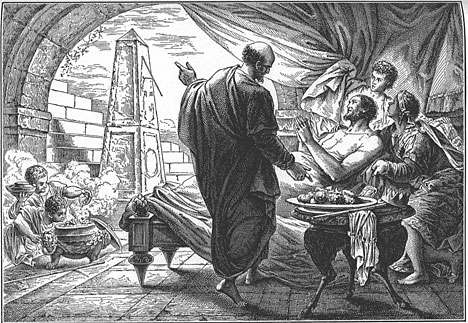
or Raising Up the Temple
An analysis of the literary structure of Day 5 of Creation and passages that are apparently parallel.
Continue reading
Comments Off | tags: Altar of the Abyss, Chiasm, Creation Week, Deuteronomy, Ezekiel, Genesis, Hezekiah, Incense Altar, Isaiah, Literary Structure, Tabernacle | posted in Bible Matrix, Biblical Theology, Creation, The Last Days
Dec
27
2010
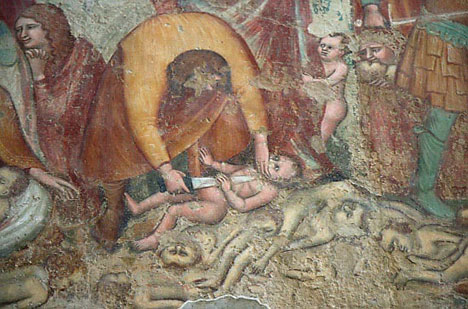
A Christmas sequel to Joseph Gets Passed Over.
The subject matter of this article was corrected, revised, and expanded in December 2018 and published here: Matthew 2: Jerusalem as Egypt.
1 comment | tags: AD70, Add new tag, Altar of the Abyss, Christmas, Gehenna, Herod, Literary Structure, Matthew | posted in Bible Matrix, Biblical Theology, Totus Christus
Dec
16
2010
“Then Jesus told them: You can be sure that tax collectors and prostitutes will get into the kingdom of God before you ever will! When John the Baptist showed you how to do right, you would not believe him. But these evil people did believe. And even when you saw what they did, you still would not change your minds and believe.” (Matthew 21:31-32)
James Jordan teaches you to observe the universals in Scripture. I believe one of the most important is the Totus Christus pattern, head and body, and its counterfeits and distortions.
As mentioned around here a couple times (sorry, a couple of times. I’ve been reading too many Americans), the curse upon Adam concerned his head, and his responsibility to provide for and protect the body. The curse upon Eve concerned her body, her role in producing offspring. Both curses were a limited form of barrenness.
But what of the relationship between head and body? James Jordan writes:
Continue reading
2 comments | tags: Abortion, Altar of the Abyss, Covenant curse, Covenant Theology, Doug Wilson, Genesis, James Jordan, Marriage | posted in Biblical Theology, Quotes, The Last Days, Totus Christus
Aug
4
2010
or Festivals from the Abyss

Herod, when he saw that he was deceived by the wise men, was exceedingly angry; and he sent forth and put to death all the male children who were in Bethlehem and in all its districts, from two years old and under, according to the time which he had determined from the wise men. Then was fulfilled what was spoken by Jeremiah the prophet, saying: “A voice was heard in Ramah, lamentation, weeping, and great mourning, Rachel weeping for her children, refusing to be comforted, because they are no more.” Matthew 2:16-18
Continuing from New Covenant Virility – 2
GLORIFICATION: (Tabernacles feast, marriage, children, rest)
Wow. This last bit really rubs in the kind of offspring (fruit) Israel gave God. It is the seventh stanza of this section, yet in itself it has seven stanzas. Each section submits itself to the common themes in Glorification, yet each section reiterates one step the sevenfold pattern. Tabernacles was the big feast, so in this final ascerbic prophecy, the prophet turns the annual Feasts into curses. [1] What sublime poetry is Isaiah.
Tabernacles is the Feasts of Booths. It is God’s people reaching maturity as a great tree and sheltering the nations. The cycle began with dry trees (eunuchs, etc.) being made fruitful. Here, God lays the ax to the root of the old tree.
Continue reading
1 comment | tags: Altar of the Abyss, Cyrus, Darius, Esther, Isaiah, Solomon, Tabernacles, Un-Passover | posted in Bible Matrix, Biblical Theology, The Restoration Era
Jul
27
2010
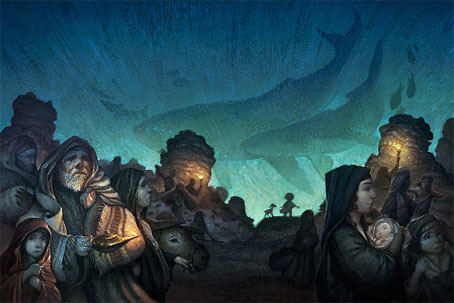
Adam couldn’t face God. Cain’s face fell. Moses’ face shone with reflected light when he returned from the mountain of God. Bezalel and Aholiab constructed the Table of Facebread, which corresponded in the cherubim to the Face Of The Man. David and his men ate the facebread. Saul feared Goliath, but David’s face was red, literally “filled with blood,” before he bloodied Goliath’s face and the usurper fell facedown. [1]
Continue reading
2 comments | tags: Altar of the Abyss, Ascension, Circumcision, Creation Week, Genesis, Incense Altar, Pentecostal, Revelation, Systematic typology, Table of Showbread | posted in Bible Matrix, Biblical Theology, Creation, The Last Days
Nov
1
2009
and the Usefulness of the Blood of Abel
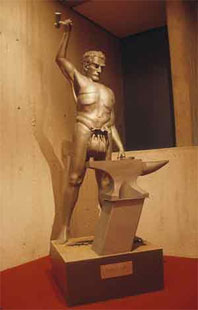 “…you have come… to the blood of sprinkling that speaks [more useful, more serviceable, more advantageous] things than [that of] Abel.” Hebrews 12:22-24
In Biblical Horizons newsletter 203, James Jordan argues that since Cain’s “exodus” to build a city occurred around 130 years after the Fall, he was publicly humiliated before thousands. He would have been accompanied by at least 1000 people, so he didn’t build the city on his own.
This means that Adam, like Solomon, was father to a divided kingdom. 1 Kings presents Solomon as a new Adam, even down to his naming of animals in his biological studies. Cain was like Jeroboam, shown mercy, given a chance, but who then caused Israel to sin.
What does Genesis give us after this? Continue reading
7 comments | tags: Abel, Altar of the Abyss, Athaliah, Cain, Genesis, Hebrews, Herodias, Jeroboam, Solomon, Tabernacle | posted in Biblical Theology, The Last Days
Sep
18
2009
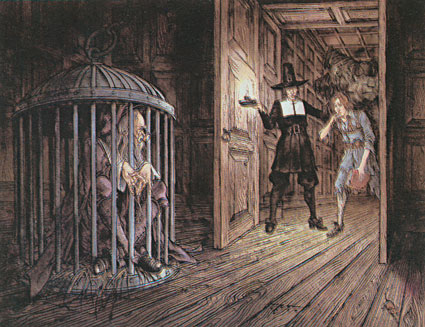
I saw in my dream, that the Interpreter took Christian by the hand again, and led him into a very dark room, where there sat a man in an iron cage. Now the man seemed very sad. He sat with his eyes looking down to the ground, and his hands folded together, and he sighed as if his heart would break.
Then said Christian, “Who is this?”
“Talk with him and see,” said the Interpreter.
“What used you to be?” asked Christian.
“I was once a flourishing professor, both in my own eyes, and also in the eyes of others,” answered the man. “I was on my way, as I thought, to the Celestial City and I was confident that I would get there.”
“But what did you do to bring yourself to this condition?” Christian asked.
“I failed to keep watch,” the man replied. “I followed the pleasures of this world, which promised me all manner of delights. But they proved to be an empty bubble. And now I am shut up in this iron cage—a man of despair who can’t get out.”
No further explanations were given. No one said who put him there. But the Interpreter whispered to Christian:
“Bear well in mind what you have seen.” [1]
. . . . . . . . . . . . . . . . . . . . . . . . . . . . . . . . . . . . . . .
Another thought related to the ideas in Behind Closed Doors.
The whole aim of the construction process, whether in sex, foetal development, education, business, art, music, family or state government, is the ultimate revelation of a mature glory. We are given the opportunity to create, and that involves certain God-given freedoms. If the freedoms are abused, what we construct for ourselves is a cage. Lust is a cage. A dysfunctional family or state is a cage. Enforced egalitarian socio-economics is a cage. Undisciplined children are a cage.
Jesus laid down His life for this world, and the freedoms of western culture have been a direct outcome. In its final stages, we have rebelliously inverted each of these freedoms (including the economic ones) and turned both our Christian protection (including our God-given wealth) and Christian mandate into a cage. Ancient Israel did the same. Why does this inversion process seem such a logical path for fallen human nature?
Continue reading
3 comments | tags: Altar of the Abyss, Babel, Biblical worldview, Culture, Dominion Theology, Doug Wilson, Economics, Incense Altar, John Bunyan, Parenting, Politics, Postmillennialism, Solomon, Tabernacle, Worship, Worship as commerce | posted in Christian Life, Quotes
Apr
8
2009
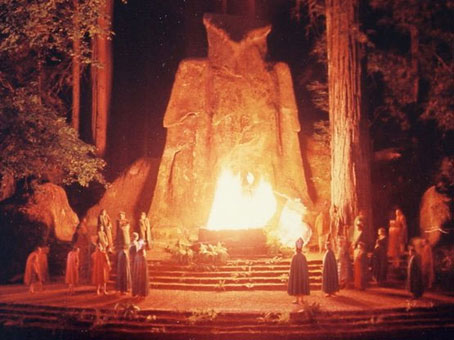 During the Creation week, there were three days of forming new “empty spaces” by dividing the original watery deep (the Abyss), then three days of filling them. A ‘world model’ develops with God’s throne at the top and the Abyss at the bottom, the place furthest from the throne. The architecture of the Tabernacle follows this model, laid out upon the ground.
When the priesthood – the Land-mediators – disobeyed God, the Abyss was dredged up to cover the Land (holy place). We see this first in the flood, and later in the invasions of Assyria, Babylon and Rome.
The Valley of Hinnom became a symbol of the ‘Abyss’ below the true mountain of God. As an evil twin of the holy place, it was an ‘Adamic’ clay pit with no glorious metal. It was also the place where Judah sacrificed their infants to false gods. It was counterfeit worship in the tabernacle of hell, and the Lord said He would fill it with their bodies. Their dark ‘table of showbread’ became a snare. [Read Jeremiah 19]
After the Babylonian captivity, Zechariah saw the church in “the deep” (often translated valley or glen). A new Land-altar was rising out of the ‘waters’ – a new mountain of God, with a new Eden-temple to mediate for the world.
TAOTA
Comments Off | tags: Altar of the Abyss, Babylon, Creation Week, Exile, Gehenna, Jeremiah, Priesthood, Tabernacle, Table of Showbread, The flood, Zechariah | posted in Biblical Theology, The Restoration Era