Mar
26
2016
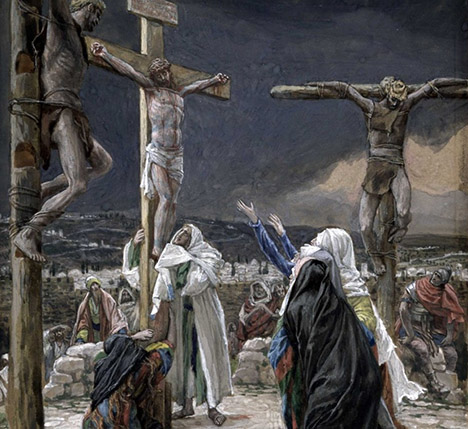
The abandonment of the Son by the Father is made palpable not in the crucifixion of His body, since He willingly laid down His life, but in the darkness which covered the Land for three hours. But perhaps this darkness was a sign of the Father’s nearness rather than His distance.
Continue reading
Comments Off | tags: Acts, Babel, Babylon, Crucifixion, Exodus, Ezekiel, Herod, James Jordan, Judas, Leviticus, Peter Leithart, Revelation, Tabernacle | posted in Biblical Theology, The Last Days
Jul
2
2014
Raising Cain
“Just as Circumcision made impossible a global corruption,
so paedobaptism makes impossible a global Gospel.”
Part 1 here.
With so many young people leaving the Church, it is no wonder that there is a push to renew an understanding of biblical Covenant. Giving our children a profound sense of their “Covenant identity” is a crucial means of re-establishing the Covenant framework which has been neglected. Unfortunately, those pushing for these things are going about it in entirely the wrong way, because they are re-establishing the wrong Covenant.
Continue reading
12 comments | tags: Abel, Abraham, Babel, Baptism, Cain, Circumcision, Covenant Theology, Genesis, Jonah | posted in Biblical Theology
Jul
10
2012

Excerpt from James B. Jordan, Babylon and the Babel Project, Biblical Horizons Occasional Paper No. 39. Available from www.biblicalhorizons.com
Continue reading
Comments Off | tags: Ark of the Covenant, Babel, Babylon, James Jordan, Zechariah, Zerubbabel | posted in Biblical Theology, Quotes, The Restoration Era
Feb
14
2012

“Let this mind be in you which was also in Christ Jesus, who, being in the form of God, did not consider it robbery to be equal with God, but made Himself of no reputation, taking the form of a bondservant, and coming in the likeness of men. And being found in appearance as a man, He humbled Himself and became obedient to the point of death, even the death of the cross. Therefore God also has highly exalted Him and given Him the name which is above every name, that at the name of Jesus every knee should bow, of those in heaven, and of those on earth, and of those under the earth, and that every tongue should confess that Jesus Christ is Lord, to the glory of God the Father.” (Philippians 2:5-11)
This passage (or pericope?) retraces the Covenant pattern, which is also played out in the flow of the history of Israel. We’ll have a look at the structure of the passage and then I want to discuss the significance of the literary placement of “every tongue.”
WARNING: Weird ahead.
[This post has been refined and included in Sweet Counsel: Essays to Brighten the Eyes.]
Continue reading
2 comments | tags: Achan, AD70, Babel, Babylon, Circumcision, Covenant Theology, Evangelism, Genesis, Herod, Joshua, Moses, Pentecost, Philippians, Postmillennialism, Systematic typology, Tabernacle, Tongues | posted in Bible Matrix, Biblical Theology, The Last Days
Sep
22
2011
or The False Bride Will Never Get A Management Position
“…the only unity that will be allowed by the Father is the unity that Jesus requested from the Father in John 17.”
One of the interesting “universal themes” that James Jordan has uncovered in the Bible is that of Satan’s various attempts to “gather the nations” against the Church. You can read about that in a series of blog posts called Amalek Debunks Hyperpreterism (click here and scroll down).
Continue reading
4 comments | tags: AD70, Babel, Economics, Herod, James Jordan, New Jerusalem, Postmillennialism | posted in Biblical Theology, The Last Days
Jun
26
2011

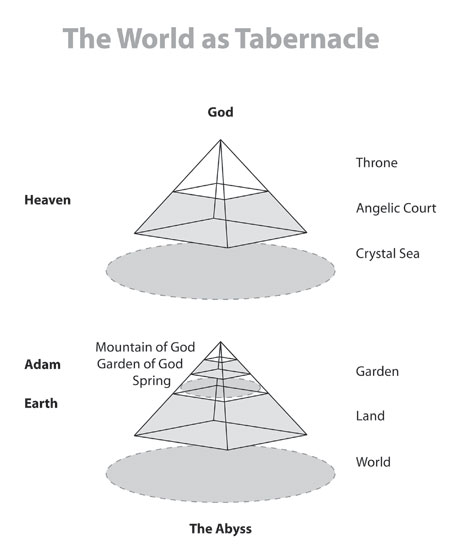
We receive baptism, but is membership of the visible New Covenant body entirely objective? The Old Covenant church, “the Body of Moses,” was Adamic. The Tabernacle was a Babelic tower, a ladder to heaven, laid out prostrate on the ground. The New Covenant Body, the Body of Jesus, is Evian. As a Temple filled with the Spirit of God, it stands upright and walks on the Crystal Sea.
Continue reading
Comments Off | tags: Babel, Baptism, Esther, Mordecai, Moses, Revelation, Tabernacle | posted in Bible Matrix, Biblical Theology, The Last Days
Aug
23
2010
Psalm 114 – Family of Blood
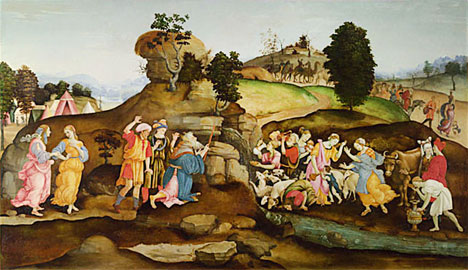
Psalm 114 is one of those weird passages of Scripture that makes you wonder if the author was high on something. Without an understanding of the significance of the place of this song among these seven Psalms, the lyrics appear to be either the overly-clever, sophomoric crypticism of an ancient Bono or the fragmented derivatory prattlings of a madman.
Continue reading
4 comments | tags: Babel, Egypt, Literary Structure, Numbers, Peter Leithart, Psalms, Zechariah | posted in Bible Matrix, Biblical Theology
Jan
18
2010
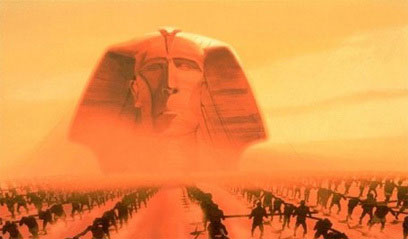
or The Sick Fix of Quick Bricks
God had repeated His promises of land and people to Isaac, but it was to Jacob that God revealed He was going to build the true Babelic tower in the Promised Land. With his head on a rough stone, Jacob saw angels ascending and descending on a stairway to heaven, a ziggurat, a constructed holy mountain, between God and man. As with Eve, the Lord would build it out of flesh and blood—Jacob’s offspring—a living Tabernacle made of precious stones mined from the Land.
Continue reading
Comments Off | tags: Babel, Compromise, Daniel, Genesis, Jacob, Nimrod, Pharaoh, Tabernacles, Temple | posted in Biblical Theology
Sep
18
2009
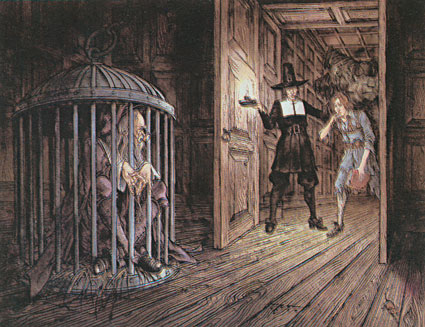
I saw in my dream, that the Interpreter took Christian by the hand again, and led him into a very dark room, where there sat a man in an iron cage. Now the man seemed very sad. He sat with his eyes looking down to the ground, and his hands folded together, and he sighed as if his heart would break.
Then said Christian, “Who is this?”
“Talk with him and see,” said the Interpreter.
“What used you to be?” asked Christian.
“I was once a flourishing professor, both in my own eyes, and also in the eyes of others,” answered the man. “I was on my way, as I thought, to the Celestial City and I was confident that I would get there.”
“But what did you do to bring yourself to this condition?” Christian asked.
“I failed to keep watch,” the man replied. “I followed the pleasures of this world, which promised me all manner of delights. But they proved to be an empty bubble. And now I am shut up in this iron cage—a man of despair who can’t get out.”
No further explanations were given. No one said who put him there. But the Interpreter whispered to Christian:
“Bear well in mind what you have seen.” [1]
. . . . . . . . . . . . . . . . . . . . . . . . . . . . . . . . . . . . . . .
Another thought related to the ideas in Behind Closed Doors.
The whole aim of the construction process, whether in sex, foetal development, education, business, art, music, family or state government, is the ultimate revelation of a mature glory. We are given the opportunity to create, and that involves certain God-given freedoms. If the freedoms are abused, what we construct for ourselves is a cage. Lust is a cage. A dysfunctional family or state is a cage. Enforced egalitarian socio-economics is a cage. Undisciplined children are a cage.
Jesus laid down His life for this world, and the freedoms of western culture have been a direct outcome. In its final stages, we have rebelliously inverted each of these freedoms (including the economic ones) and turned both our Christian protection (including our God-given wealth) and Christian mandate into a cage. Ancient Israel did the same. Why does this inversion process seem such a logical path for fallen human nature?
Continue reading
3 comments | tags: Altar of the Abyss, Babel, Biblical worldview, Culture, Dominion Theology, Doug Wilson, Economics, Incense Altar, John Bunyan, Parenting, Politics, Postmillennialism, Solomon, Tabernacle, Worship, Worship as commerce | posted in Christian Life, Quotes