“The meek will eventually inherit the earth but the wicked will always have to buy it.”
Reading the book of Zechariah, like most Bible prophecies, is like tuning in to Season 3 of any good TV series without watching Seasons 1 and 2. Our problem today is not that we haven’t actually read the books of Moses (well, I hope we have) but that we haven’t been taught to read them into the prophets and the New Testament. We treat them like we’ve now switched channels, or shows, and the authors are starting with a blank canvas! However, the canvas isn’t blank. The prophets were God’s repo men, and their messages were all framed in the context of the Covenant contract. What amazes me is how inventive the prophets are (or the Spirit is) in coming up with something new and surprising using the patterns laid down in Moses.
“When Moses slew the Egyptian, he was doing the will of God but not with the power of God.”
Numbers 12:3 says that Moses was the meekest man “on the face of the ground [adamah].”
Psalm 37:11 says the meek will inherit the Land [eretz] and delight in abundant prosperity.
Isaiah 11:4 says that
with righteousness [God] shall judge the poor,
and decide with equity for the meek of the Land;
and he shall strike the Land with the rod of his mouth,
and with the breath of his lips she shall kill the wicked.
Firstly, what is meekness? And secondly, why is it connected to “face of the ground” (Adam), or Land?
This post has been slain and resurrected for inclusion in my 2015 book of essays, Inquietude.
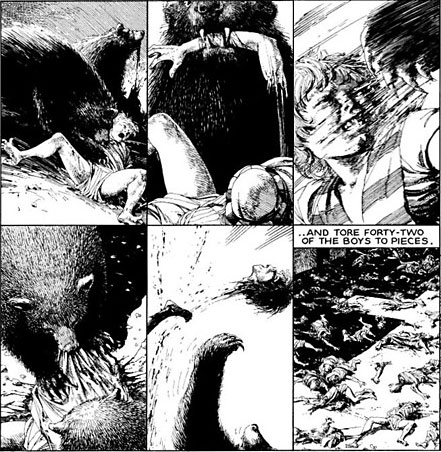
Atheists love to embarrass Christians with a snide reference to the story of Elisha setting two bears upon some helpless children. What nobody, even Christians, seem to get is the “Covenant significance” of all the players in the story, harking back to Moses. The prophets were, after all, God’s “repo men.” [1]
[This post has been refined and included in Sweet Counsel: Essays to Brighten the Eyes.] Continue reading
Now it came to pass on the third day, Pharaoh’s birthday, that he made a feast for all his servants; and he lifted up the head of the chief butler and of the chief baker among his servants. Then he restored the chief butler to his butlership again, and he placed the cup in Pharaoh’s hand. But he hanged the chief baker, as Joseph had interpreted to them. Yet the chief butler did not remember Joseph, but forgot him. (Genesis 40:20-23)
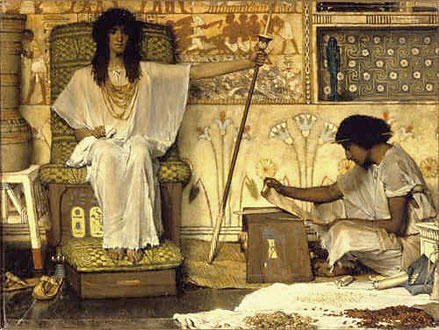
Joseph’s life has three “matrix” cycles: as a prophet betrayed by his brothers [1], a priest tempted to “harlotry”, and finally as a conquering king.
God had repeated His promises of land and people to Isaac, but it was to Jacob that God revealed He was going to build the true Babelic tower in the Promised Land. With his head on a rough stone, Jacob saw angels ascending and descending on a stairway to heaven, a ziggurat, a constructed holy mountain, between God and man. As with Eve, the Lord would build it out of flesh and blood—Jacob’s offspring—a living Tabernacle made of precious stones mined from the Land.
There is a patisserie in the Blue Mountains that bakes traditional German sourdoughs.Originally the mother culture for their sourdoughs was brought to Australia in a phial by the owner’s father from a bakery near Stutgart. The culture is 500 years old and has been given the name, “Corey”. This is a fantastic picture of what leaven symbolises in the Bible. It is not a symbol of sin. It is a symbol of historic continuity.
There are two kinds of whiteness in the Bible, and an understanding of this explains a great deal. There is the whiteness of covering and the whiteness of uncovering. And, as mentioned, the Bible makes a great deal out of the concept of covering.
Bone Collector
Purge me with hyssop, and I shall be clean; Wash me, and I shall be whiter than snow.
Touching a corpse made an Israelite unclean. The remains of those slain in battle were marked with lime for two reasons: so that they could be avoided by the clean, and so they could be gathered up and burned to lime by the bone collectors. Jesus said that the righteousness of the Pharisees was like a whitewashed sepulchre. Not only were they full of the ceremonial uncleanness of broken Covenant, their so-called righteousness was actually a mark from God upon them. They would be gathered to their people not by the Father sending His angels to the four corners of the Land, but by the father of lies and his scavengers sent by God to clean the wound.
This image goes right back to Genesis. Like the angels, the Covenant scavengers, though demonic, are also God’s servants. They are the raven of Noah surviving on floating corpses until the water goes down; they are the scavenging dogs that lick up Jezebel’s blood; they are the maggots in misused manna and abandoned grapes (false bread and wine); they are the unclean birds and animals that screech and howl inside the corpse of a defeated Babylon; they are worms inside Herod ‘enthroned’ as a human Gehenna.
The whiteness of the Pharisees was the whiteness of Miriam’s and Gehazi’s skin-plague. It is the whiteness of flesh and bones exposed as unclean to the eyes of God. Satan himself appeared as an angel of light, but like the Pharisees, he was a false lightbearer, a tutor guiding his children the wrong way.
Mike Bull is a graphic designer who lives and works in the Blue Mountains west of Sydney, Australia. His passion is understanding and teaching the Bible, and he writes occasionally for Theopolis Institute in Birmingham AL, USA.