Mar
31
2013
Covenant Structure in Judges 14-15:8
“I will open my mouth in a parable;
I will utter dark sayings from of old… “
Psalm 78:2
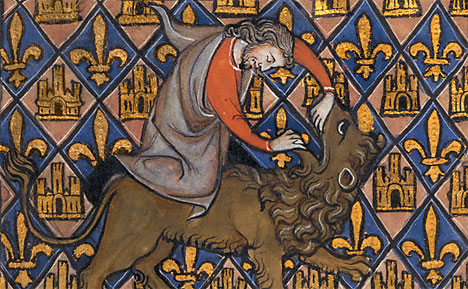
The account of Samson’s marriage and the subsequent collateral damage is one of those stories out of which teachers and preachers try in vain to wring a moral. After all, isn’t that what the Old Testament is for? Actually, no. It is a history of God’s Covenants, and every single text, whether historical narrative or prophetic vision, has a Covenant structure. Certainly, there are morals, but some stories resist such an obvious use (unless we are willing to cook the Book). These stories of God’s delegated authorities are intended to illustrate the work of God in the world.
Continue reading
Comments Off | tags: Covenant Theology, Feasts, Judges, Literary Structure, Samson | posted in Bible Matrix, Biblical Theology
Dec
1
2010
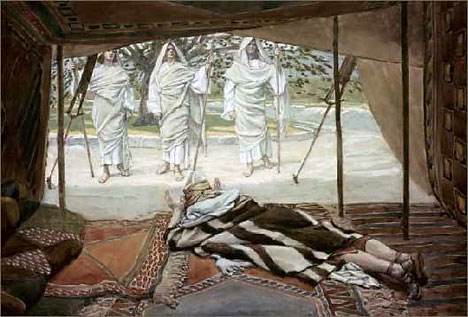
“…of the angels He says:
‘Who makes His angels spirits
and His ministers a flame of fire.’”
God is the source of all things, and He identifies Himself as such in His speeches. Every speech is Covenantal, and every preamble within His speeches is a statement of transcendence. “I am the Lord your God.”
After the initial call comes delegation, Covenantal Hierarchy. A man, a Moses, an Abraham, receives the Word with meekness.
We know that angels are God’s messengers, the sent ones. They administered the Old Covenant as our tutors, Satan becoming the first false teacher, the first corrupt ambassador, or, if you will, the first publican.
[This post has been refined and included in Sweet Counsel: Essays to Brighten the Eyes.]
Continue reading
5 comments | tags: Abraham, Angels, Covenant Theology, Creation Week, Daniel, Genesis, Judges, Leviticus, Nazirite, Nebuchadnezzar, Resurrection, Revelation, Samson, Sodom | posted in Bible Matrix, Biblical Theology, The Last Days
Nov
6
2010
or A Bigger Christendom
“In the middle of its street, and on either side of the river,
was tree of life, which bore twelve fruits,
each tree yielding its fruit every month.
The leaves of the tree were for the healing of the nations.”
Revelation 22:2
NOTE: THIS POST HAS BEEN REMIXED AND INCLUDED IN GOD’S KITCHEN.
While the governments of the first global economy in history explore areas of policy for which there is no historical precedent, Christians need to understand that even now, there is nothing new under the sun. It may be true, as some believe, that every war (including World War I) can be traced back to disputes over resources. But all the economic advice we need, whether personal, national or global, is contained in the Bible. The Tree of Life is still at the centre of the Garden, but it is the Church, and God is working on a forest. Continue reading
7 comments | tags: Economics, Gnosticism, Jonah, Paul, Postmillennialism, Samson, Tabernacle | posted in Biblical Theology, The Last Days, The Restoration Era
Oct
29
2010
The Slow Wheels of Justice
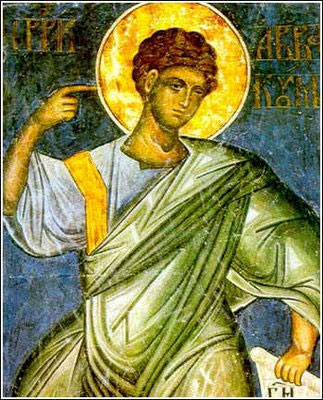
I am Habakkuk the prophet. And this is the message that the LORD gave me. Our LORD, how long must I beg for your help before you listen? How long before you save us from all this violence? Why do you make me watch such terrible injustice? Why do you allow violence, lawlessness, crime, and cruelty to spread everywhere? Laws cannot be enforced; justice is always the loser; criminals crowd out honest people and twist the laws around.
Habakkuk 1:1-4
[Part 1 here.]
Perhaps there is more to this idea of “suing God” than a mere Puritan quote, especially when God Himself fails to keep His own rules, when God Himself appears to break Covenant.
Continue reading
Comments Off | tags: Abel, AD70, Covenant curse, Covenant Theology, David, Habakkuk, Judges, Peter Leithart, Postmillennialism, Revelation, Samson | posted in Biblical Theology, Quotes, The Last Days
Feb
4
2010
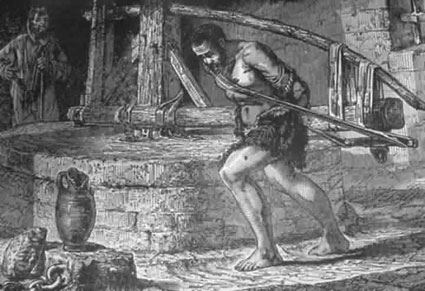
On Day 3 we have grain and fruit plants. They are the promise of bread and wine at God’s Sabbath table on Day 7.
The third elected judge was Deborah. Her song calls for a warrior like the sun. The seventh elected judge was Samson, “Sunrise.”
Continue reading
Comments Off | tags: Creation Week, Deborah, Judges, Nazirite, Samson, Temple | posted in Biblical Theology, The Last Days
Jan
22
2010
26. Christ returned in A.D. 70 (?), but according to preterists the literal cloud was missing (see Acts 1: 9; Matt. 24: 30; Rev. 1: 7).
The “Bible matrix” pattern always begins with a Word from God’s glory cloud on the Lord’s Day (Sabbath), the accepted Mediator received into this single-cloud “Tabernacle” (Firstfruits) and ends with multiple clouds, a corporate Mediator (the body). The Feast of Tabernacles (“succoth”) is literally the Feast of Clouds. This was fulfilled in AD70. Christ ascended to prepare the place, and the firstfruits church was received into it at the destruction of the Temple.
See also Not Just Any Old Cloud.
Continue reading
Comments Off | tags: Feasts, Glory cloud, Isaac, Jacob, Judaisers, Samson | posted in Biblical Theology, The Last Days
Nov
12
2009
 As the end of the ‘Creation week’ (slavery to Sabbath) that created a new nation, there were twelve judges. Twelve is the ‘offspring’ number, being the three of heaven married, multiplied with, the four of the Land.[1] However, we know these brave ‘champions’ were not a sabbath society but a rescue operation after the failure of the Levites.
Continue reading
Comments Off | tags: Bible Chronology, Bible history, Bible Matrix, Boaz, Judges, Obed, Ruth, Samson, Samuel | posted in Biblical Theology
May
30
2009
A House of Bread
There are two kinds of whiteness in the Bible, and an understanding of this explains a great deal. There is the whiteness of covering and the whiteness of uncovering. And, as mentioned, the Bible makes a great deal out of the concept of covering.
Bone Collector
Purge me with hyssop, and I shall be clean; Wash me, and I shall be whiter than snow.
Touching a corpse made an Israelite unclean. The remains of those slain in battle were marked with lime for two reasons: so that they could be avoided by the clean, and so they could be gathered up and burned to lime by the bone collectors. Jesus said that the righteousness of the Pharisees was like a whitewashed sepulchre. Not only were they full of the ceremonial uncleanness of broken Covenant, their so-called righteousness was actually a mark from God upon them. They would be gathered to their people not by the Father sending His angels to the four corners of the Land, but by the father of lies and his scavengers sent by God to clean the wound.
This image goes right back to Genesis. Like the angels, the Covenant scavengers, though demonic, are also God’s servants. They are the raven of Noah surviving on floating corpses until the water goes down; they are the scavenging dogs that lick up Jezebel’s blood; they are the maggots in misused manna and abandoned grapes (false bread and wine); they are the unclean birds and animals that screech and howl inside the corpse of a defeated Babylon; they are worms inside Herod ‘enthroned’ as a human Gehenna.
The whiteness of the Pharisees was the whiteness of Miriam’s and Gehazi’s skin-plague. It is the whiteness of flesh and bones exposed as unclean to the eyes of God. Satan himself appeared as an angel of light, but like the Pharisees, he was a false lightbearer, a tutor guiding his children the wrong way.
Continue reading
Comments Off | tags: antichrist, Boaz, Egypt, Ezra, Herod, Jezebel, Lampstand, Laodicea, Leviticus, Manna, millstone, Pergamum, Pharaoh, Pharisees, Priesthood, Rahab, Resurrection, Revelation, Ruth, Samson, Scavengers, Solomon | posted in Biblical Theology, The Last Days, The Restoration Era
May
7
2009

The Nazirite Vow
(Article requested by Drew J.)
This vow in Numbers 6 follows the “inspection of jealousy” in Numbers 5. Mark Horne observed that, just as the woman in Numbers 5 was to be inspected for harlotry with her hair untamed, so the Nazirite (whether male or female) was not to cut his or her hair. A Nazirite is a human picture of the church as a warrior bride. Hair is glory. Hair is the cloud of angels (and now, saints) surrounding the throne of God.
“Therefore the woman ought to have a symbol of authority on her head, because of the angels.” (1 Cor. 11:10)
A woman is the glory of her man. A woman’s hair is a symbol of submission, but also a symbol of her own “cloud of angels” – her godly offspring (See Ezekiel 5 for the children of Israel symbolised as the prophet’s hair, Micah 1:16, Matthew 10:30 and also my comments on Nehemiah and his hair-pulling). In battle, a Nazirite was like a blazing torch (the Ark-chariot/Adam) and smoking firepot (the smoke clouds of the incense altar/Eve army), parting his enemies like the pillar of God.
The hair is her “crop”, the twelve stars around her head (Rev. 12), and the question constantly posed to Israel concerns her role as God’s mediatorial Land. Is her crop one of thorns and thistles, or is it godly grain? This is also the question in Numbers 5, and the Lord put Israel to this exact test after the idolatry with the golden calf. The “harlots” were slain with the Levitical sword.
Continue reading
3 comments | tags: Adam, David, James Jordan, John the Baptist, Judges, Nazirite, Numbers 5, Numbers 6, Obed, Paul, Revelation, Samson, Samuel, serpent, Showbread, Tabernacle, Uriah, Wisdom | posted in Against Hyperpreterism, Biblical Theology
Apr
11
2009
Samson is often presented as a moose.
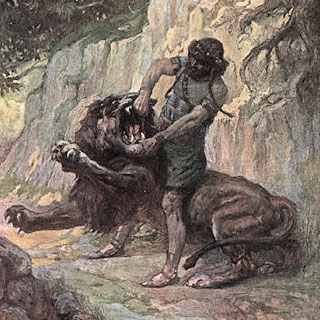 A commonly held opinion is that Samson was stupid. However, his earlier acts were inspired by the influence of the Spirit, carefully calculated, spectacularly executed and achieved the desired results.
For instance, Samson only told his wife the answer to his riddle so he would know where the leak came from when she was tested.
This reminded me of the test for harlotry in Numbers 5. The priest administers the bitter word to the woman, and if she passes the test, she will be a fruitful blessing.
Samson’s wife failed the test, and the outcome was a bit like that after the harlotry with the golden calf, with Samson as the slaughtering Levite.
Speaking of which, Numbers 5 comes right before Numbers 6 — the Nazirite vow. Men who took this vow became, basically, warrior brides. Their uncut hair was a sign of submission. Revelation draws on this imagery to describe the apostles and first century saints as virgins.
So Samson’s wife betrayed him, and Samson betrayed his own covenant ‘husband,’ the Lord.
Doug Wilson points out (somewhere) that biblical relationships are more complex than those of Islam. In Islam, the line of authority is linear, the natural outcome of a simple god of power. Might is right, from top to bottom. With Christianity, the submission of the members of the Trinity within the Godhead overflows into family and society, with the members submitting to one another, and constantly bestowing good upon one another.
So Samson can be both a bride and a bridegroom. Facing heaven, a minister is part of the bride. Facing his church, he images the bridegroom.
Comments Off | tags: Doug Wilson, Judges, Numbers 5, Samson, Trinity | posted in Biblical Theology