Jul
18
2014
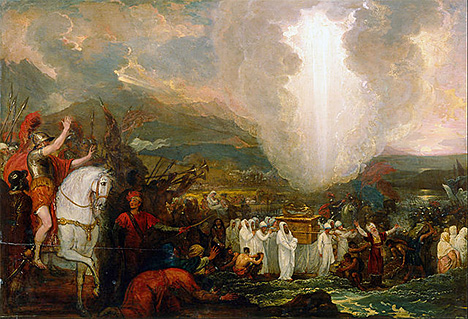
At that time the Lord said to Joshua,
“Make flint knives and circumcise
the sons of Israel a second time.”
(Joshua 5:2)
Was Israel disobedient in its failure to circumcise every male born in the wilderness? The Lord never chastised them for this. If this lapse in the practice of circumcision was in the plan of God, what was the purpose of that plan? The example which first comes to mind is the circumcision of the firstborn son of Moses in Exodus 4:24-26.
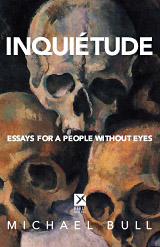
This post has been slain and resurrected for inclusion in my 2015 book of essays, Inquietude.
Continue reading
Comments Off | tags: Circumcision, Covenant Theology, Egypt, Exodus, Firstfruits, James B. Jordan, Jericho, Moses, Revelation, Sodom | posted in Bible Matrix, Biblical Theology, The Last Days, The Restoration Era
Aug
31
2013

“Once prosperous (gold), we forgot God and dismantled marriage (girls) and then relied upon military power rather than God’s protection to maintain peace with our enemies (guns).”
In Deuteronomy 17:14-20, Moses gave Israel three laws for her future kings. As moderns who wrongly assume the Bible is merely “propositional truth,” we not only fail to see these three laws as a continuum, and thus fail to identify them in Bible history, we also fail to interpret contemporary history in their brilliant “triune” light.
Continue reading
Comments Off | tags: Covenant Theology, David, Deuteronomy, Egypt, Herod, Literary Structure, Mission, Solomon, Tabernacle, Ten Commandments | posted in Bible Matrix, Biblical Theology
Jun
24
2013
or Who Is The Real Jericho?
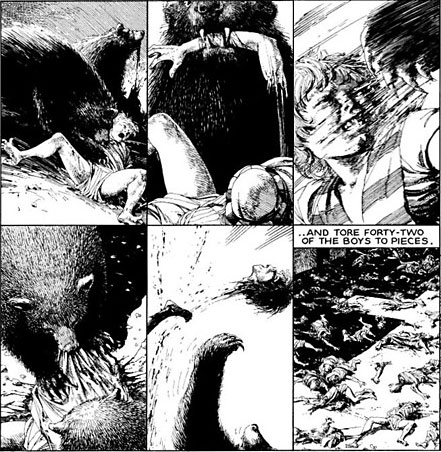
Atheists love to embarrass Christians with a snide reference to the story of Elisha setting two bears upon some helpless children. What nobody, even Christians, seem to get is the “Covenant significance” of all the players in the story, harking back to Moses. The prophets were, after all, God’s “repo men.” [1]
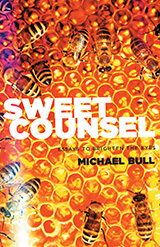
[This post has been refined and included in Sweet Counsel: Essays to Brighten the Eyes.]
Continue reading
Comments Off | tags: AD70, Covenant curse, Covenant Theology, Egypt, Elisha, Feasts, Herod, Jericho, Jezebel, Kings, Leviticus, Peter Leithart, Pharaoh, Revelation | posted in Apologetics, Bible Matrix, Biblical Theology, The Last Days
Mar
29
2012
or The Holy Hymen 101
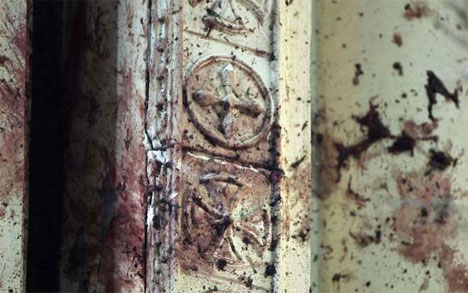 Blood on the doorpost of the al-Qiddissin Coptic Church in Alexandria, Egypt.
“This, like many things in the Torah, sounds pretty barbaric. But, like many of the weirdest things in the Torah, we see these laws, which are personal types, played out in corporate antitypes right to the end of the Bible.”
“But if the thing is true, and evidences of virginity are not found for the young woman, then they shall bring out the young woman to the door of her father’s house, and the men of her city shall stone her to death with stones, because she has done a disgraceful thing in Israel, to play the harlot in her father’s house. So you shall put away the evil from among you.” (Deuteronomy 22:20-21)
In a recent debate about Greg Bahsen’s woeful review of Chilton’s The Days of Vengeance, an online friend took interpretive maximalism to task.
For instance, because doorposts could be likened to legs, Jordan claims that the passover blood smeared on doorposts corresponds to the blood of circumcision—which in turn is equivalent to the tokens of virginity from the wedding night (I am not kidding; cf. The Law of the Covenant, pp. 82-83, 252-258). [PDF]
Yes, this sounds weird, but it isn’t at all. Bahnsen didn’t have an imagination fully informed by the Bible.
Continue reading
Comments Off | tags: David Chilton, Egypt, Greg Bahnsen, Hermeneutics, Martyrdom, Paul, Revelation, Systematic typology, Totus Christus | posted in Biblical Theology, Quotes, The Last Days
Oct
18
2010
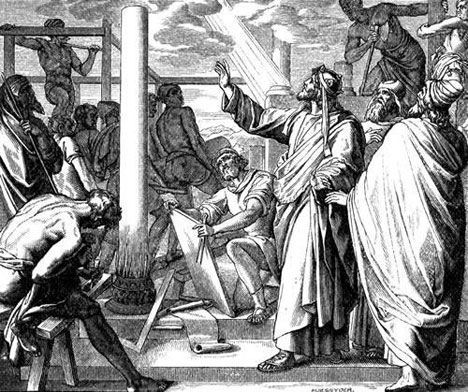
“Egypt, Judah, Edom, the people of Ammon, Moab, and all who are in the farthest corners, who dwell in the wilderness. For all these nations are uncircumcised, and all the house of Israel are uncircumcised in the heart.” - Jeremiah 9:26
Reading through the Old Testament as a young Christian, I always felt the Bible got bogged down when the Lord started pronouncing judgments upon nations other than Israel. For starters, I hadn’t paid enough attention earlier to remember who these sovereign states were. And more to the point, wasn’t God losing the plot a bit? I mean, there were plenty of other peoples during these times which aren’t even mentioned in the Bible at all.
Unfortunately, few commentators take the Bible seriously enough to understand what is actually going on. Older books will fill you in on the background, which is certainly helpful. But the big question is Why is God doing this now?, both now in history and now in the prophet I am reading?
As usual, when the structure and context of things is understood, seemingly boring “classic” texts suddenly come to life. In the case of the prophets it is a consuming fire. Continue reading
Comments Off | tags: Babylon, Creation Week, David, Egypt, Ezekiel, goliath, Literary Structure, Numbers, Numbers 5, Revelation, Solomon | posted in Bible Matrix, Biblical Theology, The Last Days, The Restoration Era
Aug
31
2010

From James B. Jordan’s Trees and Thorns: [1]
The land and garden of Eden were watered by a spring. Why call attention to the fact that God did not send rain? Why not just mention the spring and leave off the statement about rain? The reason, I believe, is to call our minds back to Genesis 1:2-9. We find in Genesis 1:2 that there was an ocean over the original earth. Then God created the firmament, and separated the waters above from the waters below. On the third day God gathered the waters below into areas below the surface of the land.
Now we have a clear distinction between waters above the firmament, the source of rain, and waters below, which would have to come up from under the earth. Both Genesis 1:2-9 and 2:5-6 set up the distinction eschatologically; ground water comes first, and then heavenly water.
Continue reading
Comments Off | tags: Egypt, Genesis, James Jordan, Moses, Sodom | posted in Biblical Theology, Creation, Quotes
Aug
23
2010
Psalm 114 – Family of Blood
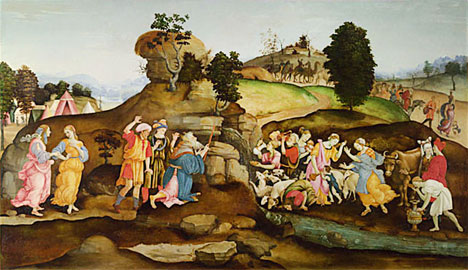
Psalm 114 is one of those weird passages of Scripture that makes you wonder if the author was high on something. Without an understanding of the significance of the place of this song among these seven Psalms, the lyrics appear to be either the overly-clever, sophomoric crypticism of an ancient Bono or the fragmented derivatory prattlings of a madman.
Continue reading
4 comments | tags: Babel, Egypt, Literary Structure, Numbers, Peter Leithart, Psalms, Zechariah | posted in Bible Matrix, Biblical Theology
Nov
16
2009
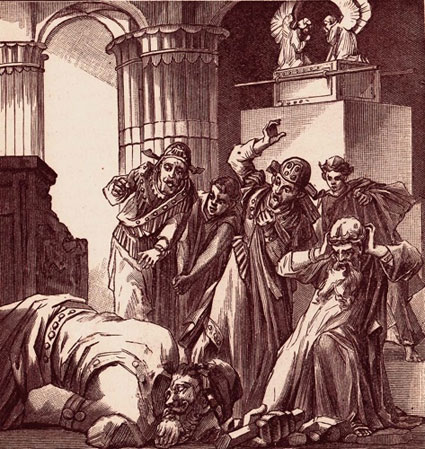
“The LORD will strike you with the boils of Egypt, with tumors, with the scab, and with the itch, from which you cannot be healed.” Deuteronomy 28:27
The Bible matrix pattern brings out some interesting parallels. Step 5 is about a military multitude in unity after being tested under the Law of God. It is Deuteronomy. It is Trumpets. It is the swarms of fish and birds on Day 5. It is the step of plagues and plunder. It is the step where Jesus tells His disciples they will now need both swords and moneybags.
Continue reading
Comments Off | tags: Ark of the Covenant, Bible Matrix, Egypt, Eli, Herod, Sodom | posted in Biblical Theology, The Last Days
Nov
3
2009
or Every Knee Shall Bow
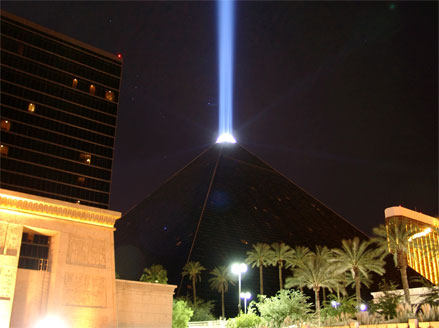
Day 1
So, Adam fouled the first Sabbath. He failed to be Light.
Day 2
Cain made a false exodus (with Abel as the Passover lamb) and went to “worship in the wilderness.” God marked him as a “covering.” Being “barren”, Cain built a city as a covering, but it was just like Adam’s figleaves. It was a phony firmament, a fabricated Covenant, a city built on the wrong sort of blood.
Day 3
His offspring built a counterfeit Tabernacle – in opposition to the worship at the Gate of Eden. This was a false Land, a false mountain, like Mount Gerizim became to the Samaritans. Lamech, as a false Moses, “ascended” not as a Lamb slain, but as an accuser, the incarnation of the serpent. But someone true ascended as Firstfruits: Enoch.
This brings us to Day 4. As in the Garden, and as in Israel’s wilderness, the test was harlotry.
Continue reading
Comments Off | tags: Abel, Babylon, Cain, Egypt, Enoch, Genesis, Herod, Incense Altar, Lamech, Noah, Satan, Seth, Sodom | posted in Biblical Theology, The Last Days
Sep
16
2009

or Why Four Horsemen but Seven Seals?
“…the Egyptians are men, and not God; And their horses are flesh, and not spirit.” Isaiah 31:3
One of the three laws for Israelite kings was a command against multiplying horses and chariots—especially Egyptian ones. Solomon’s horse trading was, for a nation with a miraculous escape ON FOOT, in the eyes of the Lord, just like the faithless behaviour of the Hebrews in the wilderness. It’s always better to dwell in a tent with God than in a palace with the devil. Solomon’s kingdom of chariots and oppression became a new Egypt. By the end of the era, the pigs ruled the farm.
Continue reading
Comments Off | tags: Chariots, David, Egypt, Four Horsemen, Isaiah, Lampstand, Psalms, Solomon, Zechariah | posted in Biblical Theology, The Last Days, The Restoration Era