May
5
2015

I recommend this article by Pastor Bill Smith.
Christ is absent. Though he is not dead, he did go away, leaving his ministers to care for his bride and “raise up seed” for him. As levirs, they have the right to profit from the inheritance of the heir–the entire church–until the seed/son comes of age.
The church in Corinth was a pastoral nightmare. Factionalism, sexual immorality, incipient syncretism, using the church as a stage for self-promotion, and denial of the final resurrection were just some of the problems.
Continue reading
Comments Off | tags: Bill Smith, Corinthians, Deuteronomy, Ecclesiology | posted in Biblical Theology, Christian Life, Ethics
Sep
10
2014

This post has been slain and resurrected for inclusion in my 2015 book of essays, Inquietude.
Continue reading
2 comments | tags: Abraham, Absalom, Baptism, Cain, Circumcision, David, Deuteronomy, Esau, Genesis, Jacob, Joseph, Laban, Lamech | posted in Bible Matrix, Biblical Theology, The Last Days
Jun
28
2014
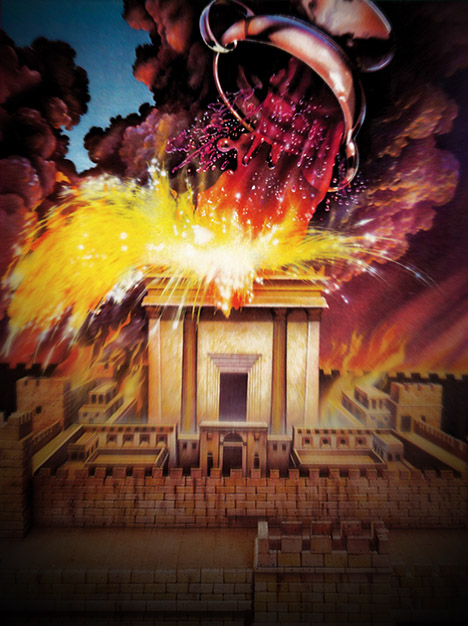
or Where Kenneth Gentry Is Wrong on the Revelation
Part 1 here.
I’ve been meaning to write this post since I wrote Part 1 (over two years ago). A friend’s recent question concerning Kenneth Gentry’s lectures on the Revelation encouraged me to bite the bullet and bust a gut and get it done. The question is this: Is the Revelation to be interpreted in the light of Josephus’ Jewish War, or in the light of the Bible itself?
Continue reading
6 comments | tags: AD70, Ark of the Covenant, Covenant curse, Covenant Theology, Deuteronomy, James B. Jordan, Kenneth Gentry, Leviticus, Literary Structure, Peter Leithart, Revelation, Revelation 20, Thessalonians | posted in Against Hyperpreterism, Bible Matrix, Biblical Theology, The Last Days
Oct
28
2013
 Born from Above
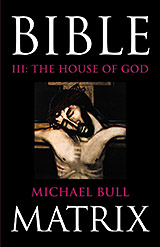
I’m currently working hard on Bible Matrix III: The House of God. This third volume is bigger on the inside than it is on the outside. It really is. Being so engrossed in the shape and processes of the Bible (yes, even more than usual), it has struck me how foreign the various theological schools’ thinking and speech is to the actual text.
The debates about “Pauline Theology” are the perfect example, especially the focus on narrow (yet important) topics such as justification. An academic divides and redivides the text in the way an expert in any science overspecializes. He ends up knowing everything about nothing. After spending a few hours each day wandering and describing the halls of biblical architecture, I am more convinced than ever that the only way to fully understand Scripture is architecturally. This is because, for our glorious God, architecture is ethics, and ethics is architecture. Divorced from the biblical mud map, the Edenic grid, modern theologians are discussing less than a dim distorted reflection of the book God has given us. They are feeling their way around the house with their eyes shut. Continue reading
Comments Off | tags: Abraham, Baptism, Circumcision, Covenant Theology, Deuteronomy, Exodus, Feasts, Galatians, Genesis, Literary Structure, Moses | posted in Bible Matrix, Biblical Theology
Oct
18
2013
Paul’s Deuteronomy
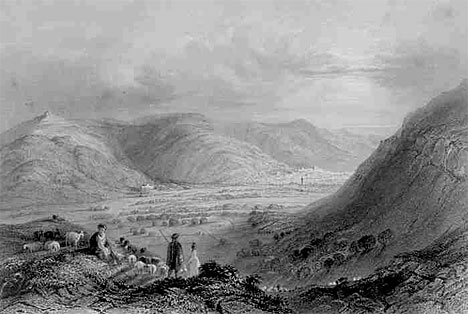
That day Moses charged the people, saying, “When you have crossed over the Jordan, these shall stand on Mount Gerizim to bless the people: Simeon, Levi, Judah, Issachar, Joseph, and Benjamin. And these shall stand on Mount Ebal for the curse: Reuben, Gad, Asher, Zebulun, Dan, and Naphtali. (Deuteronomy 27:11-13)
Paul now moves into the Deuteronomy section of his epistle to the Galatians, and it becomes clear that, structurally-speaking, Galatians gets no further than Moses. The epistle is fivefold in nature, a recapitulation of the Torah, and thus it ends on the wilderness side of the Jordan. Like Moses, Paul will not live to see the new order, except from afar.
Continue reading
Comments Off | tags: Baptism, Circumcision, Covenant curse, Deuteronomy, Galatians, Literary Structure, Moses, Paul | posted in Bible Matrix, Biblical Theology, Ethics, The Last Days
Aug
31
2013

“Once prosperous (gold), we forgot God and dismantled marriage (girls) and then relied upon military power rather than God’s protection to maintain peace with our enemies (guns).”
In Deuteronomy 17:14-20, Moses gave Israel three laws for her future kings. As moderns who wrongly assume the Bible is merely “propositional truth,” we not only fail to see these three laws as a continuum, and thus fail to identify them in Bible history, we also fail to interpret contemporary history in their brilliant “triune” light.
Continue reading
Comments Off | tags: Covenant Theology, David, Deuteronomy, Egypt, Herod, Literary Structure, Mission, Solomon, Tabernacle, Ten Commandments | posted in Bible Matrix, Biblical Theology
Mar
10
2013
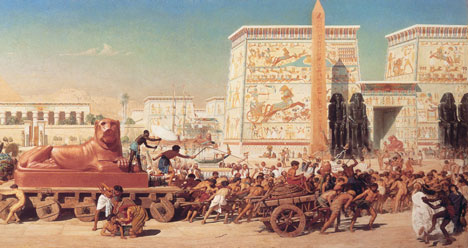 One of the reasons why moderns (including Christians) don’t really know what to do with the Mosaic Law is the failure to understand biblical history as a process of maturation. The prohibition of the second (kingly) tree in the Garden corresponds to the Food Laws, for instance. Like Israel’s temporary abstinence from meat (kingly food) in the wilderness, these laws were all for the purpose of humbling, for preparing servants to rule as God’s representatives. Once mature, they would be invited to eat with God as friends, rather than merely attending as servants.
Continue reading
Comments Off | tags: Alastair Roberts, Deuteronomy, Exodus, James Jordan, Peter Leithart | posted in Biblical Theology
Jul
25
2012
The Vow
 [Apologies to those readers who have had enough of me railing against paedobaptism. It's not personal. It's not that I have any loyalty to any doctrinal system, denomination or tradition. It's that a group of godly guys taught me how beautiful the structure of the Bible is but maintain, to my eyes at least, a tradition which contradicts that beauty. The internal logic of the Scriptures -- including the Old Testament Scriptures -- spits out paedobaptism at every turn. In every round of typological musical chairs I play, paedobaptism has nowhere to sit.]
We ended last time with the observation that all Israel was a “bridal” nation. The Israelite robe, like the Nazirite vow, was something that pertained to both males and females. Why is this?
Continue reading
13 comments | tags: Baptism, Circumcision, Deuteronomy, Doug Wilson, Exodus, Federal Vision, Jericho, Toby Sumpter | posted in Biblical Theology
Jun
2
2012
In a recent sermon on 1 Samuel 30, Doug Wilson commented on David’s insistence that those who stayed behind to guard the supplies received an equal share of the plunder:
Continue reading
Comments Off | tags: David, Deuteronomy, Doug Wilson, Generosity, Samuel, Saul | posted in Biblical Theology, Christian Life, Ethics, Quotes
Mar
16
2012
 Douglas Wilson writes:
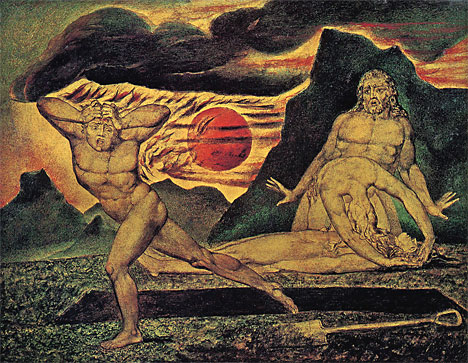
“What is the meaning of ”one is taken and the other left’? This is commonly thought to refer to the rapture — one taken up into heaven, and the other left on earth to kick himself for not praying the sinner’s prayer when he had a chance. On the bright side, there will be a lot of free, unmanned cars available” (Heaven Misplaced, p. 104).
Matthew 24 is a prediction of the Covenant curses falling upon Judah for the last time. One being taken and the other left has to do with displacement. Titus enslaved the best Jews and took them in ships to Egypt.
“And the Lord will take you back to Egypt in ships, by the way of which I said to you, ‘You shall never see it again.’ And there you shall be offered for sale to your enemies as male and female slaves, but no one will buy you.” (Deuteronomy 28:68)
It’s one thing to get the historical fulfilment correct, but there’s a whole lot more going on here. In His speech, as the fulfilment of Israel, Jesus is working through the Bible Matrix, a combination of the Creation week, the weekly and annual Feasts, and the process of Dominion. This means that He is using examples of all the previous historical Covenant structures to make His point. The Covenant cycle has snowballed through history and picked up a lot of events on its way.
Continue reading
1 comment | tags: Abel, Atonement, Cain, Covenant Theology, Deuteronomy, Doug Wilson, Esau, Feasts, Genesis, Jacob, Lamech, Literary Structure, Matthew, Systematic typology | posted in Against Hyperpreterism, Bible Matrix, Biblical Theology, The Last Days