Aug 20 2011

Judicial Maturity

6a00d8341bffb053ef0134818071ae970c-500wi

“…and their eyes were opened, and they knew that they were naked.”
(Genesis 3:7, cf. Matthew 9:30; Luke 24:31; Acts 9:8)

Jesus’ sermons are all literary masterpieces. Perhaps it was not only the explicit content of His speeches that riled the rulers. He not only claimed to be Yahweh, His sermons all follow the structure of the speeches of Yahweh. They are Covenantal not only in content but in form. No other man spoke like this man, except perhaps Moses and the Prophets, who repeated the Words dictated to them by God.

TRANSCENDENCE - Initiation
Do not think
…..that I came to destroy
……….the Law

……….or the Prophets.
…..I did not come to destroy
but to fulfill.

This stanza is deliberately missing its “Pentecost.” It follows the Creation pattern but the Law has not yet been “opened.” As Robert Alter claims, much of the Bible’s communication relies on repetition of establishes forms but with modification, additions, and omissions. Sometimes what is not said is the elephant in the room. Jesus would fulfil the Law at the centre of history and send the Spirit. He would kindle the fire on the Altar of Israel at Pentecost, and it would be totally consumed in AD70. He does it again in stanza 2.

HIERARCHY - Delegation
For assuredly, (Initiation)
…..I say to you, (Delegation)
……….till heaven and [Land] pass away, (Presentation)
……………[No Holy Fire, no Pentecostal Purification]
……….one jot or one tittle (Transformation - Law repeated)
…..will by no means pass from the law (Vindication)
till all is fulfilled. (Restoration)

Notice that heaven and Land are at Day 3,  the Ascension offering. Genesis (Initiation), Exodus (Delegation), Leviticus (Presentation)… All the tribes possessed Land except Levi because the Levites were the holy Firstfruits upon the Altar-Land.

ETHICS - Purification (Israel threshed)
Whoever therefore (Creation)
…..breaks (Division)
……….[of these commandments the least] (ironic Ascension)
…………….(No Testing)
……….and teaches men so, (Maturity)
…..shall be called least (ironic Conquest)
in the kingdom of heaven; (Glorification)

Notice that this stanza follows the Creation week’s 1-2-3 (least), 1-2-3 (least) forming and filling. In this case it is a failure to form and a subsequent failure to fill. It is Adam at Day 6 who is least.

SANCTIONS - Vindication
but whoever (Creation)
…..[shall practise (Division)
..........and teach, (Ascension)
...............this one] (Testing)
……….great (Maturity)
…..shall be called (Conquest - Vindication)
in the kingdom of heaven. (Glorification - Succession)

Finally, we have a Man in the middle.

SUCCESSION - Restoration
For I say (Genesis)
…..to you, (Exodus)
……….that unless your righteousness (Leviticus)
……………exceeds (Numbers - Testing)
……….the scribes and Pharisees, (Deuteronomy)
…..you will by no means enter (Joshua)
the kingdom of heaven. (Wise Judges)

What did Jesus mean in this final stanza? The purpose of the Covenant process is to put Man under God’s eyes at Ethics/Testing, so that Man might become God’s eyes by the end, and initiate the next cycle as God’s tried and tested representative. Adam failed so God moved to the next generation, which also failed. The failures continued (except for Enoch as righteous Firstfruits) until Noah become the first righteous judge, and was handed the sword of judgment instead of being scattered by it.

The scribes and Pharisees came to an end with the Old Covenant in AD70. They were denied Succession. The key is that this entire structure above recapitulates God’s Covenant plan for Adam. Jesus is saying that unless you have eyes that judge righteously between good and evil, by obedience to the Spirit of God, you will be as blind as the Pharisees, who judged according to outward appearances only. The Spirit’s choice of the Son of David was the same as it was for David. The Pharisees were not looking upon Jesus’ heart. But God was, and it pleased Him.

All those who have the Spirit of God are not missing the “Pentecostal” line of the Covenant poem. Obedience to the gospel allows God to pour out the holy fire and transform the sacrifice. Baptism is the vindication of such a person by the Church. At “Sanctions” and “Glorification”, we find robes and wine.

Robes and wine are for those who are spiritually, and judicially mature. But the watershed is one’s own personal Pentecost. The first birth is (fundamentally) about growing in stature, rising like a loaf of bread whose purpose is to be broken. The second birth breaks the bread, and its purpose it that we are to be poured out like wine.

For sure, we are to grow into even greater maturity after conversion, but if we have the Spirit of Christ, we are justified and have the wisdom of Christ guiding us into all truth. Certainly, there are stages of maturity within the regenerate, but the indwelling Spirit of God is quite clearly the baseline, and repentance and baptism are the first “baby” steps of obedience in our new life.

The beginning of this “judicial maturity,” this righteousness that exceeds that of the Pharisees, is someone being cut to the heart, recognizing that they are unrighteous and Jesus is righteous, that light is day and darkness is night. Conversion begins a new creation — in that individual. It is a Covenant process that is both objective and subjective. Jesus calls His sheep and His sheep responds.

Paedobaptists object to credobaptism because it’s hard to tell if a child is ready. And if they are ready at aged 7, how can this be the Maturity that the Covenant process demands. We like to pin maturity down to how old someone needs to be. The Old Covenant pinned everything down so they didn’t have to think. Ages were specified. That’s priestly. It’s childhood. The New Covenant doesn’t do that. We are led by the Spirit, and babies aren’t.

To clarify, the “age in years” is more about the first birth than the second — a maturity that is practical and valuable but nonetheless a carnal wisdom. The wisdom the New Covenant requires is a gift of the Spirit of God. There are certainly overlaps (elders should be elders) but that concerns a maturity that comes with years of rule by the Spirit. A newborn Christian, born by the Spirit, that is, receives a Spirit of judgment far beyond anything the Pharisees could hope to possess. Their eyes were full of darkness, so Jesus fulfilled the Law and became a light to their path. When Pentecost finally came, they continued to blaspheme the Holy Spirit and His conviction of their unrighteousness. The only place for them was outer darkness. But the Spirit-filled man — or child — has wisdom beyond his years: the riches of the wisdom of Christ.

___________________________
See also Matthew’s Literary Artistry.
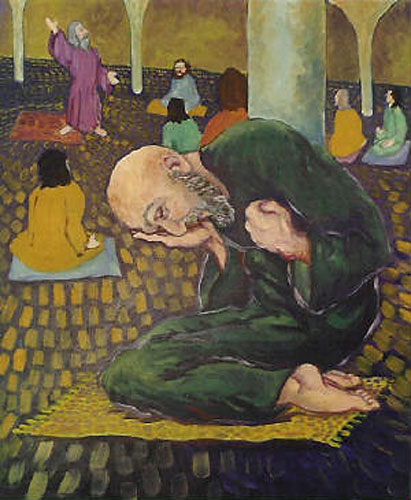
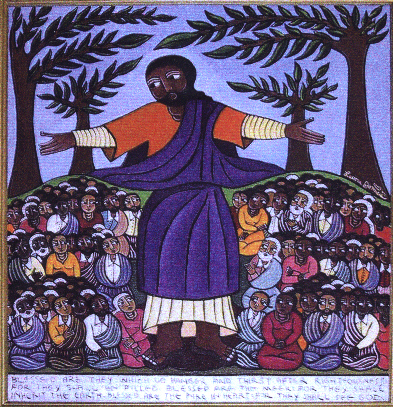
Art: Sermon on the Mount by Laura James.

Jan 28 2011

Strong Delusion

or Goblet of Fire

waugh-grail-1912

“And the times of this ignorance God winked at;
but now commandeth all men every where to repent…”
Acts 17:30

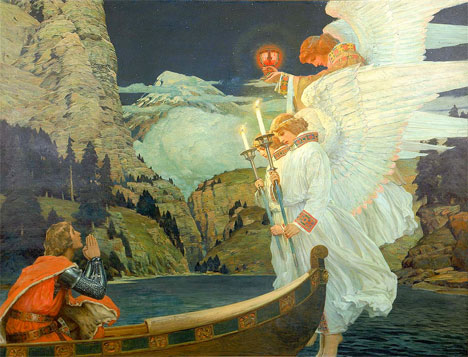
Reading the Bible without an understanding of Creational and Covenant structures is like watching test cricket without knowing the rules. It’s not unusual for even the best commentators to be distracted by something as inconsequential as a lost seagull. But every moment is part of a bigger picture. Isaiah can seem tedious at times, but it’s a long game. Let’s look at Isaiah 4:2-6, which relates the purging of exiled Israel to the jealous inspection in Numbers 5. In this case, she comes up trumps.

Continue reading


May 31 2010

Counterfeit Virtue

canawedding

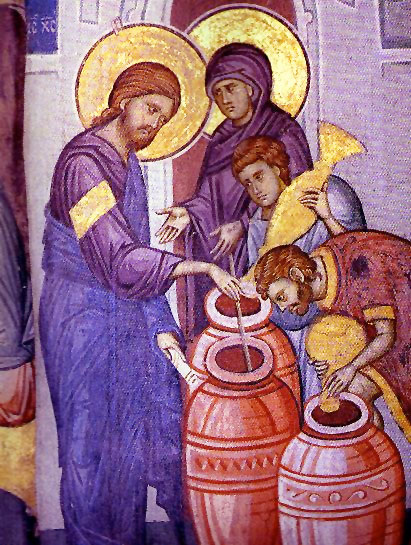
“The Son of Man has come eating and drinking, and you say, ‘Look, a glutton and a winebibber, a friend of tax collectors and sinners!’” (NKJV) Luke 7:34

Some good logical thoughts concerning alcohol from Andre Rook’s blog, and comments from me at the end:

Alcohol is synonymous with sin for many. Still for others it is considered an act of Christian love to perpetually abstain from alcohol, to provide a good Christian witness to others. My beef with the latter view (the former being easily dismissed on account of Scripture, and also condemned in the heresy of Manicheism) is that it creates a counterfeit virtue for the Christian.

Continue reading


Nov 4 2009

Feasts in Mark 3

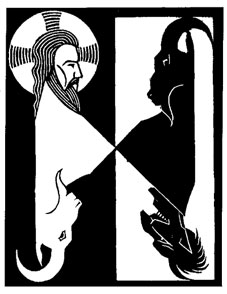
escherscapegoat.

Sabbath - Jesus defiantly heals a man on the Sabbath under the accusing eyes of the Pharisees. It is a conflict between the brittle light of the law and the perfect light of lawful love.

Passover - The Pharisees “go out” and plot with the Herodians to destroy Him. But Jesus withdraws with His disciples to the sea. 

Firstfruits - Jesus ascends a mountain and calls those He wants. He appoints the twelve to preach.

Pentecost - (Wilderness/Rulers) Jesus is accused of being the “Lord of the Flies.”

Trumpets - He calls them to Himself and speaks of the fall of a divided house or family, entering the strong man’s house and plundering his vessels.

Atonement - All sins will be forgiven, except blasphemy against the Holy Spirit, Whom the Pharisees had called “unclean” [1]

Tabernacles - Those who do the will of God are Jesus’ true family.

_____________________________________________
[1]  ie. they got their goats mixed up right up until AD70. For more on this see under subhead “The Word is ‘Yes’” in A White Stone - 3.

Pic: The Scapegoat by M.C. Escher.


Oct 20 2009

Pharisees were Evangelicals

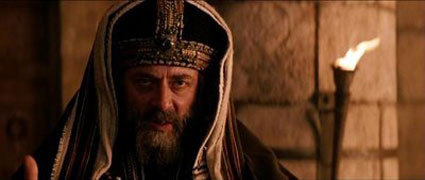
caiaphas

or Tearing the Old Adam in Two

Jesus comes to the Pharisees. Who are the Pharisees? They are us. Pharisees are the evangelicals. They are the faithful in Israel.

The Sadducees were the liberals, the zealots were the political activists and the Essenes were the dropouts, and Jesus doesn’t fool with them at all.

Continue reading


Aug 18 2009

Looking in Faith

How were the gentiles related to Passover?
By watching it, and putting faith in it.

bronzeserpent-sIn order for a stranger to eat Passover, he had to circumcise himself and his household (Ex. 12:45-49). If he did so, he became “like a native of the land” (v. 48). We are so accustomed to connecting Passover with the Lord’s Supper that it seems strange to consider that perhaps Passover was only for the priestly people, but such was the case. Converted gentiles were not to eat of it unless they were circumcised, and thereby were incorporated into the seed line of Abraham. Did this exclude them from salvation? No, it only excluded them from priestly duties. Did it make them second class citizens? Only in the eyes of the Pharisees. Biblically speaking, their downstream cultural labors in Havilah were just as important as Israel’s sanctuary task. After all, if everyone had become an Israelite, then who would mine the gold of Havilah? Who would bring it to the sanctuary? Israel had its task, and the converted nations had theirs.

Continue reading


May 30 2009

A White Stone - 5

A House of Bread

There are two kinds of whiteness in the Bible, and an understanding of this explains a great deal. There is the whiteness of covering and the whiteness of uncovering. And, as mentioned, the Bible makes a great deal out of the concept of covering.

Bone Collector

Purge me with hyssop, and I shall be clean; Wash me, and I shall be whiter than snow.

Touching a corpse made an Israelite unclean. The remains of those slain in battle were marked with lime for two reasons: so that they could be avoided by the clean, and so they could be gathered up and burned to lime by the bone collectors. Jesus said that the righteousness of the Pharisees was like a whitewashed sepulchre. Not only were they full of the ceremonial uncleanness of broken Covenant, their so-called righteousness was actually a mark from God upon them. They would be gathered to their people not by the Father sending His angels to the four corners of the Land, but by the father of lies and his scavengers sent by God to clean the wound.

This image goes right back to Genesis. Like the angels, the Covenant scavengers, though demonic, are also God’s servants. They are the raven of Noah surviving on floating corpses until the water goes down; they are the scavenging dogs that lick up Jezebel’s blood; they are the maggots in misused manna and abandoned grapes (false bread and wine); they are the unclean birds and animals that screech and howl inside the corpse of a defeated Babylon; they are worms inside Herod ‘enthroned’ as a human Gehenna.

The whiteness of the Pharisees was the whiteness of Miriam’s and Gehazi’s skin-plague. It is the whiteness of flesh and bones exposed as unclean to the eyes of God. Satan himself appeared as an angel of light, but like the Pharisees, he was a false lightbearer, a tutor guiding his children the wrong way.

Continue reading


Apr 15 2009

Why Do They Hate Us? - 2

My comment on iMonk’s article, Why Do They Hate Us? is here. Below is another comment that I thought interesting:

As a former rabid atheist, I disliked Christians because I saw them as ignorant, intolerant and absurdly convinced that they had the Truth. The only evidence for this was TV and the people I came in contact with. Also, many of my College Professors found them easy targets and I enjoyed laughing at these poor deluded souls. But I was empty if the truth be told. However, I was won over to the other side, in the San Francisco Bay area because I personally witnessed the love amongst Christians and I had had enough of the self righteousness of New Agers and fellow Freethinkers to know they were a bunch of lost souls. Continue reading


Apr 10 2009

Jesus, Man of Letters? - 2

Rieu’s theory of Jesus as a ‘man of letters’ is borne out by the structure of the Sermon on the Mount. As with many of the prophets, His “book” begins with a preamble that follows the themes of Israel’s 7 feasts in Leviticus 23.

Jesus begins with the Sabbath rest of those who have a humble spirit, works through those who mourn for their sins at Passover, and ends with the Atonement covering of the blood of those who would be persecuted yet to be shed on the Land. And at Tabernacles, their reward is in heaven.

Continue reading


Apr 10 2009

A “priesthood of all believers” can be messy - 2

ezrainprayer

Ezra took a great risk to bring Levites and riches to the Temple from Persia. Mixed marriages were suddenly of more concern, which poses a difficult question. Things seem to be heading backwards—away from the New Testament rather than towards it.

Continue reading