Feb
26
2013

“Getting Genesis 1 wrong, capitulating to the worldview and resulting pseudo-science and pseudo-history of darkened minds, will eventually lead you to get Genesis 2 wrong as well.”
[Addendum added below for those who are not familiar with my biblical-theological framework. This post is not really about the complementarian debate. It is about our modern ignorance of biblical structure and process.]
Sydney Anglicans used to have an online forum for discussion of theology. It was a great way to spend a few hours I didn’t have. From those times, two things stick in my mind: the creation/evolution thread that would not die, and one commenter who denied that compromising on a particular controversial issue would lead the compromisers down the proverbial “slippery slope.”
Since I called people names this week, very ungraciously, perhaps it might help if I explained myself a little. I see the interpretation of early Genesis as crucial for our interpretation of the rest of the Bible, but also for our understanding of the world we live in. If a Christian gives in to whatever the prevailing culture demands, there will be ramifications for the rest of his theology. This is because the Bible is fractal in its nature. It is a closely knit network, a carefully constructed grid, just like the created world. To cave on one issue will have outcomes in other areas of theology, and the example I have in mind right now is John Dickson, a brave, educated and wise Christian apologist.
Continue reading
4 comments | tags: Compromise, Genesis, Gnosticism, Hermeneutics, John Dickson | posted in Biblical Theology, Creation
Jul
5
2012
or The Undeserved Immunity of Devilish Talmudism
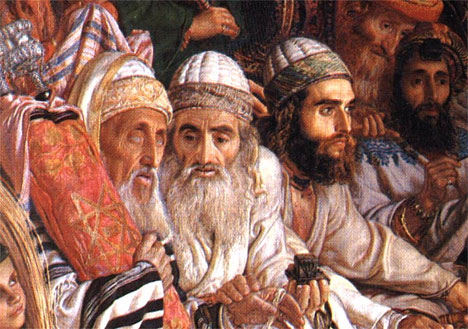
“For they bind heavy burdens, hard to bear, and lay them on men’s shoulders; but they themselves will not move them with one of their fingers.”
Matthew 23:4
One of the great benefits of understanding the “preteristic” nature of the New Testament is the way the many supposedly “generic” apostolic warnings in the epistles are suddenly grounded in their Jewish context. The destruction of the Temple barely gets a mention in any church today, yet when the letters of Paul, Peter, James and John are understood to be aimed at Jews outside the Church and Judaizers inside it, the New Testament doesn’t become less relevant to us, but more relevant.
Continue reading
1 comment | tags: AD70, Baptism, Federal Vision, Gnosticism, Luke, Martyrdom, Revelation, Talmud | posted in Biblical Theology, Ethics, Quotes, The Last Days
Nov
18
2011

In Deep Comedy, Peter Leithart compares the Bible’s essentially comic and hopeful view of history with the Greco-Roman view, which is essentially and irredeemably tragic.
In Paul’s estimation, anyone who thought that the new life through Jesus pertained to some realm outside this history was simply an unbeliever. For the gospel says otherwise.
Continue reading
1 comment | tags: Church Fathers, Church History, David, Ecclesiastes, Faith, Gnosticism, Job, Literary Structure, Peter Leithart, Postmillennialism, Solomon | posted in Against Hyperpreterism, Biblical Theology, Quotes
Nov
11
2011

“In Genesis 1, God creates the world in six days, through certain steps. Then He creates human beings out of ‘world,’ and human beings made out of world are going to live like ‘world’ does. They are going to go from darkness to light, formlessness to form; they are going to marry and take dominion. They are going to become like lights ruling over the earth. They’re going to live in 24 hour cycles. They will undergo times when God pulls them apart and puts them back together in new ways–all because they are made out of world. And these are all steps of glorification.” — James B. Jordan (The Bible You Never Read)
Some Christians assert that Adam was not the first man, only the first man in Covenant with God. [1] This means that the judgments upon such a Covenant could only be social, not “Creational.” They could only fall upon those under Covenant, not the “pre-Adamic” people from which this Covenant separated Adam. This assertion must be made to support the view that the Great Flood was only a local event, destroying only the “Adamites,” not all people on the planet. Does this assertion have any support in Scripture? Apparently yes, but factually no.
Continue reading
2 comments | tags: Abraham, Covenant Creationism, Covenant Theology, Flood, Gnosticism, James Jordan, Noah | posted in Against Hyperpreterism, Biblical Theology, Creation, Quotes, The Last Days
Oct
20
2011

When Sam Frost reviewed Bible Matrix, he was a full preterist. What changed his mind was the Bible’s inescapable trajectory, its relentless reach towards maturity and glory.
From Sam’s blog:
Mike Bull has recently sent me his new book, Bible Matrix II: The Covenant Key (Westbow Press, 2011). Like his Bible Matrix, this one is full of “patterns”. Did you ever think that Esther, probably one of the most neglected books in the Bible, was covenantal in structure and outline? That it speaks directly to us? Get ahold of Bull’s “key” and you will.
Continue reading
Comments Off | tags: Gnosticism, Ray Sutton, Sam Frost | posted in Bible Matrix
Nov
8
2010

From James Jordan, The Framework Hypothesis: A Gnostic Heresy, Biblical Horizons No. 107
…I submit that the entire Christian faith stands or falls on how Genesis 1 is interpreted, and that the guardians of the Church must take an unequivocal stance on this matter.
The issue is hermeneutics and religion. Since these “contradictions” in Genesis 1 serve to indicate that this passage is not to be taken historically, the only alternative is to take the passage as giving some kind of archetype for creation by God. It is a foundational “myth,” expressing in “human language” matters that cannot be expressed any other way. It is a true myth in that the ideas taught in Genesis 1 are true.
And this is where the shift from true religion to gnosticism comes in. History has been replaced by ideas. Continue reading
3 comments | tags: Add new tag, Exodus, Genesis, Gnosticism, Hermeneutics, James Jordan | posted in Apologetics, Creation, Quotes
Nov
6
2010
or A Bigger Christendom

“In the middle of its street, and on either side of the river,
was tree of life, which bore twelve fruits,
each tree yielding its fruit every month.
The leaves of the tree were for the healing of the nations.”
Revelation 22:2
NOTE: THIS POST HAS BEEN REMIXED AND INCLUDED IN GOD’S KITCHEN.
While the governments of the first global economy in history explore areas of policy for which there is no historical precedent, Christians need to understand that even now, there is nothing new under the sun. It may be true, as some believe, that every war (including World War I) can be traced back to disputes over resources. But all the economic advice we need, whether personal, national or global, is contained in the Bible. The Tree of Life is still at the centre of the Garden, but it is the Church, and God is working on a forest. Continue reading
7 comments | tags: Economics, Gnosticism, Jonah, Paul, Postmillennialism, Samson, Tabernacle | posted in Biblical Theology, The Last Days, The Restoration Era
Jul
16
2010
or The Spirit Bids Geldings Be Fruitful

It’s cat-among-the pigeons time again.
Identifying the Bible Matrix in Acts reveals in quite a number of places that the author, Luke, has a sense of humour. Or the Holy Spirit does. In Acts 8, at Ascension (Firstruits), the Ethiopian eunuch asks Philip to hop up into his chariot. [1]
Philip opens the Law for him at Pentecost, the man is “resurrected” at Trumpets, baptized at Atonement (the Laver), and at Tabernacles we have both a Jew and Gentile whose witness flows out into the nations.
Continue reading
4 comments | tags: Acts, Baptism, Covenant curse, Covenant Theology, Gnosticism, Mordecai, Noah, Postmillennialism, Ruth | posted in Bible Matrix, Biblical Theology
Jul
7
2010

Full preterist Samuel Frost has kindly reviewed the book:
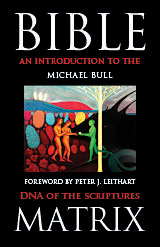
Mike Bull recently sent me a copy of his book, Bible Matrix: An Introduction to the DNA of Scriptures, 2010, Westbow Press. Peter Leithart, who I began reading when studying the book of Samuel, writes the introduction. Leithart, as many of you may know, is a close student of the works of James B. Jordan, who is perhaps closer to our view than most, but nonetheless stays within the “orthodox” limits.
Continue reading
Comments Off | tags: Add new tag, Covenant Theology, Dominion Theology, Gnosticism, James Jordan, Peter Leithart, Postmillennialism, Sam Frost | posted in Bible Matrix, Biblical Theology, The Last Days
Jan
3
2010
A Lesson for Modern Evangelicals

.
Not being from an oral communication/event-oriented culture, my recollection of the details of the following account might be a bit fluffy. But the story is true nonetheless.
Continue reading
Comments Off | tags: Gnosticism, Mission | posted in Biblical Theology, Christian Life