Apr
17
2014
 Letters to My Sons: A Humane Vision for Human Relationships, by Matt Bianco
An excerpt from Letter XII: “Hatred Leads to Blindness.”
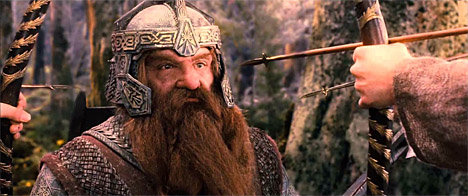
Today I was thinking again about Tolkien’s Fellowship of the Ring. Do you remember the scene where the fellowship enters the land of Lothlórien? Gimli is the only dwarf in the fellowship and he is singled out by the elves. Their hatred for the dwarves causes them to see him as an enemy when his labors are with them as a friend.
Continue reading
Comments Off | tags: Genesis, Matt Bianco, Parenting | posted in Biblical Theology, Christian Life
Feb
20
2012
Blessed are they who mourn…
Blogger Kiersten writes:
Good books wound the reader. Great books leave scars that the reader will carry and revisit throughout life, and that is precisely why we have chosen to allow our children to begin to bear these wounds while they are relatively young.
Continue reading
Comments Off | tags: Biblical worldview, Education, Parenting | posted in Christian Life
Jun
11
2011
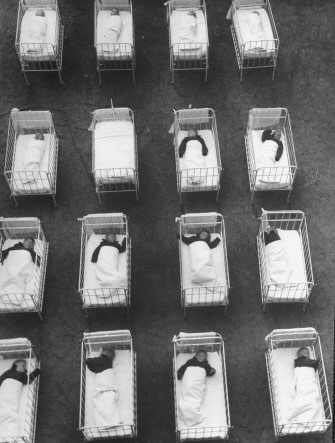
You can find this over at Doug Wilson’s blog. I’m reposting it here because I’ve just spent over an hour responding to Doug R. and John B.’s good objections to comments on Shakin’ The Tree, so I’ve not got time to write anything new. Also, posting it here means I can find it more easily in future! So, at the risk of becoming the anti-paedobaptist/anti-hyperpreterist blog…
Baptism Points Away
Continue reading
22 comments | tags: Abraham, Baptism, Circumcision, Covenant Theology, Doug Wilson, Parenting, Tabernacle | posted in Against Hyperpreterism, Bible Matrix, Biblical Theology, Ethics, Quotes, Totus Christus
Apr
23
2011

Doug Wilson writes:
“When it comes to child-rearing, between the Old and New Testaments there is total and complete continuity on the subject of godly parenting. There is no discontinuity. It needs to be emphasized again that there is continuity in the promises of God with regard to parenting. Not surprisingly, this has ramifications for the subject of infant baptism” (To a Thousand Generations, p. 10).
I am currently reading this book. Lots of good stuff in there, even for a Baptist. BUT…
Continue reading
2 comments | tags: Baptism, Circumcision, Covenant Theology, Doug Wilson, Parenting, Resurrection | posted in Biblical Theology, Quotes
Oct
19
2010
or Correspondence Will Be Entered Into
The recent Australian federal election resulted in a hung parliament, with the balance of power held by a small number of elected independents. Not being forced to toe the party line, each of these men is free to stand for the needs of his own electorate. This can certainly slow down the process of government in the courts of men, but not in the courts of God.
As Christians, we are taught to toe the party line. This is a false piety. Our Father actually loves a lively, argumentative parliament. The process of maturity is supposed to bring us to the point where we are wise judges whom He can include in His government (pictured in baptism), standing on the crystal sea as joint heirs with His Son, Great Prophets whose very words change history.
Back room deals and bargaining with God are an abuse of prayer. Or are they? Not when those disputing with God are men whose hearts are like those of the Father. Abraham and David did it. God’s desire is that we should be like them. Continue reading
1 comment | tags: Abraham, Ascension, David, Doug Wilson, John Bunyan, John Piper, Parenting, Prayer, Psalms | posted in Bible Matrix, Biblical Theology, Christian Life, Quotes
Feb
6
2010
or What’s Wrong with this Picture?

“When I began to edit the film, something happened. I found I was being educated. And not just with arguments. I was watching a Christian life. I was seeing a Christian man.” —Darren Doane
Just watched The History Boys, a film based on an entertaining but self-indulgent West End play by Alan Bennett. Despite the fact that under Course Language and Sexual References it should also have a “gay theme” warning (but I guess that’s not politically correct), the film is hysterical is places and unwittingly highlights a fatal flaw in our culture.
Continue reading
2 comments | tags: Christopher Hitchens, Culture, Darren Doane, Doug Wilson, Film, Masculinity, Parenting | posted in Christian Life, Ethics, Quotes
Sep
27
2009
Or The Tabernacle in Genesis 3
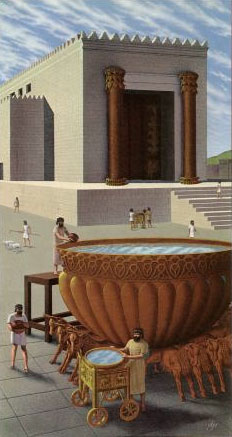 One of the best things you get from James Jordan is a big handle on the Tabernacle.[1] It was a miniature of the creation. It was also a further development of the Garden of Eden, being more glorious than the Garden itself (the trees were now worked timber, and the wood was covered in precious metal).
Jordan’s theory that Satan was to be a tutor to Adam and Eve, but fell in the moment he deceived them, finds support in the Tabernacle layout. (Angels tutor God’s people throughout the Old Testament.) Satan was the secondary lightbearer, the Lampstand, facing north.
Adam was to be broken bread and poured out wine, the Face of the Man, facing south, the Table of Showbread (the facebread).
Between them, Eve, the mother of all living, was the Altar of Incense. As element 5, Day 5, she is a “multitude” in one body. She is awesome as an army with banners. Women possess all their ova from birth.[2] Continue reading
Comments Off | tags: Greater Eve, Holy Place, Incense Altar, James Jordan, Lampstand, Parenting, Satan, Showbread, Tabernacle, Temple | posted in Biblical Theology, Creation
Sep
18
2009
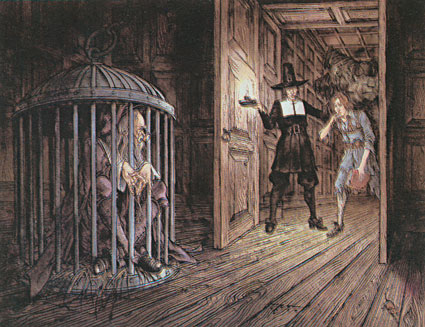
I saw in my dream, that the Interpreter took Christian by the hand again, and led him into a very dark room, where there sat a man in an iron cage. Now the man seemed very sad. He sat with his eyes looking down to the ground, and his hands folded together, and he sighed as if his heart would break.
Then said Christian, “Who is this?”
“Talk with him and see,” said the Interpreter.
“What used you to be?” asked Christian.
“I was once a flourishing professor, both in my own eyes, and also in the eyes of others,” answered the man. “I was on my way, as I thought, to the Celestial City and I was confident that I would get there.”
“But what did you do to bring yourself to this condition?” Christian asked.
“I failed to keep watch,” the man replied. “I followed the pleasures of this world, which promised me all manner of delights. But they proved to be an empty bubble. And now I am shut up in this iron cage—a man of despair who can’t get out.”
No further explanations were given. No one said who put him there. But the Interpreter whispered to Christian:
“Bear well in mind what you have seen.” [1]
. . . . . . . . . . . . . . . . . . . . . . . . . . . . . . . . . . . . . . .
Another thought related to the ideas in Behind Closed Doors.
The whole aim of the construction process, whether in sex, foetal development, education, business, art, music, family or state government, is the ultimate revelation of a mature glory. We are given the opportunity to create, and that involves certain God-given freedoms. If the freedoms are abused, what we construct for ourselves is a cage. Lust is a cage. A dysfunctional family or state is a cage. Enforced egalitarian socio-economics is a cage. Undisciplined children are a cage.
Jesus laid down His life for this world, and the freedoms of western culture have been a direct outcome. In its final stages, we have rebelliously inverted each of these freedoms (including the economic ones) and turned both our Christian protection (including our God-given wealth) and Christian mandate into a cage. Ancient Israel did the same. Why does this inversion process seem such a logical path for fallen human nature?
Continue reading
3 comments | tags: Altar of the Abyss, Babel, Biblical worldview, Culture, Dominion Theology, Doug Wilson, Economics, Incense Altar, John Bunyan, Parenting, Politics, Postmillennialism, Solomon, Tabernacle, Worship, Worship as commerce | posted in Christian Life, Quotes
Jul
21
2009

“I gave the sermon on Hagar and Ishmael today… I began my remarks by pointing out the similarity between the stories of Hagar and Ishmael sent off into the wilderness and Abraham going off with Isaac to sacrifice him, as he believes. My point was that Abraham is in effect called upon to sacrifice both his sons, and that the Lord in both instances sends angels to intervene at the critical moment to save the child. Abraham’s extreme old age is an important element in both stories, not only because he can hardly hope for more children, not only because the children of old age are unspeakably precious, but also, I think, because any father, particularly an old father, must finally give his child up to the wilderness and trust to the providence of God. It seems almost a cruelty for one generation to beget another when parents can secure so little for their children, so little safety, even in the best circumstances. Great faith is required to give the child up, trusting God to honour the parents’ love for him by assuring that there will indeed be angels in that wilderness.
I noted that Abraham himself had been sent into the wilderness, told to leave his father’s house also, that this was the narrative of all generations, and that it is only by the grace of God that we are made instruments of His providence and participants in a fatherhood that is always ultimately His.”
Reverend John Ames, in Gilead by Marilynne Robinson, p. 128-129.
Comments Off | tags: Abraham, Marilynne Robinson, Parenting | posted in Christian Life, Quotes
Apr
24
2009
“Since I was a little girl, friends, relatives and neighbours would bring their problems to Mother. She had a rare combination of being completely moral and completely nonjudgmental at the same time — the exact opposite of liberals who have absolutely no morals and yet are ferociously judgmental.
You could tell Mother anything, get good counsel and not end up feeling worse about yourself.”
–Ann Coulter
Comments Off | tags: Ann Coulter, Parenting | posted in Quotes