Dec
27
2010
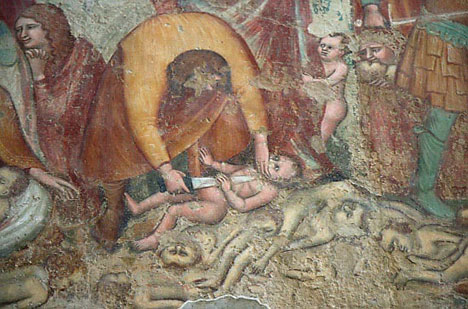
A Christmas sequel to Joseph Gets Passed Over.
The subject matter of this article was corrected, revised, and expanded in December 2018 and published here: Matthew 2: Jerusalem as Egypt.
1 comment | tags: AD70, Add new tag, Altar of the Abyss, Christmas, Gehenna, Herod, Literary Structure, Matthew | posted in Bible Matrix, Biblical Theology, Totus Christus
Dec
18
2009
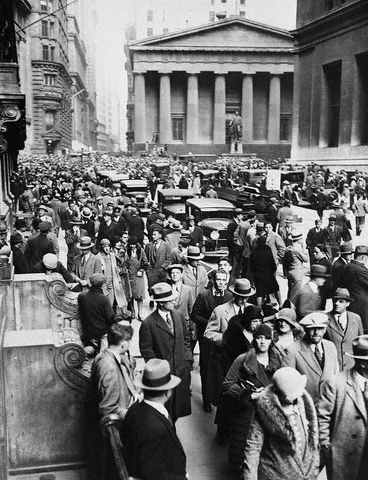
or The Crash of AD70
Now a river went out of Eden to water the garden, and from there it parted and became four riverheads. The name of the first is Pishon; it is the one which skirts the whole land of Havilah, where there is gold. And the gold of that land is good. Bdellium and the onyx stone are there. The name of the second river is Gihon; it is the one which goes around the whole land of Cush. The name of the third river is Hiddekel; it is the one which goes toward the east of Assyria. The fourth river is the Euphrates. (Genesis 2:10-14)
After the Herod and Shylock post, I had one complaint that the Worship as Commerce tag didn’t really do what it said on the tin, so I hope to capture it (briefly?) here. Now, where to start? As James Jordan explains, the idea begins in Eden.
Continue reading
1 comment | tags: AD70, Amalek, Gehenna, Genesis, Gnosticism, Herod, High Priest, Isaiah, Manna, Moses, Numbers 5, Revelation, Solomon, Temple, Worship as commerce | posted in Against Hyperpreterism, Biblical Theology, Christian Life, Creation, Ethics, Quotes, The Last Days, Totus Christus
Sep
19
2009
 Revelation is laced with the Dominion pattern like brandy through a Christmas pudding. As a literary structure, its identification highlights some interesting things.
Continue reading
Comments Off | tags: AD70, Bible Matrix, Feasts, Gehenna, Herod, Joke, Literary Structure, Revelation, Scavengers | posted in Biblical Theology, The Last Days, Totus Christus
Aug
5
2009
or Daniel’s 70th Week Postponed
“The people that walked in darkness have seen a great light: they that dwell in the land of the shadow of death, upon them hath the light shined.” Isaiah 9:2
A great deal of time has been spent on the chronology concerning Daniel’s seventy sevens. Quite frankly, chronology is not my strong point [1], but perhaps the solution for this enigmatic problem is not chronological but theological.
Continue reading
4 comments | tags: Aaron, AD70, Daniel, Eli, Gehenna, Herd, Herod, Pentecost | posted in Biblical Theology, The Last Days
Apr
10
2009
Matthew 23:15 “Woe to you, scribes and Pharisees, hypocrites! For you travel land and sea to win one proselyte, and when he is won, you make him twice as much a son of Gehenna as yourselves.”
They cross Land and Sea to make one disciple for their corrupted religion, and make him twice the child of Gehenna as themselves. “Ge-Henna” is Greek for the despised Valley of Hinnom southwest of Jerusalem, the previous location of Tophet’s child sacrifices that became an open, mass grave during the Babylonian seige. It became the rubbish dump, full of maggots, with the refuse continually burning. Jesus quotes Isaiah 66:23-24 to describe it. The Roman siege would begin when Jews from all over the empire were in Jerusalem for Passover. Their “Table” was made a snare, and Gehenna was filled with the bodies of these deceived “children.”
Comments Off | tags: Compromise, Gehenna, Pharisees, Tophet | posted in Biblical Theology, Totus Christus
Apr
8
2009
 During the Creation week, there were three days of forming new “empty spaces” by dividing the original watery deep (the Abyss), then three days of filling them. A ‘world model’ develops with God’s throne at the top and the Abyss at the bottom, the place furthest from the throne. The architecture of the Tabernacle follows this model, laid out upon the ground.
When the priesthood – the Land-mediators – disobeyed God, the Abyss was dredged up to cover the Land (holy place). We see this first in the flood, and later in the invasions of Assyria, Babylon and Rome.
The Valley of Hinnom became a symbol of the ‘Abyss’ below the true mountain of God. As an evil twin of the holy place, it was an ‘Adamic’ clay pit with no glorious metal. It was also the place where Judah sacrificed their infants to false gods. It was counterfeit worship in the tabernacle of hell, and the Lord said He would fill it with their bodies. Their dark ‘table of showbread’ became a snare. [Read Jeremiah 19]
After the Babylonian captivity, Zechariah saw the church in “the deep” (often translated valley or glen). A new Land-altar was rising out of the ‘waters’ – a new mountain of God, with a new Eden-temple to mediate for the world.
TAOTA
Comments Off | tags: Altar of the Abyss, Babylon, Creation Week, Exile, Gehenna, Jeremiah, Priesthood, Tabernacle, Table of Showbread, The flood, Zechariah | posted in Biblical Theology, The Restoration Era
Apr
8
2009
In the Sermon on the Mount, Jesus gave the pattern for a new Tabernacle. The sermon follows the pattern of the Tabernacle furniture, which in turn follows the pattern of the Creation week.1 At ‘Day 3′, Altar and Table, are His commands concerning Covenants (divorce and oaths), and the Lord’s prayer.
“Leave your gift there before the altar, and go your way. First be reconciled to your brother, and then come and offer your gift.” Matthew 5:24
Interestingly, these blessings are mirrored by the curses upon the saints’ evil twins in Matthew 23, the Jews who sat in Moses’ seat of judgment.2 The “woes” follow exactly the same pattern, and climax with Christ’s prophecy of the destruction of the Old Covenant Temple. And what do we find in this passage at Day 3?
Continue reading
Comments Off | tags: Altar of the Abyss, Daniel, Gehenna, Passover, Sermon on the Mount, Table of Showbread, Temple, The flood | posted in Biblical Theology, The Last Days
Apr
8
2009
“And another angel came out from the altar, the angel who has authority over the fire, and he called with a loud voice to the one who had the sharp sickle, “Put in your sickle and gather the clusters from the vine of the Land, for its grapes are ripe.” So the angel swung his sickle across the Land and gathered the grape harvest of the Land and threw it into the great winepress of the wrath of God. And the winepress was trodden outside the city, and blood flowed from the winepress, as high as a horse’s bridle, for 1,600 stadia.” Revelation 14:18-20
Like Pharaoh, the “plagues” Trumpet warnings only hardened the hearts of the Jewish leaders. Like Pharaoh, he had raised up the Herods only to demonstrate His power in their destruction (Romans 9:17). Continue reading
Comments Off | tags: 70 Weeks, Altar of the Abyss, Gehenna, Harvest, James Jordan, Martyrdom, Pharaoh, Revelation, Tophet, Totus Christus | posted in Biblical Theology, The Last Days