Feb
12
2013
 “With this theory of the joke in mind, the final chapter of Nehemiah is holy and hysterical.”
In his book, Deep Exegesis, Peter Leithart speaks of the biblical text as many things, but none is more confronting than his viewing the text as a “joke.” His explanation, however, makes perfect sense. What makes a joke funny? It is either prior knowledge to which not everyone is privy, or a confounding of expectations (which are also based on prior knowledge to some degree). The Bible is full of such jokes, and realizing one is in on the joke is immensely satisfying.
Continue reading
Comments Off | tags: Compromise, Ezra, Hermeneutics, Joke, Literary Structure, Nehemiah, Peter Leithart | posted in Bible Matrix, Biblical Theology, The Restoration Era
Sep
6
2010

The Restoration era Scriptures are the most misunderstood texts in the Bible. Our failure to recognise their recapitulation of patterns from the Torah — and the fact that they are not presented in chronological order but by genre — makes it hard for us to put the pieces together. [1] Very often, we miss great ironies because we don’t get the joke.
Continue reading
1 comment | tags: Covenant Theology, Daniel, Ezekiel, Jeremiah, Joke, Nebuchadnezzar, Zedekiah | posted in Biblical Theology, The Restoration Era
Feb
22
2010
or Show Me the Tropes

Literary agent Peter Rubie would undoubtedly have read many story synopses, both fiction and non-fiction. His colleague Janet Reid advises that anyone wishing to write a bestseller should read at least two thousand novels before attempting to write their own. Peter gives some helpful advice:
Continue reading
Comments Off | tags: C. S. Lewis, Culture, Feasts, Joke, Literary Structure | posted in Biblical Theology
Jan
5
2010
Understanding the Two Tables
Another thought on Jesus’ “joke” in Matthew 24. In Menu for the the Dirty Birds, I wrote:
“For wherever the carcass is, there the eagles will be gathered together.” Matthew 24:28
Tabernacles, as the final harvest of the year (grapes and olives), was also called “Ingathering.” Matthew 24 also follows the feast structure (twice), and Jesus uses this factor to make a terrifying joke.
As a holy priesthood, we are to be eaten by the world. But there are two Tables and we often confuse them.
Continue reading
Comments Off | tags: AD70, Communion, Feasts, Jewish war, Joke | posted in Biblical Theology, Christian Life, The Last Days
Sep
19
2009
 Revelation is laced with the Dominion pattern like brandy through a Christmas pudding. As a literary structure, its identification highlights some interesting things.
Continue reading
Comments Off | tags: AD70, Bible Matrix, Feasts, Gehenna, Herod, Joke, Literary Structure, Revelation, Scavengers | posted in Biblical Theology, The Last Days, Totus Christus
Sep
18
2009
Excerpts from Peter Leithart’s new book, Deep Exegesis: The Mystery of Reading Scripture:
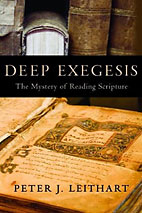 “My insight, if such it is, into the workings of humour was reinforced and generalised when I watched Shrek, a movie that I now tell my students is a gold mine of hermeneutical insight. All the funny parts of that film assume that the viewer has information the movie does not provide, information from three main sources: nursery rhymes, fairy tales, and popular culture, especially movies…”
Johannine Jokes
…How does all this apply to our reading of Scripture? Scripture has the same literary properties as the texts we have been examining. Just as Eliot read Dante who read Virgil who read Homer, so Matthew had read Jeremiah, who knew Kings (or wrote it), and the writer of Kings had read the Hexateuch. Let us look at some examples. Let me tell some biblical jokes, again taken from John 9.
Continue reading
Comments Off | tags: Culture, Hermeneutics, John, Joke, Peter Leithart | posted in Biblical Theology, Quotes