“Then Jesus told them: You can be sure that tax collectors and prostitutes will get into the kingdom of God before you ever will! When John the Baptist showed you how to do right, you would not believe him. But these evil people did believe. And even when you saw what they did, you still would not change your minds and believe.” (Matthew 21:31-32)
James Jordan teaches you to observe the universals in Scripture. I believe one of the most important is the Totus Christus pattern, head and body, and its counterfeits and distortions.
As mentioned around here a couple times (sorry, a couple of times. I’ve been reading too many Americans), the curse upon Adam concerned his head, and his responsibility to provide for and protect the body. The curse upon Eve concerned her body, her role in producing offspring. Both curses were a limited form of barrenness.
But what of the relationship between head and body? James Jordan writes:
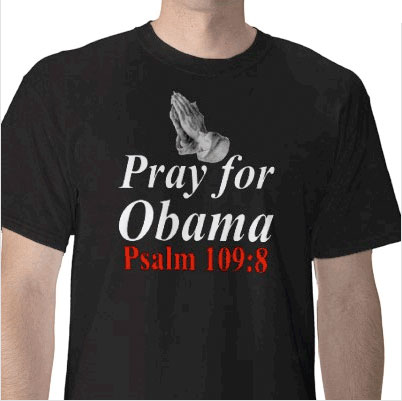
“Let his days be few, and let another take his office.” Psalm 109:8
The imprecatory Psalms seem to contradict the instruction of Christ to love our enemies. Ben Myers recently noted a campaign to pray for President Obama, to pray Psalm 109:8, that is:
Apparently some Southern Baptist pastors have been using Psalm 109:8 as a prayer for Obama’s death: “May his days be few; may another take his place of leadership. May his children be fatherless, and his wife a widow.” This even inspired a line of creepy bumper stickers and T-shirts that read “Pray for Obama.” One of these pastors says: “You’re going to tell me that I’m supposed to pray for the socialist devil, murderer, infanticide, who wants to see young children, and he wants to see babies killed through abortion and partial-birth abortion and all these different things. Nope. I’m not gonna pray for his good. I’m going to pray that he dies and goes to hell.”
“One of the most ominous events of modern history is quietly unfolding. Social science and economics come together to declare a looming demographic winter which threatens to have catastrophic social and economic consequences.”
If the data this documentary presents holds up, most of Obama’s “change” is based on hysteria that is between 1 and 3 decades old and totally debunked. The only thing going for these suicidal policies is political correctness. A good example is a recent Outloud Opinion podcast which covered the baseless ideology behind Obama’s aggressive pro-abortion policy, highlighting just one of the nutcase extremists the President continues to surround himself with. Continue reading
The Lord’s plan from the beginning has been to take each man through three stages of development before transfiguration. The first is to give him access to the Tree of Life (bread) and test his obedience as a priest. Adam failed this test. The second is to give him access to the Tree of the Knowledge of Good and Evil (wine) and test his wisdom as a king. Solomon failed this test. The third is to give him access to and membership of God’s council of elders as a decision maker, one whose words in and of themselves change history. This is testing as a Prophet, one who has been willing to be broken bread and poured out wine, and whose final years are spent giving wise words to the next generation.[1] The Old Covenant prophets passed this test.
Doug Wilson on Craig Blomberg’s review of N. T. Wright’s book-length response to John Piper’s book (breath):
“Then there is Blomberg’s misunderstanding of the relationship of the Reformers and culture.
‘Fixate on the Reformers’ (understandable) preoccupation with how an individual becomes right with God (crucial in its day against medieval Catholicism) and one may miss the bigger picture, in which the fulfillment of God’s covenant with Abraham through the children of Israel as progenitor of the Messiah looms even larger.’
Notice what is being juxtaposed here. The Reformers had an individualistic fixation on getting individuals into heaven when they die. But we, upon whom the new perspective has shone, now understand that there is a “bigger picture.” I see. And what did the Reformers do with their narrow vision? Well, they toppled kings, transformed laws, overhauled cultures, settled a continent, built nations, founded schools and colleges, inspired musicians and painters, and we could continue in this vein for quite a while. And what do we do, entranced as we are by the new perspective? We write academic papers, download podcasts of academic lectures that we can listen to in the privacy of our ear buds, and we go white in the face if conservative Christians suggest that Jesus might have an opinion about the ongoing slaughter of the unborn. John Piper, with his preaching on the pro-life issue, challenges the principalities and powers. The soft statism that goes with trendy theology these days does nothing of the kind — it simply suggests (but not too loudly) that we need kinder, gentler principalities and powers.”
Mike Bull is a graphic designer who lives and works in the Blue Mountains west of Sydney, Australia. His passion is understanding and teaching the Bible, and he writes occasionally for Theopolis Institute in Birmingham AL, USA.