Deus ex machina

or Covenant as Human Shield
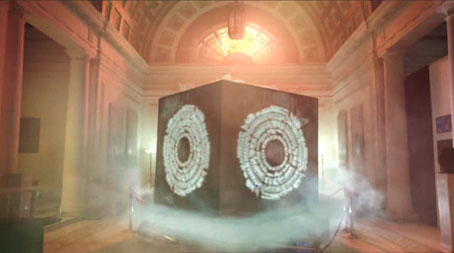
pandorica

“…woe to you, scribes and Pharisees, hypocrites! For you shut up the kingdom of heaven against men; for you neither go in yourselves, nor do you allow those who are entering to go in.” Matthew 23:13

All Creation is Covenantal, and therefore all relationships within it have a hierarchical structure. God calls a vassal (Creation), separates/sanctifies him as a delegated authority (Division). He gives him a job to do (Ascension), and a period of time to accomplish it.

This Adam, the Covenant Mediator, stands between heaven and earth (Land). The Land was raised out of the Sea, and the Man was raised out of the Land as “grain and fruit.” Then this new house, this body of broken earth, was filled with heaven, with the Spirit of God, sun moon and stars: This Adam was to be a singular prism that expands the white light of God into plural lights, a greater body, the full spectrum of colour. But he was to be a broken man. The light had to pass through him.

The passed-through man is a preacher who is given the Word, opens the Word, and explains the Word. The pulpit is the place of Adam lifted up, a man of grain and fruit, of broken bread and poured-out wine. When he breaks the bread, Jesus is recognised in him, and the body becomes governing lights.

As a “human shield,” a firmament of flesh, the office of Mediator is a position of passivity towards God, and activity towards Creation. Slavery to God brings dominion over the world. When Adam refuses to be bread and wine (a slave to the will of the Father), he makes slaves of those he was supposed to lead by his sacrificial example. They become his food, and he becomes bars and gates instead of The Door. When his children, his parish, his employees look up for light, the heaven is brass. An abdication of personal slavery to Christ does not bring an egalitarian utopia. The good yoke of Covenant hierarchy cannot be broken, only perverted into a burden for those it was supposed to shield and shelter. If obedience is shirked, the burden is multiplied (like offspring) and borne by the body. When the perversion is full-grown, God sends a sword and makes a New Covenant.

James Jordan writes:

An examination of Biblical material regarding slavery takes the student to the heart of the anti-egalitarian polemic of Christian faith, and is most relevant in demonstrating the erroneous character of  “theologies of liberation”…

It is … imperative that a consideration of the Biblical material concerning slavery be undertaken against the backdrop of the Bible’s own presuppositions and worldview. Biblical slavery cannot properly be understood apart from the Biblical understanding of man’s relationship to God, man’s relationship to his fellowman, man’s relationship to the sub-human creation, man’s calling to labor, the human family, and the state; as well as the perversions wrought in these zones of life by the rebellion of man…

The Bible reveals that man is a creature of God (Gen. 1:26f), so that man’s existence and his essence are derived from God, and exist outside of God but in inescapable relationship with God. Thus, man’s foundational relationship with God is one of total passivity. God is wholly—radically and comprehensively—Lord, and man is wholly slave. Unlike trees and stones, however, man also relates to God in an active, mutual manner (e.g., Gen.32:24-28; Jas.2:23), but always against the backdrop of essential passivity.

The Bible also reveals that man is the image and likeness of God and that he has been given dominion over the sub-human creation, and especially over the animals (Gen.l:26-28; 2:19-20). Thus, man’s preeminent relationship with the sub-human creation is one of activity:  Man is Lord, and the sub-human creations are slaves of man. Man’s lordship over the sub-human creation is, however, not absolute, for man is not the Creator of the sub-human creation. Rather, man’s lordship is relative to God’s primary mastery, and is under His Law.

The Bible further reveals that all men are descended from Adam the first man, and are of one blood. Thus, all men have the same essential ontological status. Whatever differences in abilities, age, and sex may appear in humanity, there is an essential or foundational equality among all men. Man’s relationship with his fellowman is, then, essentially one of mutuality, reciprocity, or coequality.

It emerges that man has relationships with three spheres of existence: God, the sub-human creation, and fellowman.  It follows that man’s nature is in part defined in terms of these three relationships and that man has a need rightly to be related to each of these three spheres. A complex of right relations is a situation of order; the rebellion of man, however, introduced a situation of disorder. Man’s rebellion against God entailed a perversion of all relationships, but not an effacement of man’s nature. Man, being author neither of his own existence nor of his own essence) can destroy neither.  He is still essentially a creature who needs an absolute reference point, a supreme master, to whom he can relate with absolute passivity.  Man’s rejection of the Creator as God does not result in his having no god at all, but in his having some false god. Man does not obliterate his psychological need for an absolute, he “exchanges” it for a lie (Rom.l:23). Thus, man may be said to have a “slave drive” which ever seeks some god to submit to.

According to Scripture, every man is slave of some master. If he is not a slave of God and Christ (e.g., Rom 1:1; Rev 22:3), then he is necessarily the slave of sin (Rom.6: l6f, John 8:34). Man, being a slave, has a drive to become what he is. The Spirit’s exhortation in Romans 6 is based on this fact. The Christian is enslaved to Christ, thus the Christian should live as a slave of Christ. Scripture shows that the Christian not only should live as a slave of Christ, but that he has a heart-desire, a need, a “drive” to so live (Ps.119). The Christian’s “drive” is his loyalty (faith, love, fear, etc.) to God. The sinner’s “drive” is his rebellion against and hatred of God (Rom.8: 6ff.), which results in love of death (Prov.8:36). The Christian’s drive to love God, coupled with his basic nature as a slave, makes the Christian a willing slave of God. The sinner’s drive to hate God, coupled with his ineradicable basic nature as a slave, makes the rebel a slave of anything but the Creator, though since the rebel seeks to play God himself, he is not willingly a slave of anyone but himself.

The New Testament speaks of slavery to “sin” as the opposite of slavery to God (Rom. 6:12-23; Acts 8:23). By comparison with slavery to sin, slavery to God is liberty (John 8:32, 36). Indeed, because there is a real transition from wrath to grace in history at the time of Christ’s resurrection, the freedom of Israel in the Old Covenant is bondage compared with the liberty of New Covenant believers (Gal. 4). Before Christ and outside of Christ the world is not only in bondage to sin, but to the consequences of sin. Thus, even Israelites could be bound by Satan (Luke 13:16), and statist oppression abounded. Thus “slavery to sin” is not a mere abstraction in some ideal or nominal sense, but is a concrete principle expressive of the subjective heart-characteristic of rebellious man in both his individual and his corporate life, and which places sinful man in an objective condition of oppressive bondage to evil angelic powers and Babelic statism.

Just as man does not cease to be a slave when he rebels against God, neither does he cease to be “dominion man”. Rather, his “dominical drive” is simply redirected and perverted. Nor does man cease to be a being who needs relationships of mutuality with equals. He remains a social being. Man can no more eliminate his essence than he can his existence, for both are authored not by himself, but by God. [1]

Just as the obedience of one man becomes institutionalised (ie. takes on a body), so does the disobedience. Adam’s sin multiplied into that of Cain; Cain’s multiplied into that of Lamech, and Lamech’s violence, once amplified, ended the world. [2] Offspring amplifies. The sins which Gideon toys with are fully embraced by Abimelech.

In Revelation, John wept because the end of the world was nigh. The Old Covenant had failed and judgment was at hand. There was no one, in heaven, on the Land, or under the Land (Adams who had returned to dust), who was able to stand in the gap. He describes the heavenly realities of all the Tabernacle furniture except for one crucial piece, the Table of Bread and Wine. Creation, History and Covenant were apparently at an end—until John spied the standing Lamb.

How could the disastrous first century situation of a priesthood bound by personal, communal and state slavery (under the Herods) be reversed by the obedience of a single Man? And then spread so quickly over a few centuries to encompass the known world? Was it a deus ex machina cop-out rescue after the truly impossible cliffhanger? God is a better screenwriter than that.

The Old Testament is not a trail of clues left by a divine Agatha Christie, clues that only make sense when the denouement finally arrives (although that’s how most moderns teach the Bible!) The Old Testament is a search for faithful Covenant heads. Certainly, they are types of the Christ, but the Covenants these men were to keep were real enough.

So, Christ could reverse the trajectory of the entire universe by being lifted up as bread and wine in the Covenant machine. One Man as Head can make a door that many can pass through as Body, whether he be a husband, a father, an employer, a minister, a president, or Christ Himself, our Human Shield.

That is the heart of Covenant: passivity towards God (death) and activity towards Creation (resurrection). If one of these is missing we are left with either impotent pietism or violet revolution. This place of tension, this seemingly impossible position, is where Adam’s dominion, Christ’s kingdom, is found. It is the paradox of a living sacrifice.

Covenant is a choice between God’s device and the gods of our own devising. Abel and Cain. Blessing and cursing. Both are slavery.

(The picture above is the Pandorica, an enigmatic puzzle-box in a recent Doctor Who that turned out to be an ingenious trap, a tomb from which there was no escape, and also, through self-sacrifice, the only means of “rebooting” a cracked, doomed universe. Great stuff to watch with the kids. An interesting factor is that, like the veil and the cubic Most Holy Place, the tomb of Christ, it was not a doorway to another world but a doorway to this world transformed. The world is changed behind closed doors. [3])

________________________________
[1] James B. Jordan, Slavery in Biblical Perspective, 1980.
[2] See The Significance of Adah and Zillah.
[3] See Behind Closed Doors.


Leave a Reply