The Significance of Adah and Zillah
“Peter came to Him and said, ‘Lord, how often shall my brother sin against me, and I forgive him? Up to seven times?’ Jesus said to him, ‘I do not say to you, up to seven times, but up to seventy times seven.’” (Matthew 18:21-22)
Genesis 4 seems to contain two “feast” cycles. Near the end of the first, at “Atonement”, the Lord set a mark upon Cain to protect him from vengeance. As on the Day of Covering after Adam’s sin in Eden, the full weight of the law was withheld. Cain complained that his “liability” was greater than he could bear. Cain was covered but he still went from the presence of the Lord, as the goat which carried the sins into the wilderness. It seems Cain despised mercy.
Just as the Lord and the Land were two witnesses against his crime, he now fled from the face of the Lord and the face of the Land. Only the High Priest could face God, standing in the Veil, the firmament between heaven and earth. Abel was the true facebread, the authorised priest. [1]
In the second cycle, vengeance appears in the same slot. But this time it is Lamech speaking as a god. [2] The seven sprinklings of blood at Atonement are magnified into seventy-seven, and it is human blood. Men were not yet mature enough to judge and sentence murderers—Noah was the first. Like Israel’s priesthoods that became corrupt and started authorising the shedding of human blood (God’s real sheep), Lamech was the first legalist. His words founded a culture of bloodshed, a culture without mercy, a culture with a god of appeasement instead of the God who desired nearbringing.
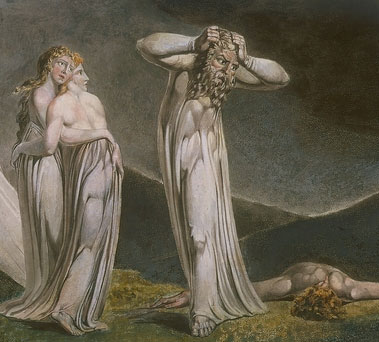
Lamech’s two wives appear at this un-Atonement ceremony. The only way we can interpret their full significance here (besides the observation of Lamech’s invention of polygamy) is through later patterns. What suddenly stands out is Lamech’s failure to judge between them. They are the two goats of Yom Kippur in this passage. [3] Lamech’s worship service leaves the sins of the faithful un-covered and covers the unfaithful.
The later examples of this pattern are too numerous to list (many of these are observed in Totus Christus), but the most noteworthy might be: Abraham judging between Hagar and Sarah;the two prostitutes standing before Solomon for judgment (concerning their children); Rahab the harlot and Jericho the harlot city; the Moabite women who committed harlotry with the men of Israel (those who remained virgins were not slain but taken as brides); and of course the harlot and the bride in Revelation. We also have Laban’s deception of Jacob, resulting in polygamy, and Esau’s intermarriage with Canaan, his two Hittite wives who made Isaac and Rebekah’s life (literally) “bitter.” [4]
Lamech established “Herodian” worship. He instituted a religion of “non-substitutionary” bloodshed (instead of animal sacrifices) which led to a Land filled with violence. And his polygamy, like that of Solomon, led to a priesthood without sound judgment, sons of God who were easily compromised. Like the Herodians, they could not “ascend” as the first goat because they were unequally yoked to the goat of Azal.
The events leading up to AD70, prophesied using this “feast” language in the Revelation, followed exactly the same pattern. As in the Great Flood, the saints were covered and the sinners dis-covered. God brought true, wise judgment in Christ as He did in Noah, and gave Him the authority to execute the murderers.
“Blessed are those whose lawless deeds are forgiven, and whose sins are covered.”
Romans 4:7
______________________________________
[1] See The Holy Headbutt.
[2] See The Significance of Tubal-Cain and The Significance of Jabal and Jubal.
[3] It is also interesting that in this cycle, the two women are “Atonement”, but in the greater cycle from Adam to Noah, these two brides appear at the “Covenant” step (Ascension/Firstfruits): see Leaving Las Vegas. In Eden, this “Ascension” step is where the Lord gave Adam the Law, and married Adam and Eve, the first “nearbringing.” In Revelation, it is the step where Christ approached the throne as the slain lamb and qualified to receive the New Covenant scroll.
[4] We might also include the Lord’s reference in Ezekiel to Judah and Samaria as two harlotrous women. Samaria was a slut, but open about it. Judah kept up her pretense of “whiteness.”


January 19th, 2010 at 11:00 am
Do more with Lamech’s failure to judge between his two wives. What was his assessment to be? I would have thought they were two witnesses against him.
January 19th, 2010 at 11:23 am
Good thinking, but the two witnesses are always male. They are the two cherubim flanking the Ark. The two women are always the two goats. Don’t know how that would go down with BH feministas if there were such a thing.
The High Priest basically tossed the dice (the urim and thummim), so the Lord chose the goat. The last time the lot was drawn was just before the Spirit baptism at Pentecost, so now WE get to decide. We judge between the goats. For more on this see:
http://www.bullartistry.com.au/wp/2009/05/20/a-white-stone-3/
under the subhead “The word is ‘Yes’”
So, under the New Covenant, if you find yourself having to choose between the affections of two women, you don’t need to toss a dice. ; )
January 19th, 2010 at 12:39 pm
You mean “toss a die” and you still didn’t explain for my poor brain what he had to choose between them for. I get the scapegoat idea but fail to see it in the narrative itself.
January 19th, 2010 at 1:23 pm
It’s structural. Both cycles in chapter 4 follow the Feasts. It’s not that one was evil and one was good in this instance. It’s Lamech’s refusal to choose.
January 19th, 2010 at 3:42 pm
“You mean ‘toss a die…’”
Don’t you usually toss a pair?
January 21st, 2010 at 5:28 am
Yes, but you said “a” dice…..get it? ;^,