The Whole Bloody Bible
juliantheapostate

Ending the False Dichotomy of Blood and Spirit

The Old Testament is a bloody book. Beginning with Adam’s “dissection” to build Eve and the animals the Lord made into tunics, it culminates in Revelation with the massacre of saints under Herod/Nero (Revelation 14) and then the massacre of Jews under Vespasian and Titus.

The Land is always bought with blood. Sitting around John Piper’s eschatology round table recently, the premillennialist (Jim Hamilton) and the amillennialist (Sam Storms) had problems understanding that postmillennialism is not about a sudden Utopia on earth. It is about buying the world with blood—this world. Yes, there is martyrdom, but then there is Christian culture. Following the example of Christ, it is being willing to die because you have one eye on the glory that can be bought for God. Like Wycliffe’s prayer from the stake that God would open the King of England’s eyes, it is Visionary Suffering. (See also Postmillennial Suffering.)

But blood is only ever a foundation. Spirit follows. The Law kills but the Spirit gives life. The slaughter of saints actually disarms the old worship, and Christianity fills the void. The atrocities of communism in China and Mongolia cast the ancient demons out of the house and the Holy Spirit finds it swept and garnished. He fills the vacuum like a mighty, rushing wind.

So, the Reformers didn’t need to keep dying. The firstfruits church didn’t keep dying. The “last days” are only ever the last days of the old order. A New Jerusalem is formed on the blood of the apostles and prophets—but then it is also filled! My friend Matthew recently posted:

If you had to put your finger on what caused the rise of the church in the Roman world (and beyond) in the first four centuries AD, what would you suggest? Miracles (as Eusebius suggests)? The blood of the martyrs (as Tertullian suggests)? I’d be inclined to follow sociologist Rodney Stark’s suggestion that it was through relational networks of family and friends.*

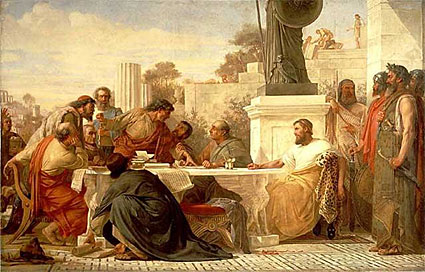
According to Emperor Julian (b.331/332, d. 363), the last pagan emperor of the Roman Empire, the rise of Christianity in its first four centuries — by the end of which at least half the empire was Christian — was the distinctive behaviour of Christians (which D.B. Hart includes as temperance, gentleness, lawfulness, and acts of supererogatory kindness) which were visible and appealing to their non-Christian neighbours. Julian wrote:

“It is [the Christians'] philanthropy towards strangers, the care they take of the graves of the dead, and the affected sanctity with which they conduct their lives that have done most to spread their atheism.” — Julian, Epistle 22 to Arsacius, the pagan priest of Galatia. Quoted by D.B. Hart in Atheist Delusions: The Christian Revolution and Its fashionable Enemies, 2009.

* Rodney Stark would also argue that it was Christian behaviour that made it so attractive, particularity its treatment of women.

Of course, all of this comes back to totus Christus, the head then the body. The head is blood (circumcision), the body is Spirit (baptism). Saints die as seeds, as Christ did, and their deaths allow a great harvest. But that harvest is characterised by community life, a brand new culture, a new leaven. The living stones of the bridal city have the Spirit as mortar.

So, the blood of the martyrs is indeed the seed of the church, but Tertullian’s famous quote only gives us half the picture. Stark, however, only gives us the other half of the picture. There must be blood and Spirit.

The problem with our “post-Christian” culture is that the harvest here has mostly ended. An anaemic Christianity thinks “community” is the answer. That bloody Old Testament is now foreign to us. It is now all about the Spirit of lerv, and fellowship and community. Like Rome, we just want Eve because she is soft and motherly. But our faith has become effeminate, so we need new foundations. [1]

True, culture-changing community can only be achieved again when Christians are willing to be Adam-seeds. We need those bloody foundations, and teaching the whole bloody Bible is the place to start. Without the shedding of blood there is no remission of sins, no nearbringing to the throne. This shedding begins with faithfulness to Bible and Table and Mission, bloody Word, bloody sacrament and bloody government until the whole world knows the power of His resurrection.

“Of the increase of His government and peace there will be no end, upon the throne of David and over His kingdom, to order it and establish it with judgment and justice from that time forward, even forever. The zeal of the LORD of hosts will perform this.”  Isaiah 9:7 

___________________________________________
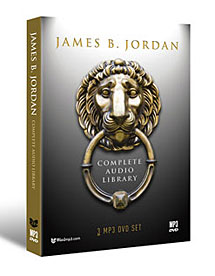
[1] I highly recommend James Jordan’s Crisis, Opportunity and the Christian Future

jbjcrisisopp“We are witnessing the end of Western Civilization. The present crisis in our culture is the greatest since the first century. Many commentators on the present scene believe that the entire world is moving into a period of “neo-tribalism.” 

In this striking book, theologian James B. Jordan argues that this cultural change is part of God’s ongoing plan for humanity, the plan by which the Holy Spirit grows God’s daughter, humanity, into a fit bride for His Son. 

The present crisis provides a tremendous opportunity for the Christian Church to challenge and transform the world as never before. Here, Jordan points to how this can be done. 

While many view the present crisis with dismay, and are looking backwards to older traditions, Jordan argues that God is calling us forward, and that the Bible points the way.”

2 Responses to “The Whole Bloody Bible”

Leave a Reply