The Holy Headbutt
“In the sweat of your face you shall eat bread till you return to the ground…” (Genesis 3:19)
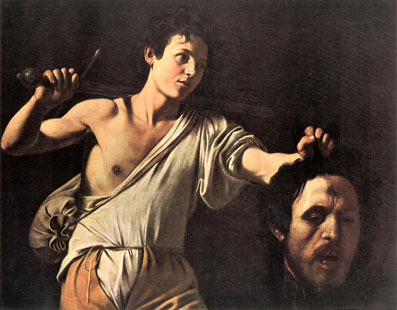
The book of Judges continually uses the imagery of the crushing of the heads of the Lord’s enemies, whether this is literal skulls or heads of state. The Bible makes a big deal of heads and bodies, whether this is the sacrifices picturing the totus Christus, or His rival, Gog and Magog.
The most famous head crushing is that of Goliath, and the literary structure follows, you guessed it, the feast pattern (beginning at the anointing of Saul). David is presented as a sort of High Priest for the people, standing as a lone head representing the helpless body on the Day of Atonement.[1] On this day, the High Priest did not wear his holy armour or his glorious robes, but simple linen. David did not wear Saul’s armour, and he took on the head of the scaly (chainmailed) Philistine army alone.
Usually, the High Priest wore a golden plate on his forehead, engraved with “Holy to the Lord.” It was a covering that protected him from the curse of the Law. King Uzziah approached to burn incense without a covering and plague broke out upon his forehead. Moses faced the Lord over blood sacrifices and then had to veil his face because it terrified the people. But on the Day of Atonement, the High Priest only wore a linen turban. He approached the throne with the blood of a bull to cover the sins of the priesthood. Symbolically, he was Christ facing the Father as Adam with his own righteous blood. [2]
David approached Goliath boldly (he ran!) with a blood-red (ruddy), good-looking face...[3] It symbolised his righteousness as a perfect reflection of the beauty of the Lord. It was a holy headbutt, and Goliath’s unrighteous face ended up in the dirt. The text explicitly says face down. And then it was quite literally a face-off.
The Table of the “bread of the face” symbolised the New Covenant, the Covenant of the Man (the fourth face of the cherubim). It is the face of Christ already bloodied in Gethsemane (bloody sweat - Garden), beaten by the priesthood (Land) and crowned in Pilate’s court (World). With a ruddy face, the David Who would be King ran boldly to meet the unbloodied, uncircumcised face with no armour but nakedness and graveclothes. [4]
David did get to eat the Facebread later on as well. But that’s another story.
________________________________________
[1] This literary structure matches Saul’s initial victory over the Philistines chiastically with David’s slaying of Goliath. Saul, however, allowed the Philistines to dominate through a monopoly over the iron. David used Philistine iron against the Philistine. Prefiguring Christ, he used the weapon of death upon its own minister to free the saints from its bondage.
[2] See also A White Stone - 3: Flintstone-Faced
[3] The Hebrew translated “ruddy” is admoniy, a word related to Adam. It means showing blood in the face. The High Priest represented Adam. I think his flesh also represented the bread on the Table: see Gold, Onyx and Bdellium.
[4] There are lots of theories about the meaning of David’s five smooth stones. Five is the biblical number of military strength, and later on David trusts the angels of the Lord to go before Him. So here, I think they are the angelic host going before Him. Like Christ, David’s ministers were like lightning. Like Christ, when men failed to obey God, He raised up stones to do the work. This also corresponds to the Day 5 - Incense Altar elders - Trumpets step of the Dominion pattern. Trust me. David was the flaming “head”, and the stones were his “body.”