Jul
8
2015
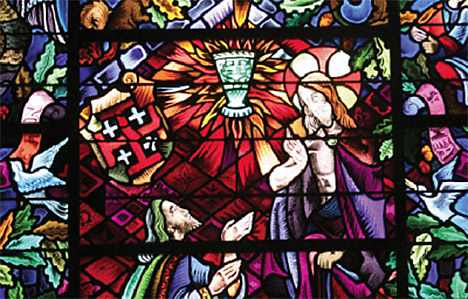
“By the imperative, time is formed into a cup, still empty but formed for the special purpose of being filled with the content demanded by the order.”
The Imperative Comes First
Essay by John Barach
As many people have pointed out, in Christian ethics, the indicative precedes the imperative. First God says, “I am Yahweh your God, who brought you out of the land of Egypt, out of the house of bondage,” and then he gives the Ten Words (“You shall have no other gods before me…”). First Paul tells us what Christ has done and who we are in Christ, and then he summons us to act accordingly. First comes the good news of what God has done for us and then comes the summons to respond in faith and love and new obedience.
Continue reading
Comments Off | tags: Covenant Theology, Eugen Rosenstock-Huessy, John Barach, Ten Commandments | posted in Biblical Theology, Creation, Quotes
Oct
1
2014
-
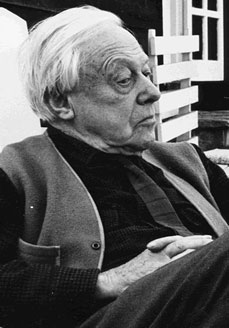
“If the creed is not considered dangerous, divine worship is emasculated.”
A creed is either worthless or worth everything we have. Here’s a classic quote from an essay by Eugen Rosenstock-Huessy entitled “The Peace of the Pirates” in Planetary Service (1978).
I have had the honor to have been considered a public danger more than once in my life. The first time was in 1912 when I wrote, “Language is wiser than the person who speaks it.” My thesis almost foundered on this disturbing reality of the Holy Spirit which I had perceived. Balaam’s ass was considered unscientific!
Continue reading
Comments Off | tags: Eugen Rosenstock-Huessy | posted in Apologetics, Quotes
May
21
2013
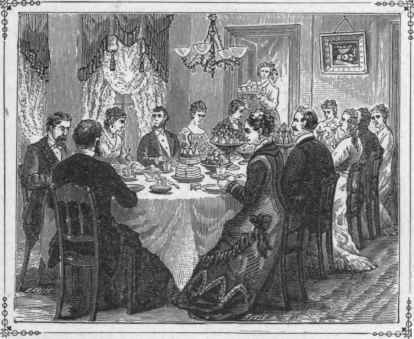
“Matthew understands Jesus to be the rightful heir of the chieftaincy who instead volunteers to become the Victim at the tribe’s feast. But by being the voluntary victim, he becomes the first victim in the world who can speak.”
An excerpt from Eugen Rosenstock-Huessy’s “Fruit of Lips”:
“…as oral as Peter the fisherman must have been and as much as he probably detested ink, Matthew certainly was familiar with paper work and written records, only too well. Since we do not expect him to be employed inside his old activities, where he had used writing for superficial purposes to say the least, we may expect him to fight elsewhere…”
Continue reading
Comments Off | tags: Communion, Eugen Rosenstock-Huessy, Gospels, Matthew, Sacraments | posted in Biblical Theology, Ethics, Quotes
Aug
13
2012
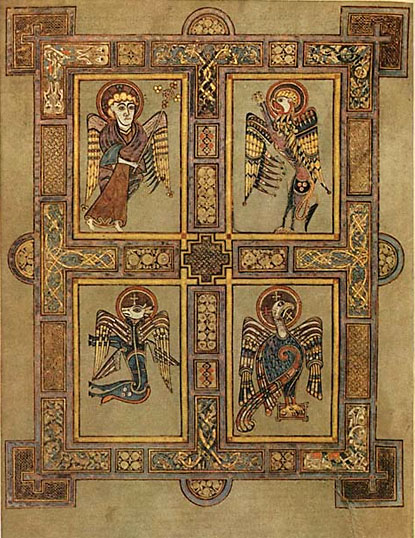 James Jordan maintains that Matthew’s Gospel was written first. Eugen Rosenstock-Huessey does too.
Continue reading
Comments Off | tags: Acts, Eugen Rosenstock-Huessy, Gospels, James Jordan, John, Luke, Mark, Matthew | posted in Bible Matrix, Biblical Theology
Nov
3
2010
“Adam himself was to bring both death and life into the world through wise judgment.”
.
The view that the death and resurrection of Christ purchased back for us the innocence (and innocent world) of Genesis 1 seems extremely childish to me now. How did we miss the fact that the Old Testament is filled to overflow with deaths and resurrections, personal, familial, national and imperial? There was no death before sin, but the scenario deliberately set up by God in Genesis was to bring Adam to a point of making a wise judgment. He was to crush the head of the serpent. In a sense, he was to kill death. His obedience would guarantee future life, but his obedience itself was a form of death. Obeying God is a daily dying, but as Paul understood, it was a dying so that there might be rejoicing on the other side. Obedience is a death that makes a judgment call to purchase, nay, miraculously create, new life. The original creation was set up, wound up, to go somewhere better, to be something greater.
Peter Leithart gave some lectures on the writings of Eugen Rosenstock-Huessy in 2008: Continue reading
Comments Off | tags: Eugen Rosenstock-Huessy, Genesis, Nietzsche, Obedience, Peter Leithart, Postmillennialism, Resurrection | posted in Biblical Theology, Creation, Quotes
Jan
10
2010

or Being a Truly Impure Thinker
“If you love me, you will keep my commandments.” John 14:15
NOTE: THIS POST HAS BEEN REMIXED AND INCLUDED IN GOD’S KITCHEN.
You must be logged in to see the rest of this post.
Join now for a year for $15!
Peter Leithart wrote this week:
How do we know things? Experimentation, deduction, observation?
In Genesis, knowledge is first associated with two things – with food and with sex. There is a tree of the knowledge of good and evil, whose fruit opens the eyes of Adam and Eve so that they perceive that they are naked. Then Adam knows his wife and she conceives Cain.
If we want a strictly biblical answer: Knowledge is eating. Knowledge is sex.
Continue reading
Comments Off | tags: Add new tag, Communion, Eugen Rosenstock-Huessy, Food laws, Maturity, Moses, Peter Leithart, Solomon, Wisdom | posted in Biblical Theology, Christian Life
Apr
8
2009
or The Knowledge of Good and Evil is Always a Two-Edged Sword
“Nobody has the power to bless or be blessed who has lost the vigor to curse. Our society is so polite that it cannot curse social evils and prefers to blaspheme God instead.”
- Eugen Rosenstock-Huessy
Judgment is not destruction. Judgment is assessment. For every beast rejected and sent to outer darkness, there is a redeemed beast that ascends to God. AD70 was the ultimate Yom Kippur, the outworking of the cross. Passover always leads to the Day of Atonement, the Day of the Lord when the flaming sword turns to and fro.
Comments Off | tags: Atonement, Eugen Rosenstock-Huessy | posted in Biblical Theology