Knowing As We Are Known
fathersoneating

or Being a Truly Impure Thinker

“If you love me, you will keep my commandments.” John 14:15

Peter Leithart wrote this week:

How do we know things? Experimentation, deduction, observation?

In Genesis, knowledge is first associated with two things – with food and with sex. There is a tree of the knowledge of good and evil, whose fruit opens the eyes of Adam and Eve so that they perceive that they are naked. Then Adam knows his wife and she conceives Cain.

If we want a strictly biblical answer: Knowledge is eating. Knowledge is sex.

I guess he is having a go at the moderns’ approach to science and philosophy: the belief that true knowledge is only possible for those who are detached, dispassionate and unbiased. The scientist must remove himself from reality in order to observe it. The world is an object upon which we work.

In his lectures on Rosentock-Huessy at the 2008 Biblical Horizons Conference, Leithart says:

“The slogan of the Middle Ages was the slogan of Augustine and of Anselm: credo ut intelligam, ‘I believe that I may understand.’ Faith comes first. And faith seeks understanding.

But the slogan of the modern world is the Cartesian slogan, cogito ergo sum, ‘I think therefore I am.’ This detached ego, trying to push away all tradition and all learning that it has gotten from elsewhere, to establish a foundation for his own existence in his own thought, is the slogan of modern philosophy.

Rosenstock-Huessy doesn’t see either of these slogans as inherently wrong. But he proposes a new slogan that transends both, respondeo etsi mutabor, ’I respond, although I shall be changed.’ [2]

Now finding it difficult to assess anything outside the head-and-body Dominion paradigm that is inherent in Scripture, I would say there are two kinds of eating and two kinds of sex.

Firstly, we eat from the Tree of Life and are joined in marriage (Ascension). These are obedience to knowledge (Firstfruits - Sinai). It is Covenant. It is blood. It is bread. It is priestly faith. It is an altar. I believe.

Then, we eat from the Tree of Wisdom as the head of a new body (Glorification). The marriage is between Jew and Gentile (Tabernacles - Zion) and heaven and earth. It is Covenant succession. It is water (four rivers). It is wine. It is kingly sight. It is Shekinah. I understand.

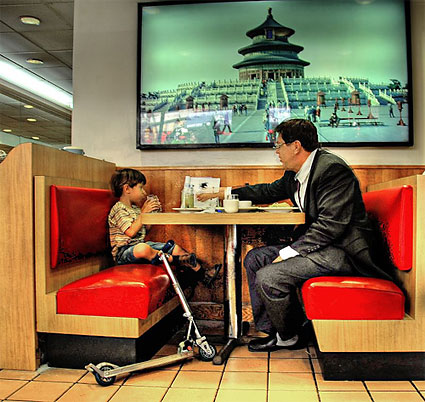
We see the same relationship between the grape-haul in Exodus and actually possessing the vineyards of Canaan. [3] The first knowledge is limited. It is deliberately so because it is a test of relationship. The child questions the command with “But why?” The father replies, “Because I am your father.” Adam’s sin was relational.

These two degrees of knowledge correspond to the Two Tables, the priest-only Passover and the all-welcome Tabernacles. [4] They also correspond to the temporary nature of the Old Covenant dietary laws. [5] Obedience is not dispassionate. Sin is passionate but obedience should be even more so. Once we get to know the true heart of the Father in Christ, we serve Him out of love. His love constrains us not with cords and bars (commandments), but with a “holy lust,” the purifying fire of the Spirit. This is the Law of Christ.

How do we stir up this passion? By eating with God, then dining with the Bride.

When we “get” this process of faith-then-sight, we move beyond the dark sayings of God and speak wisdom ourselves. We move from silence to song, from knowledge (Moses) to wisdom (Solomon), from the Law to Christ.[6] We ourselves become fathers. We finally know as we are known.

_____________________________________
[1] Available from www.wordmp3.com
[2] Eugene Rosenstock-Huessy, “Farewell to Descartes” in I Am an Impure Thinker [PDF]
[3] See Marriage as a Promise of Wine.
[4] See Eat Local and Die.
[5]  See Touch Not, Taste Not, Handle Not.
[6] See Knowledge and Wisdom.


Leave a Reply