There Can Be Only One
God took on a body, from the dust, in Adam. A trillion particles of inanimate, dead stuff pulled together and organised into the most complex system in the cosmos, an organic machine capable of feats we are yet to discover.
Adam, as Covenant head, also took on a “body.” A Divine Handful of flesh and bone, dead or dying by any human measure, organised into a being more palatial and lavish than any male eye is worthy to behold.
The Bible is a history of words, true and false, becoming incarnate. Evil takes on bodies, from serpents to bestial empires. True worship takes on bodies, from Abram in Isaac to the New Jerusalem. When the Lord takes on a body, it brings offspring. Satan’s attempts to corrupt the body and hijack the true Offspring are well-known (and have even spawned theories of what’s going on in Genesis 6 that are pure fancy [1]).
Besides those attempts to hijack the body are attempts at exalting a false head. Satan was obviously the first, usurping Adam’s place at the right hand of the Father (as an accuser) until he was deposed at the ascension of Christ (the Advocate). Others include Jabin, Haman and the Herods. All were false “words” that took on bodies not by Spirit, but by might and power.
Decapitating God
Throughout the Scriptures the battle rages between true and false “words,” each taking on bodies and trying to cut off the other’s head with his respective sword-word. Nimrod is a prime example, and the mythical Epic of Gilgamesh illustrates this battle beautifully. Bible archaeologist, David Livingstone, writes:
The author of this passage of Scripture will not call Gilgamesh by his name and honour him, but is going to call him by a derisive name, what he really is—a rebel. Therefore we should translate Genesis 10:8-10 to read:
“Cush begat Nimrod; he began to be a tyrant in the earth. He was a tyrannical hunter in opposition to the Lord. Thus it is said, ‘Nimrod the tyrannical opponent of YHWH.’”
…The Gilgamesh Epic describes the first “God is dead” movement. In the Epic, the hero is a vile, filthy, perverted person, yet he is presented as the greatest, strongest hero that ever lived (Heidel 1963:18). So that the one who sent the Flood will not trouble them any more, Gilgamesh sets out to kill the perpetrator. He takes with him a friend who is a monstrous half-man, half-animal—Enkidu. Together they go on a long journey to the Cedar Mountain to find and destroy the monster who sent the Flood. Gilgamesh finds him and finally succeeds in cutting off the head of this creature whose name is “Huwawa” (“Humbaba” in the Assyrian version; see Heidel 1963: 34ff ).
Is there a connection with the Gilgamesh epic and Genesis 10? Note what Gilgamesh says to Enkidu the half man, half beast, who accompanied him on his journey, found in Tablet III, lines 147-150.
‘If I fall,’ Gilgamesh says, ‘I will establish a name for myself.
Gilgamesh is fallen, they will say, in combat with terrible Huwawa.’But the next five lines are missing from all tablets found so far! Can we speculate on what they say? Let’s try… We suggest that those five lines include, ‘But if I win, …they will say, Gilgamesh, the mighty vanquisher of Huwawa!’
Why do we say that? Because Genesis 10:9 gives us the portion missing from the Gilgamesh tablets. Those lines include, ‘it is said, Nimrod (or Gilgamesh) the mighty vanquisher of YHWH.’ This has to be what is missing from all the clay tablets of the Gilgamesh story. The Gilgamesh Epic calls him Huwawa; the Bible calls Him YHWH.” [2]
The crucial point here is Nimrod’s counterfeit totus Christus.[3] The serpent crushes the head of the godly seed. We know it is impossible to cut off God’s head, but Gilgamesh’s convenient story of conquest reinforces the biblical theme of head-and-body. Gilgamesh wished to be the head of the people instead of Yahweh. But a “hunter” of a head, like Esau, cannot live out true Covenant succession. He eventually eats his own body.
This entire scenario is replayed in the New Testament. The Herods are Idumeans, Edomites, descended from Esau. They are hunters, predators. Jesus calls the reigning Herod, literally, a “vixen.” (Jesus knows how to insult hypocrites! It seems He called Herod a bitch!) Like Nimrod, they corrupt the true worship to build Babel, a false “gate of God.” The Jews and Judaisers who rejected or twisted the gospel were compromisers like the Shemite sons of Joktan.
“We have no king but Caesar!”
Under the apostolic ministry, the sword of the gospel cuts off the head of Rome-sponsored Herodian worship. Herod dies on his throne and the Jews are divided. True worship removes to Antioch, and Satan, deposed from heaven, takes up residence in Herodian worship, in the Temple. He spews forth a fake river of life, false doctrine. The plan is defeated by the apostles. The church is threshed, but the elect are not deceived, as Jesus had predicted.
The battle between true and false Jews is like that between David and Goliath. Both are allied with their respective “Kings of the Jews.” Each has their High Priest. David wins, but the deadly wound heals. The false word takes on another body, out of the Gentile Sea, and Goliath’s severed head (Rome’s Herodian face) starts spouting blasphemies against the Most High once again.
This time, the body is a deliberate mimick of Paul’s Jew-Gentile church. Satan calls up a more obviously Roman body, Neronic persecution, with Judaisers as Balaam, a false prophet prophesying lies in the presence of the king.
The ascended Christ is out of Satan’s reach, but the foetal church is well within it. The Head has been delivered but the body has not. Adam has been torn but Eve is not yet complete. Satan knew that his time was short. What the central part of Revelation describes is Satan’s last-ditch attempt at a partial-birth abortion of totus Christus. He actually succeeded in the slaughter of the body, but was deceived in the same manner as he was at the cross; a fool blinded by rage. Demon-possession failed. Christ-possession succeeded. But this was just the foundation for a greater conquest.
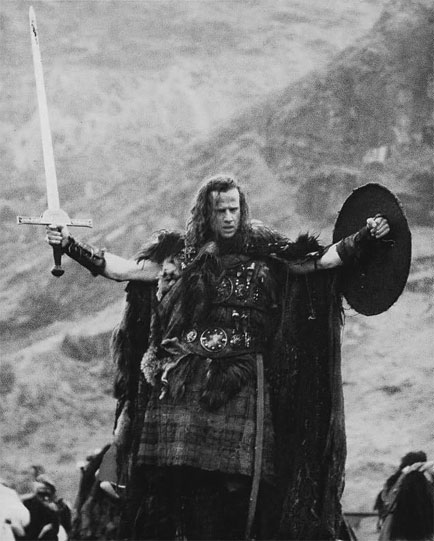
“There can be only One.”
Get the full story: order Totus Christus.
Tomorrow will be my last post for a little while. Kelby said he’d just read 25 books and that’s more than I read in two years! I have a lot of books I paid good money for that are gathering dust. There’s plenty to explore around here, so make yourself at home. Feel free to comment or ask any questions. The last post will be a doozy as far as I’m concerned. You could even say it’s a guest post.
_________________________________________________________
[1] See The Sons of God and the Daughters of Men and The Sons of God and the Daughters of Men II for the antidote to this errant idea.
[2] David P. Livingston, Who was Nimrod?
[3] See also Totus Diabolus.

February 12th, 2010 at 12:26 am
Darn it man…that was good stuff. Fine, I’ll cough up the money for Totus Christus.
February 12th, 2010 at 9:36 am
Is this an excerpt from Totus CHristus? I don’t remember reading it in my draft.
February 12th, 2010 at 10:36 am
Kelby
This is sort of a summary with a bit more on Nimrod. The Nimrod stuff will be included in the final version which should be complete in, say, 2012?