Horns of Moses

or Meat to Eat - 1

moseshorns

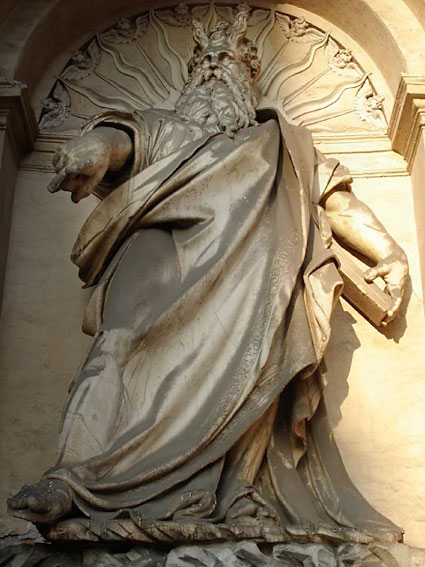
“And whanne Moises cam doun fro the hil of Synai, he helde twei tablis of witnessyng, and he wiste not that his face was horned of the felouschipe of Goddis word..” —Exodus 34:29, Wycliffe

Perhaps you’ve seen those bumper stickers that say, “If we’re not meant to eat animals, why are they made of meat?”

From memory, men didn’t eat meat until after the flood. The history from Adam to Noah follows the Feasts pattern, with Adam as the Alpha male (heh) and Noah as the mature and wise Omega male of that initial process. [1] Moving from vegetarianism (literally “seeds”) to meat was not only a sign of judgment, but a sign of greater judgment put into the hands of God’s Man. [2] Noah could eat meat, and he could also sentence murderers to death. Man now had teeth in a way he had never had them before. Even we use the phrase “toothless” to refer to ineffective pieces of legislation. As mentioned elsewhere here, teeth and tusks and ivory and horns are symbols of justice, whether they be on men, animals, or altars. [3] A blood-covered horn means the crime is atoned for. Just as Christ was a Lamb with seven horns, worthy to open the scroll, Moses came down from Sinai with not only a “scroll” (or tablets in that case) but “horns.” This translation has been dismissed as errant, but perhaps the reason for it should not be dismissed so easily. Here’s my attempt at an interpretation.

Okay, Moses’ face shone. He didn’t actually have horns despite the many depictions of him with such in various paintings and sculptures. But the primary meaning of the word from which this word “shone” is derived really is “horned.” What was Moses reflecting? The great white throne of Greater Solomon, of course, the brilliant legal glory of Yahweh. Solomon’s throne was covered in ivory. [4]

An unrighteous Adam who faces God is gored by the horns of justice. If we don’t judge we will be judged. The blood of animals was substituted and displayed as a covering so that the High Priestly “Adam” could approach. As a righteous Adam (or a man covered by the blood), Moses received this legal glory. He became the Law-Word incarnate, the moon reflecting the sun in the nighttime of the Old Covenant, a glimpse of the glory to come in Christ.

Christ, of course, combined these two Adamic images. He was a lamb slain, but also a living lamb with seven horns. He was the ultimate satisfaction of God’s brilliant justice, then He became the minister of that justice against the unrepentant ministers of the Old Creation order. He would even call Tyre, Sidon, Sodom and Gomorrah as witnesses against the Jewish leaders when their time came.

So the word “horned” is possibly a deliberate play on words, or the use of a word that combined two meanings: shining and law. Moses was a horned altar, Sinai as a man, with a face as white and hard as enamel. [5] Under his judgment, the righteous would be vindicated and the wicked destroyed. The threshing (chewing?) process would leave only two men alive, a number which didn’t even include Moses: Joshua and Caleb, two spies, two witnesses.

Under this new Levitical Law, a new “Garden” would be constructed, and a great many animals would be slaughtered and offered within its insatiable boundary. It was a King’s Table. Yahweh was already Omega, already Solomon. But Israel, not yet humble, desired Omega food, the food of “ascension.” [6] Not satisfied with the bread of “priestly” obedience, they lobbied for meat to eat.

___________________________________________________________
[1] See Omega Males.
[2] Jordan notes that the “pulse” that Daniel and friends ate in Daniel 1 is literally “seeds.” But he did eat the king’s food later on. See Touch Not, Taste Not, Handle Not for the biblical theology behind this.
[3] This might explain the three tusks/horns in the mouth of the Persian bear in Daniel 7:5. Jordan suggests that are they Daniel, Nehemiah and Mordecai—remnants of the throne of Solomon enabling Persia to devour the world. In the Bible, it’s the good angels (cherubim) that have the horns, and Daniel’s four beasts surrounded the throne of a resurrected Jew-Gentile kingdom, the oikoumene. This, of course, predicted “the age to come”, the gospel age, in which satan not only has no horns, but as the accuser he is now toothless. We have the teeth and the horns, the gospel.
[4] That is why it is mentioned in Revelation 18:12. Its position in the passage also supports this interpretation. See Totus Christus.
[5] Exodus 25-31 corresponds the Bronze Altar with the “four-cornered” Land of Day 3. Later, Canaan became the Altar. When Israel sinned, God basically turned the horns inward against those on the Land to scatter them. Zechariah shows the craftsmen rebuilding the Altar of Incense, not the Bronze Altar. This too had four horns, but it was a higher altar that Israel now represented. The Incense Altar (Day 5) is a Bronze Altar (Day 3) that has been slain under the Law (Day 4) and resurrected. Revelation also shows four angels ready to judge Herodian worship, thirsty for blood to atone for the murder of the prophets and the saints.
[6] In Exodus 24, Moses feasted with the elders and the Lord on the “crystal sea” (Exodus 24:10). Here, Moses was a “Solomon,” a king. It was the end of the “Egypt” cycle. However, when Moses ascended Sinai to receive the Law, he fasted. He was “eaten” as a priest. See Fasting as Sacrament. It was the beginning of a new cycle of creation and maturity.

Leave a Reply