Unashamed Artisans
“Be meticulous to present yourself for the praise of God as an unashamed workman, cutting the word of truth in a straight line.” (II Timothy 2:15)
Is this verse simply teaching that if we “divide up” the Scriptures correctly, we’ll get an AWANA[1] merit badge from God? Hardly. It is flanked by condemnations of those who fight over the Scriptures to no profit, and those whose vain babblings are gangrenous.
Paul speaks of a soldier and a farmer, and then a productive workman. Paul is concerned about building saints and churches, and they are built by a straight and true cutting of the word. Like most of Paul’s statements, there is a very long, fully-loaded freight train of Old Testament history and typology right behind it, and it’s coming right at you, right now.
God gives us the raw materials, and He expects us to build stuff. We cut down trees, “glorify” them with our tools, and put them up again as a house for God. God cuts down sinful men (they fall as dead [Passover-Exodus-Red Sea]) and He lifts them up again with His right hand as a house for His name [Firstfruits-Leviticus-Tabernacle]. His Letter kills, then His Spirit gives life. Trees die, lose their “figleaves” glory and are resurrected, covered in glory as a dwelling place for the Spirit of glory. The Tabernacle had wooden poles covered in precious metal. The Temple had pillars of cedar. Glorious nature becomes even more glorious culture. A new world begins with a dead tree, a slain Adam.
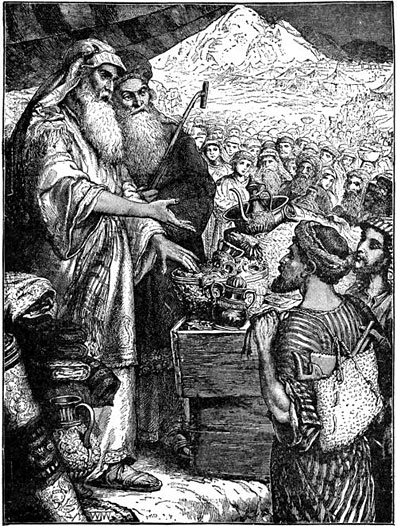
God took Moses up the mountain and showed him the heavenly Temple. He gave Moses a blueprint, and then He sent the Spirit-filled artisans, Bezalel and Aholiab, to make it a reality out of raw materials plundered from Egypt and from the wilderness.
Solomon had his artisans build the most glorious Temple in history. We think of Solomon alone as the wise one, but the Bible paints a different picture. Peter Leithart writes:
“In large part, the historical discussions miss the point of biblical wisdom… In Scripture, wisdom is more closely associated with the skill of the woodcutter than with the ecstasies of the mystic. The Hebrew word for wisdom often means “artistic skill” (Exod. 28:3; 31:3; 35:31; 1 Kgs. 7:14), and even where the reference is not directly to art, the aesthetic and practical dimension is not left behind. A furniture maker displays wisdom in craftsmanship, not only by knowing “causes” but by excellence in the sheer physical activity of the craft. A musician displays wisdom in making music, a parent in training and guiding children. There is a craft or art to these endeavours, and overall Proverbs is a book of instruction concerning skillful living, teaching how to construct a life that is attractive, fitting, and beautiful. Jesus, the incarnate wisdom, is wisdom in just this sense, the one who embodies, as Nicholas of Cusa said, the art of the Father, the craftsman who shapes the raw and ruined matter of this world into the kingdom of God, the teacher who instructs his disciples how to build well.”[2]
Leithart continues to describe Solomon’s political prowess as another example of this Proverbial, practical, productive wisdom. The word ergate denotes a worker ant, and it is derived from Paul’s Greek word for workman in 2 Tim. 2:12. It is the working wisdom of Solomon.
God gave the Temple blueprint to David, and Solomon carried it out. But after Solomon, we tend to lose the plot. So did the Jews. They became artisans of a false Temple, builders of evil inventions:
Learn not the way of the nations, nor be dismayed at the signs of the heavens because the nations are dismayed at them, for the customs of the peoples are vanity. A tree from the forest is cut down and worked with an axe by the hands of a craftsman. They decorate it with silver and gold; they fasten it with hammer and nails so that it cannot move. (Jeremiah 10)
Before the destruction of Jerusalem and Solomon’s Temple, Daniel ascended to the right hand of the power, and God showed him the blueprint of the brand spanking shiny new Tabernacle he was to build for the Jews. It appeared as a metal man. Nebuchadnezzar took all the craftsmen of Israel captive (2 Kings 24:14; Jeremiah 52:15). Nebuchadnezzar was then himself cut down as a tree, exiled to the wilderness then lifted up as a Temple for God’s people.
The oikumene (empire-Land) was a body, a living Temple for the resurrected all-of-the-Jews priesthood. Daniel as Moses, Ezekiel as Aaron, and Ezra and Nehemiah as Aholiab and Bezalel built the thing out of Babylon’s wilderness corpse. The children of the craftsmen returned to rebuild. Zechariah saw them rebuilding the Altar of Incense, the symbol of Israel’s mediation before God for the nations in the firmament/Holy Place:
Then the LORD showed me four craftsmen. And I said, “What are these coming to do?” So he said, “These are the horns that scattered Judah, so that no one could lift up his head; but the craftsmen are coming to terrify them, to cast out the horns of the nations that lifted up their horn against the land of Judah to scatter it.” (Zechariah 1:21-22)
After Daniel’s vision, the Lord showed Ezekiel the blueprint for the new empire-Temple. Made of living stones, it was completed, glorified, under the rule of Esther and Mordecai, when they plundered the world, from India to Ethiopia. James Jordan observes that Cyrus collected the materials (as David), and Ahasuerus/Darius built it (as Solomon) and his love is celebrated in a Bible book (Esther). The dominion of God’s people had expanded, but like the first Tabernacle and Temple, it would jade and fade, and need restoration again.
Enter the Spirit-filled Carpenter.
Jesus built a new Tabernacle. Like the Tabernacle of Moses, it pictured the Garden of Eden, but with “men as trees walking.” Like the Tabernacle of Moses, it was a place of silence, of listening to God on the mountain.
Then, after Christ’s death in the wilderness, “outside the city”, the Tabernacle was rebuilt. Peter ascended to a rooftop and saw a vision. It was the Tabernacle of David, filled with Gentile worshippers, and singing. The Tabernacle of David is the response of the Bride to the Bridegroom (see The Sacrifice of Praise).
But the Herods were also employing craftsmen; craftsmen who didn’t understand their king was a Nimrod, not a Solomon. He was building on sand. Not being Spirit-filled, these Jews were like the craftsmen of Ephesus (Acts 19:24-38) and they stirred up riots against the true Apostolic craftsmen. Their project was doomed by the Apostle John with the words of the ascended Christ:
“So will Babylon the great city be thrown down with violence, and will be found no more; and the sound of harpists and musicians, of flute players and trumpeters, will be heard in you no more, and a craftsman of any craft will be found in you no more…” (Revelation 18:22).
The word “craftsmen” in Zechariah 1 has the connotation of “engravers.” The Apostles were cutting men down as trees, lifting them up and engraving the words of God into them as Temple pillars. Paul carried these stigmata across the entire oikumene, staking out the Land with tent pegs, as Abraham had planted oak trees as boundary markers, and Jacob had erected “living stones” anointed with the Pentecost oil of the Spirit.
The Apostolic “Land” Davidic Tabernacle was received as a Bride into the Temple of Greater Solomon in AD70 at His coronation over the World. This was the marriage feast of the Lamb.
Jesus’ carpentry began in Eden. He cut Adam in two and “built” Eve. Peter Leithart writes:
“Even before Cain, there is a hint – only a hint, but a hint – of a better city to come. It is not good for man to be alone, Yahweh says of Adam, and then takes a rib from Adam’s side and makes that rib into a woman.
Eve is not a city. But Eve is the prototype of a different sort of city, a bridal city. The hint is in the strange verb that Genesis 2:22 uses. Yahweh doesn’t make or form Eve from the rib of Adam, but “builds” the woman. Eve is the first thing built in the Bible, and the second thing to be built is Cain’s city – that’s the next use of that verb.
But it’s not just the verb that links the two. Cain builds his city after killing his brother, shedding Abel’s blood on the ground. Adam goes into deep sleep, not death, and his flesh is opened up. The first time flesh is opened is not with Abel but with Adam. There is no reference to blood, but there must have been.
There are key differences that highlight the differences of two cities. Cain kills his brother and founds his city on the blood of his brother; Adam’s bride is built from his own body, from a kind of self-sacrifice. Further, Cain built his city; but Adam’s bride is built by God. Eve is not a city, but she is the prototype of the city that Abraham looked forward to, the city whose builder and maker is God.
The clearest evidence for this civic interpretation of the creation of Eve comes from the end of the Bible, where the city-bride is revealed in a thoroughly Edenic passage. The city-bride is a new Eve, adorned for her Husband, the Lamb, and this means that the original creation of Eve anticipated the consummation.” [3]
In Adam’s place, Jesus was cut by the Word of the Father to build a new Bride.
Like Ezekiel’s vision of the Restoration “empire” Temple, John was also shown a New Jerusalem. The round crystal sea was now a square crystal city. That is the waters above (Genesis 1:6).
At the end of history, the round Sea of nations (the waters below) will finally also be a square Holy Place, according to the architectural pattern that is currently “coming down out of heaven from God” (Revelation 21:10). As God’s Spirit-filled craftsmen, we measure out, stake out this pattern upon the world as the baptized saints commune with Christ and the ascended saints in our weekly worship. In church, the waters are no longer divided. Head and body, heaven and earth, are one. Jordan observes that the Revelation begins with a metal man (structure), and ends with a metal woman (glory).
The heavenly city is built of the plunder of the old world. The riches of true Christendom are people. The totus Christus is a worldwide Temple built of cut-down, ascended men, engraved with the words of God and bearing these marks of the Lord Jesus in their bodies.
“And Bezalel and Aholiab, and every gifted artisan in whom the LORD has put wisdom and understanding, to know how to do all manner of work for the service of the sanctuary, shall do according to all that the LORD has commanded.” (Exodus 36:1)
What are you building with? Gold, silver and precious stones? The Herods thought they were. But the Day (AD70) declared it to actually be wood, hay and stubble (1 Cor. 3:12). Zechariah saw it coming:
Open your doors, O Lebanon, That fire may devour your cedars. Wail, O cypress, for the cedar has fallen, Because the mighty trees are ruined. Wail, O oaks of Bashan, For the thick forest has come down. There is the sound of wailing shepherds! For their glory is in ruins. (Zechariah 11:1-3)
Our Day is yet to come.
Finally, based on all of this, do you think in 2 Timothy 2:15 that Paul the tentmaker meant the Word was being cut, or the tool doing the cutting?
“He who overcomes, I will make him a pillar in the temple of My God, and he shall go out no more. And I will write on him the name of My God and the name of the city of My God, the New Jerusalem, which comes down out of heaven from My God. And I will write on him My new name.” (Revelation 3:12)
_________________________________________
- Approved Workmen Are Not Ashamed, an American Bible-saturated Scouts-like youth program.
- Peter J. Leithart, Brazos Theological Commentary: 1 & 2 Kings, p. 43.
- Peter J. Leithart, Bridal City.