What the Seraphim Really Said
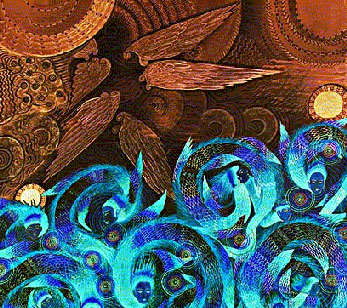
seraphim

My Hebrew teacher was reading a Kabbalistic text and noted that it was the only place where he had seen an interpretation of Isaiah 6:3 that agreed with his own translation. We usually get something like this (NASB): 

“Holy, Holy, Holy, is the LORD of hosts, The whole earth is full of His glory.”

The Hebrew is actually like this, (from Young’s translation):

“Holy, Holy, Holy, [is] Jehovah of Hosts, The fulness of all the earth [is] His glory.”

This supports the whole Ish and Isha image.[1]  The Lord created a divided world, beginning with heaven and earth. Heaven was made ’solid state’, complete, already perfect (mature). The earth was made to be brought to maturity by the heavenly pattern. The pattern, as noted yesterday, is inherent in the Creation week, the Covenants, and the Tabernacle and Temple. It is the Ish seed that makes Isha fertile so she can fill the world with godly offspring. It is these offspring that are the glory of God, as wife and children are the glory (like a robe) of a man. They are the shining city around the Lamb. They are the “hosts” (armies) of the Lord.

One thing the Bible Matrix pattern makes plain is this repeated idea of “fullness.” It corresponds to the Feast of Trumpets and the Book of Deuteronomy. It is the unified multitude that results from Isha being filled with the Law (the seed). In the book of Ruth, it is the Moabitess brought into the Covenant to make it fruitful again. Luke uses it subtly in Acts as he describes a Gentile church sending their riches to the Jerusalem church during a famine. This glorious fullness is what Paul means by “the fullness of the Gentiles”. It was a first century event.

The “earth” always refers to the mediatorial Land, symbolised in the bronze altar. In the “Big Bible Pattern”, Israel is this bronze altar, and the Old Testament shows the borders of this mediatorial Land expand from what was promised to Abraham to the extent of the Persian, Greek and Roman Empires. Paul’s mission was to harvest this territory (the Oikoumene).

But it is the apostolic church that corresponds to Trumpets, Deuteronomy, Day 5 and the Incense Altar. They are now ruling from heaven, before the throne. [2] In the Tabernacle pattern, these two altars correspond chiastically. From Israel to the church is an elevation of government from earth to heaven. It is now saints, not angels, setting the agenda and bringing the entire world as Isha-Land to its fullness. The extent of the kingdom will reach from the throne of Christ right down to the bottom of the Abyss.

“For full is the earth of the knowledge of the honour of Jehovah, as waters cover [the bottom of] a sea.” (Habakkuk 2:14, Young)

It seems like Isaiah was postmillennial.


As a bonus, Isaiah 6 follows the Feasts, although ironically. The Covenant pattern is being reversed. Dominion, fullness, is to be taken away by the words of Isaiah. Isha will be barren, like the harlot in Numbers 5.

SABBATH - ARK
In the year of King Uzziah’s death I saw the Lord sitting on a throne, lofty and exalted, with the train of His robe filling the temple. Seraphim stood above Him, each having six wings: with two he covered his face, and with two he covered his feet, and with two he flew. And one called out to another and said, “Holy, Holy, Holy, is the LORD of hosts, The fullness of the whole [Land] is His glory.”

PASSOVER - VEIL
And the foundations of the thresholds trembled at the voice of him who called out, while the temple was filling with smoke. Then I said, “Woe is me, for I am ruined! Because I am a man of unclean lips, And I live among a people of unclean lips; For my eyes have seen the King, the LORD of [armies].”

FIRSTFRUITS - ALTAR & TABLE
Then one of the seraphim flew to me with a burning coal in his hand, which he had taken from the altar with tongs. He touched my mouth with it and said, “Behold, this has touched your lips; and your iniquity is taken away and your sin is forgiven.” Then I heard the voice of the Lord, saying, “Whom shall I send, and who will go for Us?” Then I said, “Here am I. Send me!”

PENTECOST - LAMPSTAND (seven eyes of the Law) [3]
He said, “Go, and tell this people: `Keep on listening, but do not perceive; Keep on looking, but do not understand.’ “Render the hearts of this people insensitive, Their ears dull, And their eyes dim, Otherwise they might see with their eyes, Hear with their ears, Understand with their hearts, And return and be healed.”

TRUMPETS - INCENSE ALTAR (saints’ response)
Then I said, “Lord, how long?” And He answered, “Until cities are devastated and without inhabitant, houses are without people and the land is utterly desolate,

ATONEMENT - SACRIFICES & PRIESTHOOD
“The LORD has removed men far away, And the forsaken places are many in the midst of the land. “Yet there will be a tenth portion in it,

TABERNACLES - SHEKINAH
And it will again be subject to burning, Like a terebinth or an oak whose stump remains when it is felled. The holy seed is its stump.” [4]

____________________________________________
[1] See Ish and Isha
[2] See Jesus’ New Broom 
[3] This theme of an “evil Lampstand” is repeated by Christ in the Sermon on the Mount, and also in Revelation. See Black Eyes
[4] Notice the theme of succession again at Tabernacles.


One Response to “What the Seraphim Really Said”

Leave a Reply