Half the Blood

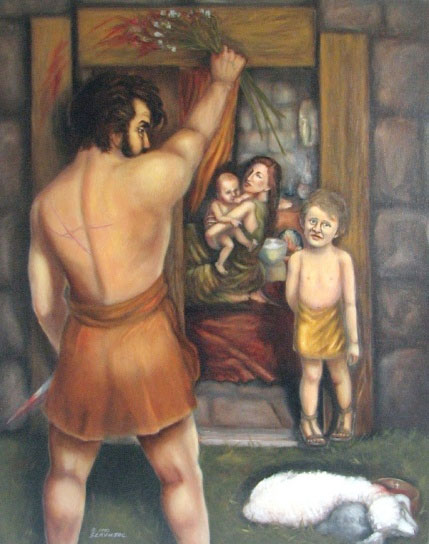
passover-darleneslavujacthau

“Do not forgive them, Father. They know exactly what they are doing.”

Throughout the Bible there are two doors, or more correctly, a door and a window.

Both of them involve blood. The first takes us out of the world. The second puts us in government. The first is the Passover door, the second is a window in Jericho. One mirrors the other chiastically in the journey from slavery to Sabbath.

Both of them involve children. The children in a faithful household were covered at Passover. The other children were slain. Anyone in Rahab’s house was covered at “Atonement.” And men, women, children and animals were slaughtered in the bloodbath at Jericho—under God’s express command. [1]

Being a preterist, I tend to major on the negative things we find in the New Testament that mistakenly get applied to the entire church age. In context, they apply to that first “adulterous” generation. Halden Doerge picked up on the positive side of the curse that the Jews who crucified Christ called down upon themselves—well, upon their children. I totally missed it.

In the account of the passion in Matthew, the crowd responds to Pilate’s declaration of innocence with the cry “His blood be on us and on our children!” (Matt 27:25). A curious irony is found here. In that the people here are taking on the responsibility for Christ’s death but do so in language that seems utterly Passoverish. And indeed, as it turns out Christ’s blood will be “on” them and their children. Just as the blood of the Passover lamb protected the families of Israel in Egypt from the angel of death, so also Christ’s blood will protect and save the very ones who shed it without regard for him.

But it doesn’t stop there. With the giving of the Spirit at Pentecost and the attending proclamation of the gospel of the resurrection, Peter claims that “This promise is for you and your children” (Acts 2:39).

Here we see the ironic and futile nature of our resistance to Christ and the radical superabundance of God’s self-giving in response to our hatred and violence. We go out for blood, thoughtlessly throwing our children in with us. God responds to us by coming to us again, as our victim, with words of forgiveness and promise. Where we would condemn ourselves and our children, God continues to come again to us with promise, with the Spirit, with new, vivifying life. [2]

At Pentecost, many Jews were cut to the heart. They realised they had crucified the Lord of glory. They did not know what they were doing. They had been led astray, and like the woman caught in adultery, they were forgiven. [3]

This is the half of the picture I missed, but it is still only half the picture. It is only the first door, the Veil of Passover. That’s about the Covenant Head, Christ. It ignores the second door/window: the Laver of Atonement. [4] This is about the Covenant Body, the Church. [5] The sin of those who refused to join Her was high-handed. They knew exactly what they were doing. As James Jordan says, Jesus forgave their crime against Him, but for their crimes against His bride, He would not forgive.

Right through the Bible there are always two goats at Atonement. As Halden notices, the history of the first century church follows the Feasts, and we must not leave it after Passover and Pentecost. The apostles summoned a new Jew/Gentile “body” as Trumpets, and pronounced plagues against all those who would not obey the gospel. Atonement came with the slaughter of saints as the first goat—the red cord—and the destruction of Jerusalem as the second. Herod’s city was the early church’s Jericho. The death of Jerusalem was a window through which the completed Old Covenant Church had to pass before its final end. Mary Magdalene pictured the harlot city from whom seven demons Jesus had cast. Where did the demons go? They returned to find a city swept and clean. Her last state was worse than the first. [6]

Josephus records that a cloisters collapsed during the war, killing six thousand women and children in one fell swoop. [7] And Revelation shows the massacred saints, Old Covenant and New Covenant firstfruits, rejoicing over this event. Jesus’ blood covered the believers, but we must never forget that His blood was also avenged upon those who refused to believe.

Is it any wonder the condemned Jesus told the weeping women to weep instead for their children? This is the other half of the picture, the other half of the liberating curse. The entire process is prefigured in Exodus 24:

……….Sabbath - The call to climb the mountain and worship from afar
………………..Passover - Moses and the elders are a human firmament
…………………………Firstfruits - Moses alone shall come near the Lord
…………………………(a new Covenant head)
………………………………….Pentecost - Moses tells the people the
………………………………….commandments and the people
………………………………….agree to obey them
…………………………Trumpets - The altar and twelve pillars are built
…………………………(a new city-body)
………………..Atonement - Half of the blood is sprinkled on the people [8]
……….Booths - Moses and the elders feast before God in peace.
……….The glory-cloud rests on the mountain

___________________________________________
[1] See Pass-over and Pass-through.
[2] Halden Doerge. Us and our Children.
[3] See Emancipation of Eve.
[4] See That Which Is Perfect.
[5] See Healing in His… Tassels?
[6] See Black Eyes.
[7] See Dashing Her Little Ones.
[8] Notice verse 10: “…and they saw the God of Israel. And there was under His feet as it were a paved work of sapphire stone, and it was like the very heavens in its clarity.” Jesus was standing on the crystal sea. Moses and his elders looked up through the windows of heaven.

Artwork: “The Passover — He Died for Me?” by contemporary Biblical artist Darlene Slavujac Thau, 1992


Leave a Reply