The Forbidden Feast
or Forbidden Mixtures - 2
Many theologians will tell you that the Old Testament Scriptures have little to say about resurrection. Yet, typologically, they scream about it constantly if we have eyes to see. Many modern conservatives don’t understand the nature of revelation. God paints the same picture of death and resurrection over and over again at both personal and national levels and all these gents do is record how many pixels are in each image.
For a visual blow-by-blow account of this death and resurrection process, get a copy of Bible Matrix and read it twice. Here, I want to concentrate on the significance of Melchizedek in the Last Supper.
Please read the previous article, Forbidden Mixtures, before you continue.
The matrix structure involves a passing-over and a passing-through.
There is blood at Passover. The city of Egypt gets “circumcised” by the angel of the Lord who comes to “cut off” flesh, the offspring of Egypt, as an atonement for the crimes of the Pharaoh against the offspring of the Hebrews eighty years before. [1]
Then, there is a passing-through. The people of God are finally qualified to be the sword-bearing angels of death, and it is Jericho that is circumcised, quite literally, as the priestly army marches around the circumference of the city. The “middle wall” of partition comes down, ending the covering sacrifice that Abram mediated over Canaan more than four hundred years before. Joseph was sold into slavery as Covenant Head, and the resulting Covenant Body was ready for conquest, a Bridal cloud terrible as an army with banners. His offspring was reunited with the Land.
So, Israel and the Land were torn apart and then reunited. But this did not end circumcision. It reinstituted it. Joshua was commanded to circumcise Israel a “second time.” There is blood in the division and blood in the reunion. [2] However, in the greater scheme of things, the tearing apart of Adam’s race into Jew and Gentile (Head and Body) would not be reversed until the first century AD.
This is where Melchizedek comes in. As mentioned in Mother of the Free, the de-central worship ruled by the priesthood of all nations after the flood was replaced by Israel. (A centralised worship was part of the sin at Babel.) Abram’s feast with Melchizedek was the last time Israel would eat bread and wine together, before God, until Christ. From the circumcision of Abram, bread and wine became “holy,” a “forbidden mixture.” Both were present in the Tabernacle, but the wine was always tipped out as an offering. It was never consumed in the presence of God by the priests. Bread and wine, flesh and blood, were divided. This is one of the evidences that Ezekiel’s temple was fulfilled in history before Christ: the wine was still to be tipped out in this construct.
Thus, the death and resurrection of Israel via Egypt was played out on a grander scale. The bones of Joseph (who was in charge of the grain/bread) came out of the grave with a body of millions, and they drank wine in Canaan from vineyards they did not plant.
So Christ, as Melchizedek, serves bread and wine together to His 12 Apostles, men from the loins of Abraham. They are representative of a new body. He brings the Aaronic priesthood, the “division,” to an end by allowing His own flesh and blood to be separated. In our communion, the bread and wine MUST be given and consumed separately, as patterned by our Lord and echoed by Paul.
We are tombs full of dead men’s bones, but they become the bones of Joseph, of Jesus. The don’t stay in Egypt. They are carried out of the grave in a new body, a holy army. In the secret place, flesh and bone and blood are miraculously reunited, like Ephraim and Judah in Ezekiel 37, like Jew and Gentile in the book of Acts. The middle wall, the priestly veil of death, is broken down. [3]
In our corporate confession at the beginning of the worship service, we are united in His death. At communion, we are united in His resurrection. At the forbidden feast, bread and wine are irretrievably mixed together inside us, nourishment and shalom together at last. As with all the other forbidden mixtures in the Law of Moses, this combination is impossible without the Spirit of God.
Old Covenant Israel was Adam broken and “tipped out.” The New Covenant Israel is Greater Eve, the marriage feast at God’s Table. The priests of God are no longer limited to humbling bread, and those to whom they minister as examples of kingdom citizens are no longer limited to the crumbs that fall off the table. In a new, united body, we are bidden to a table where bread and wine are not only together again, they are united, mixed, in us. With holy bodies, we then submit to be broken—divided—sacrifices—for the life of the world.
________________________________________
[1] See Pass-over and Pass-through.
[2] See The Context of Drawing Near.
[3] There are no longer any Gentiles to graft in. Paul’s references to this process were priestly. The wall was the one which, both legally and symbolically, kept Gentile believers out of the Holy Place. The process of ingrafting was completed in the first century. Since the end of the Temple, there are no Jews or Gentiles any more in God’s economy. Christians who think unbelieving Jews are God’s people are grossly mistaken.
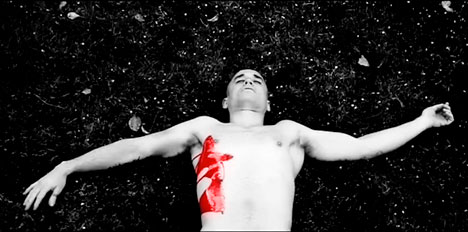
Picture is from Darren Doane’s Genesis Redux - Part 1.


September 5th, 2010 at 7:25 am
I’m not entirely sure why, but this particular post really said something to me. Maybe I just needed a good dose of typology–I’m going through a bit of a spiritual malaise/crisis and looking at the Bible’s artistry usually gets me excited.
September 5th, 2010 at 10:30 am
Very glad. I’ll be praying for you.