Apr
10
2009
In recaptulating Israel’s history, the seven letters in Revelation 2-3 confirm that the true Israel was transformed by the death and resurrection of Christ, progressing from Firstfruits through Pentecost to Trumpets. James Jordan writes:
“[Bible chronology] is a history of how the Divine Parent educated the core and centre of the human race, and then of how He called all nations to be grafted into that Olive Tree history so as to receive the benefit of it… The human race had matured to the point where it was fitting for Messiah to come, and come not only to save the race, but to bring the race to maturity… And then we can notice that the seven churches in Revelation 2-3 are each associated with a particular time in Old Covenant history. We can begin to apply the societal wisdom we have begun to learn from Israel’s history to address the particular problems and issues in our own churches. Is your church most like Pergamum? Well, that’s the wilderness church. Perhaps your church is made up of people who need to be addressed in a Law-oriented fashion. If your church is like Thyatira, maybe a strong dose of Psalms. If like Sardis, you need Jeremiah. And so forth.”
http://www.biblicalhorizons.com/biblical-horizons/no-195-how-to-do-reformed-theology-nowadays-part-4/
Comments Off | tags: Bible Chronology, Bible history, Feasts, James Jordan, Psalms, Revelation | posted in Biblical Theology, Totus Christus
Apr
10
2009
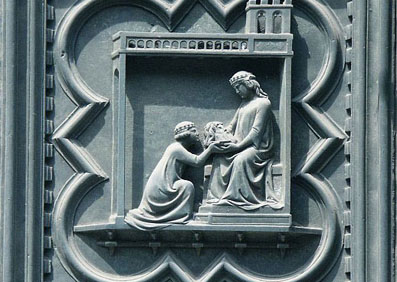
Peter Leithart observes that both Esther and Herodias’ daughter are promised up to “half the kingdom.”
There are echoes in the story of the book of Esther, at least in Mark’s version of John’s execution. Matthew tells us that when the daughter of Herodias danced before Herod, he promised with an oath to give whatever she asked. Mark records Herod’s words somewhat differently: He promises not just to give what she asks, but promises to give up to half his kingdom (Mark 6:22-23). This is the same promise that Ahasuerus gives to Esther when she says she has a request for him (5:3, 6).
In both passages, we have a woman, a queen, requesting something from a king. In both stories, we have a king promising half his kingdom. We could even say that both Esther and Herodias are asking for someone’s head. Esther knows that Haman is plotting to kill all the Jews, and she is asking for his life in order to protect the Jews.
But there the similarities end. Esther appeals to the king to save the faithful in Israel, while the daughter of Herodias is instructed instead to ask for the head of a faithful man, albeit a troubler of Herod’s kingdom, a prophet who has made life difficult for Herod because of his faithfulness. Instead of being like the protective Ahasuerus in Esther, Herod is more like Haman, seeking to wipe out the true Israel.
http://www.leithart.com/2008/06/21/herodias-and-esther/
Esther, like Deborah, and Jael, typifies Mary, the warrior bride whose offspring would crush the head of the serpent. A Nazirite growing his hair during a ‘holy war’ vow identified him with submission and purity. John uses Nazirite symbols to describe the bad Nazirites, the Judaising “locusts” troubling the church.
“And they had hair as the hair of women, and their teeth were as the teeth of lions.” Revelation 9:8 (and Joel 1:6)
They were negative-Nazirites, men who had taken vows to destroy the apostles (Acts 21:23). With the charm (and hair) of an army of Absaloms, their holy war was stamping out the Son of David. They were the false warrior bride, Herodias, seeking the head of the true Nazirite, Christ, in revenge for the victory over Goliath at the cross. This Herodias-Jezebel-Babylon of superseded Judaism would wipe out the true Israel at any cost.
Comments Off | tags: Babylon, Esther, goliath, Herodias, Jezebel, Nazirite, Peter Leithart | posted in Biblical Theology
Apr
10
2009
“A river of fire was flowing and coming forth from before him…”
Daniel 7:10
This aspect of the vision points us back to Jacob’s ladder, which had angels ascending and descending upon it (Genesis 28:12). These are angels who bear the flaming sword of Genesis 3, which bars mankind from paradise, but which also mediates between God and mankind when it comes down from His throne to light the fire on His earthly altar (Leviticus 9:24; 2 Chronicles 7:1). Fulfilling the prophecy, it is the fire that came down from Jesus on the day of Pentecost to light the fire on His new altar-people (Acts 2), which is pictured again in Revelation 8:3-5.
James B. Jordan, The Handwriting on the Wall, p. 392.
Available from www.americanvision.org
Comments Off | tags: Daniel, James Jordan | posted in Biblical Theology, Quotes
Apr
10
2009

Jesus said to him, “No one, having put his hand to the plow, and looking back, is fit for the kingdom of God.” (Luke 9:62)
In Hebrews 10, the writer (most likely Paul) tells the Jewish Christians that if they turn back from following Christ they will be destroyed. Instead of offering a lame explanation to prove this passage doesn’t contradict the New Testament teaching that believers can’t lose their salvation, we should understand where the original audience was in history. If we do that, we find no explanation is necessary.
Continue reading
Comments Off | tags: AD70, Hebrews, Lot, Revelation, Sodom | posted in Biblical Theology, The Last Days
Apr
10
2009
The content of this post has been revised and included in Bible Matrix II: The Covenant Key.
Comments Off | tags: Martyrdom, Moses, Priesthood, Resurrection | posted in Biblical Theology, The Last Days, Totus Christus
Apr
10
2009
Revelation can become a mere distraction. Charles Spurgeon wrote about prophecy buffs:
“He is great upon the ten toes of the beast, the four faces of the cherubim, the mystical meaning of badgers’ skins, and the typical bearings of the staves of the ark, and the windows of Solomon’s temple: but the sins of business men, the temptations of the times, and the needs of the age, he scarcely ever touches upon. Such preaching reminds me of a lion engaged in mouse-hunting, or a man-of-war cruising after a lost water-butt.”*
That’s a fair comment if study of symbols becomes an end in itself, but they were intended to convey crucial information. Surely the symbolic passages have more authority than our own anecdotes when trying to communicate abstract truth? There is nothing in Revelation that isn’t also elsewhere in the New Testament. It was not intended to be an isolated book, and the better it is understood, the more powerfully it can be incorporated into our teaching and preaching.
*Charles Spurgeon, Lectures to My Students, p. 76.
Comments Off | tags: Apocalyptic, Revelation, Spurgeon, Typology | posted in Biblical Theology, Quotes
Apr
10
2009

“And he carried me away in the Spirit into a wilderness, and I saw a woman sitting on a scarlet beast that was full of blasphemous names, and it had seven heads and ten horns.
The woman was arrayed in purple and scarlet, and adorned with gold and jewels and pearls, holding in her hand a golden cup full of abominations and the impurities of her sexual immorality. And on her forehead was written a name of mystery: “Babylon the great, mother of prostitutes and of the Land’s abominations.” (from Revelation 17)
The woman’s riches and robe are described after her “bestial relations.” She made her priestly office into a counterfeit kingdom. She thought she was rich, but was in fact poor, blind and naked.
Continue reading
Comments Off | tags: James Jordan, Jezebel, Revelation, Satan | posted in Biblical Theology, The Last Days, Totus Christus
Apr
10
2009
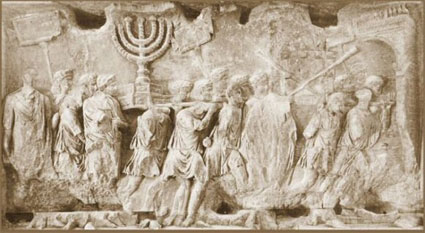
“…repent, and do the works you did at first. If not, I will come to you and remove your lampstand from its place, unless you repent.” (Revelation 2:5)
The Lampstand was the seven eyes of God, the flaming tongues of the Law given at Pentecost. Either we are judges or we are judged. An eye for an eye. Adam failed to judge rightly and Satan became the accuser, thieving Adam’s throne at the right hand of God.
Christ promises a future inspection. As prime mover, He sets things in motion then returns to measure Adam’s work on the next Lord’s day. Then we receive plunder, or He plunders us “like a thief.” If, like Adam/Solomon, we steal from Jesus, He will steal from us like Satan/Nebuchadnezzar (Matthew 13:12).
The warnings to the seven churches prefigure the greater judgments that follow in Revelation – upon the eighth church, Judaism. Jesus did come and remove the Lampstand. He came as Titus.
…”and the light of a lamp will shine in you no more…”
Comments Off | tags: Lampstand, Nebuchadnezzar, Revelation | posted in Biblical Theology, Christian Life
Apr
10
2009

The refusal of modern scholars to take typology seriously to any great extent limits their ability to interpret the Bible. Some passages only make sense in the light of previous literary structures.
The Bible is a pop-up book in glorious 3D. But they maintain they can tell us all about it with one eye shut.
Comments Off | tags: Typology | posted in Biblical Theology
Apr
10
2009
“When they persecute you in one town, flee to the next, for truly, I say to you, you will not have gone through all the towns of Israel before the Son of Man comes.” (Matthew 10:23)
John baptized in the Jordan but the disciples would be baptized in the Spirit. This was their Jordan crossing into a new Land. Their task was to take it by force and wipe out the spiritual Canaanites with the sword—in this case, conversion or judgment. In Joshua’s time, Israel had failed to complete this. But Zechariah had predicted that by the end of this first century conquest, not one Canaanite would remain in the house of the Lord – the New Jerusalem.
Comments Off | tags: Joshua, Zechariah | posted in Biblical Theology, The Last Days