50 Failed Predictions? - #10

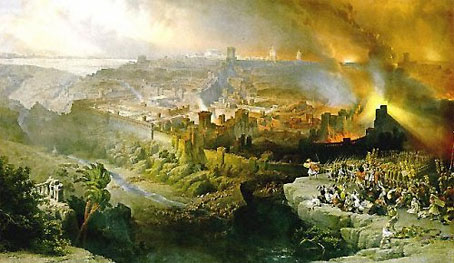
fallofjerusalem

Here’s the last installment of my answers to Brian Simmon’s 50 objections to a first century “coming in judgment” of Christ. You can find a link under Featured Articles that will list them all for you.

46. Abraham still hasn’t inherited the land God promised him (Gen. 13: 15; Acts 7: 5).

Joshua 21:43 “So the LORD gave to Israel all the land of which He had sworn to give to their fathers, and they took possession of it and dwelt in it.”

I don’t see the relevance of Acts 7:5. The Land was promised to his descendants.

47. Ezekiel’s Temple is still waiting to be built (Ezekiel 40-48).

As mentioned in earlier posts, Ezekiel’s Temple was a vision of the spiritual influence that synagogues throughout the Persian (and later) empires would have. This “temple of flesh” created the harvest that Jesus said was ready in the first century. It is the reason the angels were sent to the four winds of this “square” territory to gather the faithful at the end of the Old Covenant (Matthew 24:31; Mark 13:27). The four winds is a reference to the foundation of this Restoration worship in Ezekiel 37:9; Daniel 7:8; and Zechariah 2:6. The Lord had scattered Israel to the four winds, but once humbled, they were good seed. See Four Winds.

The meaning of Ezekiel’s temple is easier to interpret when we look at the structure of his book. Guess what? It follows the Dominion pattern. See Haman Hamstrung.

48. The Redeemer never came back to turn transgression from Jacob (Romans 11: 26-27; Isaiah 59: 20).

See yesterday’s post, Wandering Stars for how the Lord turned transgression from Jacob. He sifted first century Israel like wheat, just as He had done with the Hebrews in the wilderness. As discussed earlier, the Isaiah text actually refers to the Restoration era. Paul quotes it because the same “death and resurrection of Israel” pattern is happening again. See Jeremiah was a Bullfrog and How to Read the Prophets.

49. Sudden destruction did not overtake the children of darkness (1 Thess. 5: 2-8).

Herod finished gilding and garnishing his Temple, in defiance of the famous words of Christ: “Not one stone shall remain upon another.” It was celebrated with ostentatious Passovers and a revived persecution of Christians. The arrival of Rome was unexpected. Herod’s “victory” brought about his doom. His “ascension” was the catalyst for his fall. He should have read the wisdom of Solomon, and learned from the failures of Solomon.

Verse 1 of this chapter says, “Concerning the times and the seasons…” This particular Day of the Lord, just like the one Moses and Aaron brought to Egypt, was imminent. There is an obvious and undeniable sense of urgency in this chapter.

50. Those who kept the Lord’s sayings tasted of death (John 8: 52).

I think you should take this one up with Jesus. He was speaking figuratively—just as Ezekiel spoke about a human temple that was the precursor to the New Jerusalem “bride city.” This refusal to understand types and symbols is why Brian’s interpretation of eschatology removes most of Christ’s, the prophets’ and the apostles’ predictions from their historical context and throws them haphazardly into some future glory for a fulfilled and obsolete priesthood that was replaced two millennia ago.

50FPDZ


One Response to “50 Failed Predictions? - #10”

  • Drew Says:

    For that last one, I’ve heard that the Pharisees were actually misquoting Jesus. He wasn’t saying that people wouldn’t “taste death,” which would mean to physically die. He was saying that people wouldn’t “see death,” meaning that they would not continually envision the spectre of death hanging over them. And they wouldn’t see this death because they would have eternal life and would be living sanctified, abundant lives.

Leave a Reply