Apr 10 2009

The peskiest chapter in the Bible

The LORD will attack those nations like a warrior fighting in battle. He will take his stand on the Mount of Olives east of Jerusalem, and the mountain will split in half, forming a wide valley that runs from east to west. Then you people will escape from the LORD’s mountain, through this valley, which reaches to Azal.” (Zechariah 14:3-5)

diSpENSATIONALISTS love to quote verses from Zechariah and apply them to modern Jews. While this breaks all the rules of interpretation (context, first audience, book structure, common sense, etc.), those who realise its events were all fulfilled, culminating in the first century, still have a lot of trouble with the details. But the answers lie in Old Testament typology.

Not only does the entire book of Zechariah follow the ‘Egypt to Canaan’ pattern, each of the ‘post-vision’ chapters does so individually. There is too much detail to go into here, but I want to deal with the splitting mountain.

The Ark was the Lord’s footstool. It, along with both the incense and bronze altars, had to be purified with blood. The Lord will only stand in a clean place, and indeed even required His priests to have clean feet. As a square altar, Canaan was purified with blood by Abraham. It was purified with blood again under Joshua in the ‘devotion’ of Jericho. Immediately after this victory, the people were divided between Mounts Ebal and Gerizim, one for the blessings of the Law and one for curses (Joshua 8). Blood, and a split mountain, made a way into the new Land.

Here’s where the structure of the passage is important. It follows the feasts pattern (Lev 23) and this section appears at Atonement (Covering). One goat was blessed and ascended to God; the other carried the curses to destruction (ez azal). As the Lord’s footstool, the Mount of Olives was divided to the north and the south, just like the Temple veil was torn in two. With Christ’s death as Passover, Olivet became symbolically like Mount Gerizim and Mount Ebal at the birth of a new Promised Land, the heavenly Canaan, the New Jerusalem.

The mountain was split from the east to the west. The faithful would enter from the east, the opposite direction to Adam’s expulsion. The death and resurrection of Christ tore the Garden door open, and there were earthquakes. The death of the first century church under Herod/Rome also tore the Land in two. Old Israel became the garment of the old High Priest, torn under the Covenant curse (Matthew 26:65) to be eaten by birds and beasts.

Revelation also uses the symbolism of two mountains. One was a flaming Sinai, thrown into the Gentile sea as Jesus promised (curses – Matthew 21:21). The other was a new, heavenly Zion – the one mentioned by the writer of Hebrews (blessings – Hebrews 12:18). The saints prayed as Jesus commanded and Judaism and Christianity were split in two when Christ came in vengeance in AD70. Judaism went to Azal.

When God is making something new, He begins by tearing something in two. If it happens to be you, the something new might not be you. This is something Adam knew.

(Zechariah’s visions showed two bronze mountains allowing the Restoration era ‘gospel’ to go out into the world after the rebuilding of the Temple in 6:1. The events of Zechariah’s day prefigured the restoration of Israel in the Christian church.)

Share Button

Apr 10 2009

God indivisible?

While we are thinking about how God tears things in two to create something new (as He did on the first three days of Creation), here’s another thought on Zechariah 14′s valley.

We know Jesus was temporarily “torn in two” under the curses of the Covenant, His flesh being the veil (Hebrews 10:20). But what about the relationship between the Father and the Son? They are eternally united by the Spirit, who throughout the Bible is the ‘matchmaker’ who also assembles and brings the bride to the Son. At His crucifixion, Christ was separated from the Father by the deep – the Abyss – to send sin to destruction and allow the bride into His relationship by the Spirit with the Father. God Himself became two mountains, Ebal and Gerizim.

By allowing Himself to be divided, the indivisible God has made something new. Now the Son will reign until all His enemies are His footstool.

What a God.

Share Button

Apr 10 2009

The Last Hour

Gregory Beale examined the Old Testament background of John’s claim that “this is the last hour,” tracing it mostly back to Daniel 8-12, the only place where he could locate a combination of “last” and “hour.” He claimed that John was talking about the eschatological trial that was inaugurated in his day, but one that continued through the whole church age.

It seems better to me to see it as the eschatological trial of the first century. John is (as Beale recognised) drawing on the Olivet Discourse, but there the coming of false Christs and false prophets is a sign of the end of the age, and of the destruction of the temple. The tribulation that Jesus talks about is the tribulation of the birth pangs of the new covenant. John is talking about the same event, only telling his readers that the timetable is almost completed.

Peter J. Leithart, 1 John: Last Hour, www.leithart.com

Share Button

Apr 10 2009

Talking Animals

artstamp

“I could never believe a book that starts with a talking snake!”

The fourth beast was stronger and more terrifying than the others. Its huge teeth were made of iron, and what it didn’t grind with its teeth, it smashed with its feet. It was different from the others, and it had horns on its head – ten of them. Just as I was thinking about these horns, a smaller horn appeared, and three of the other horns were pulled up by the roots to make room for it. This horn had the eyes of a human and a mouth that spoke with great pride. Daniel 7:7-8

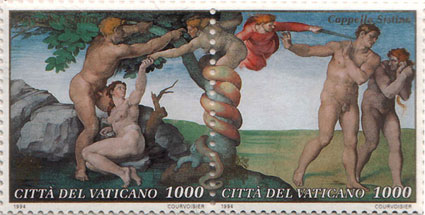
The Bible begins with Adam, Eve and a serpent in the garden, and ends with a false prophet (Adam), harlot (Eve) and beast (serpent) squatting in God’s house. The seed of man’s rebellion was now a fullgrown tree – a tree of death (James 1:14-15).

Animals are the tutors in the Old Testament. Man was created in God’s image, but instead imaged a beast. Adam was covered in animal skins and their blood temporarily covered his sin. The law was administered by angels, and the symbols God uses are mostly animals. As mentioned in a previous post, the three major covenants were symbolised by an ox, a lion and an eagle. The New Covenant symbol is the Man who is bread and wine. The New Covenant era is administered not by angels but by men, Christians.

But as this New Covenant era arrived, so did a false man: a being who had the eyes and mouth of a man but was really a man-mask for the Roman beast. Revelation refers to Jews as ‘men’ because, like Noah, they were the mediators. The gentiles are the ‘beasts’ who are called to submit and enter the ark of Christ (Acts 10:11-12).

As Israel’s history completed Day 6 (the Land animals and the Man predicted in Daniel 7), this false man, a beast who spoke like a man, was squatting in God’s garden. The Herodian line was a talking snake.

You can trust the Bible. There is always method in any apparent madness. God doesn’t do or allow anything without a reason.

(Balaam the false prophet was also a ‘talking snake.’ He was blind to God’s word, so God used a talking donkey to get through to him.)

Share Button

Apr 10 2009

The Three Shepherds – 2

James B. Jordan, following the God-given office of Cyrus as shepherd over Israel (Isaiah 44:28), interprets Zechariah 11 as a prediction of events under Greek rule, rather than Roman:

“The wicked Hashmoneans took over the Temple for themselves, and did not give glory to God and restore the true High Priest. The Hashmoneans “buy” the Temple for thirty pieces of silver, but Yahweh rejects their offer, which treats Him and His people as slaves. These evils result in the Jews being broken apart and set at each other’s throats.”1

Either way, the pattern is the same, as the Jews’ apostasy under Greek rule was repeated under Rome, with the “Temple” they sold in the second instance being Christ Himself. Both “Greek” and “Roman” interpretations link the events of chapter 10 to chapter 12, and echo the judgments upon false shepherds by the pre-exile prophets. And in both cases, it is the “Temple” seen by Ezekiel that is being judged. The flock is divided and the Temple made desolate under Antiochus Epiphanes (Greece), and under Christ and Titus (Rome).

The most important factor is that in both events, the Jews’ compromise left them without a true High Priest, and thus no true Atonement.

_______________

See James B. Jordan, The Handwriting on the Wall, p. 585-587.

Share Button

Apr 10 2009

Un-Passover

The Bible contains some patterns that are frequently repeated. Sometimes these are inverted or reversed to make a point.

An example would be the seven feasts listed in Leviticus 23 which provide a common literary structure. Revelation 1-11 follows this heptamerous pattern, with Jesus’ ascension in 4-5 as Firstfruits. Revelation 12-19 also follows this pattern, with the rise of the false prophet and harlot as an ironic counterfeit of Firstfruits.

In Revelation 16, in the second major cycle, the “Ascension” section concerns the fall of Babylon and its internal structure is upside down to make the point. Reaching the end of this second cycle, the “Atonement” section is even more tricksy. Because the seven feasts are chiastic (symmetrical) with Pentecost at the centre (actually the scorching fire of un-Pentecost), Passover (Red Sea) and Atonement (Jordan) correspond (feast 2 and feast 6). So even though the seven bowls deconstruct the Old Covenant feasts – running through their order backwards – the “un-Passover” of bowl 6 is actually the “Atonement” Joshua-conquest of the church, the new Israel. So this bowls section is a subtle see-saw, working from 7 down to 1 for the Old Covenant, and from 1 to 7 for the New. This becomes apparent at bowl 6, when, at Un-Passover, (the new church’s day of covering) old Israel is exposed, uncovered, before God.

Amazing.

Share Button

Apr 10 2009

Gate Rape – 1

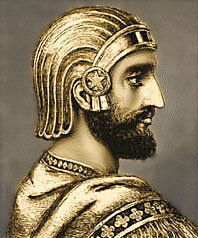
cyrusthegreatFor the ancient world, a garden, a house, a city or a temple was like a woman. An invading army, after storming through the gates of a city, would rape the virgins. It was a brutal reminder that, like the women, the conquered city was not impregnable.

“In order to understand this, we have to think like ancient Hebrews, and not like modern people… Adam was supposed to guard the garden, and he was also supposed to guard his wife.

The Song of Solomon compares the woman to a garden several times in the course of the book. In all languages, the words for city, garden, and the like are feminine, and we speak of a city as “she” in English today.

Let us take a look at the city in the Bible, remembering that what is said of the city is also true of the house, tent, Temple, Tabernacle, and other enclosed homes for humanity. The city has walls and gates. The purpose of these walls and gates is to keep the enemy out. The goal is that the city be impregnable, and note that English word – it directly connects the city with the woman. Thus, the city has to be a virgin, sealed against attack. Jerusalem is referred to as an impregnable virgin repeatedly in Scripture (2 Kings 19:21; Is. 37:22; Jer. 14:17; 18:13; Jer. 31:21; Amos 5:2). The attack on Jerusalem is thus the rape of a city (Lam. 1:15; 2:13)… Just as Eve was “built” from Adam (using an architectural term, Gen. 2:22), so Jerusalem would be rebuilt as a virgin (Jer. 31:4)… Thus, the safety and security of the virgin daughters of Israel was a symbol of the safety and security of the whole land. Their inviolability corresponded to the inviolability of the whole culture (Lam. 1:4; 2:10).”

In the case of Babylon, its walls and gates were impregnable. The city was built on the Euphrates river, which ebbed into the city under the wall. Even the banks of the river were protected by metal gates from any invaders who could hold their breath long enough. Under Belshazzar, Babylon lost her virginity (Isaiah 47:1-3), and during the feast her river gates had been left open.

In a brilliant military manoeuvre, Cyrus the Great gave the signal for his troops upstream to divert the river. The invading army marched into the city dryshod and took it with little resistance.  There were hints of this in the prophecies of both Isaiah (44:27) and Jeremiah (50:38, 51:36). The waters of the bringer of the “flood” were dried up. The Land was rising from the deep.
___________________
James B. Jordan (concerning the virginity of Jephthah’s daughter), Judges: God’s War Against Humanism, p. 211-212. Download from www.biblicalhorizons.com

Share Button

Apr 10 2009

Gate Rape – 2

“Then the sixth angel blew his trumpet, and I heard a voice from the four horns of the golden altar before God, saying to the sixth angel who had the trumpet, “Release the four angels who are bound at the great river Euphrates.” Revelation 9:13-14

To purify the Land of the sins of the nation or the High Priest, the horns of the Incense Altar were smeared with blood from the sacrifice at the bronze Altar. These four angelic commanders, who were previously held back, were horns looking for blood.*

The fifth trumpet, alluding to Joel 2, had summoned clouds of Babylonian locusts (Judaisers) with hair like women (false Nazirites) from Herod’s false altar to devour the Land. Like those in Joel, these are ‘mighty men,’ the result of the compromise of the sons of God with idolatry (Genesis 6).

Now, the sixth trumpet brought a response from the true Altar of Incense—an unimaginable cloud of true Nazirites. The position of this event in the structure of the passage alludes to Joshua’s conquest of Canaan. But as a ‘Trumpet’, this was only a warning. The sixth bowl would bring the final conquest: Armageddon.

The sixth angel poured out his bowl on the great river Euphrates, and its water was dried up, to prepare the way for the kings from the sunrise.

Like the Jews returning from Babylon, and Abraham when he first entered Canaan, they crossed the great river Euphrates in their baptism into Christ. Just as Cyrus “parted” the Great River to conquer Babylon, the river of death was parted to allow the true saints to inherit the heavenly country. Old Jerusalem became Jericho – the city devoted to destruction.

This was an army of true Nazirites who had not broken their vow:

These are the ones who were not defiled with women, for they are virgins. These are the ones who follow the Lamb wherever He goes. These were redeemed from among men, being firstfruits to God and to the Lamb. (Revelation 14:4)

Instead of storming the open gates and raping the virgins, here an army of “virgins” crossed the Euphrates, stormed into Babylon and purified the daughters of men culture around them.

(*This refers to the Hebrew for corners and commanders being the same word.)

Share Button

Apr 10 2009

Gate Rape – 3

Why were Jerusalem’s “gates” left open to the enemy? Josephus records miraculous warning signs during the period of Revelation’s Trumpets. Once again, the death angel stood at the threshing floor holding a sword over the city for the king’s “numbering” of the saints:

“Thus were the miserable people persuaded by these deceivers, and such as belied God himself; while they did not attend nor give credit to the signs that were so evident, and did so plainly foretell their future desolation, but, like men infatuated, without either eyes to see or minds to consider, did not regard the denunciations that God made to them.

Thus there was a star resembling a sword, which stood over the city, and a comet, that continued a whole year. Thus also before the Jews’ rebellion, and before those commotions which preceded the war, when the people were come in great crowds to the feast of unleavened bread, on the eighth day of the month Xanthicus, [Nisan,] and at the ninth hour of the night, so great a light shone round the altar and the holy house, that it appeared to be bright day time; which lasted for half an hour. This light seemed to be a good sign to the unskillful, but was so interpreted by the sacred scribes, as to portend those events that followed immediately upon it…

“Moreover, the eastern gate of the inner [court of the] temple, which was of brass, and vastly heavy, and had been with difficulty shut by twenty men, and rested upon a basis armed with iron, and had bolts fastened very deep into the firm floor, which was there made of one entire stone, was seen to be opened of its own accord about the sixth hour of the night. Now those that kept watch in the temple came hereupon running to the captain of the temple, and told him of it; who then came up thither, and not without great difficulty was able to shut the gate again. This also appeared to the vulgar to be a very happy prodigy, as if God did thereby open them the gate of happiness. But the men of learning understood it, that the security of their holy house was dissolved of its own accord, and that the gate was opened for the advantage of their enemies. So these publicly declared that the signal foreshowed the desolation that was coming upon them.”

“Besides these, a few days after that feast, on the one and twentieth day of the month Artemisius, [Jyar,] a certain prodigious and incredible phenomenon appeared: I suppose the account of it would seem to be a fable, were it not related by those that saw it, and were not the events that followed it of so considerable a nature as to deserve such signals; for, before sun-setting, chariots and troops of soldiers in their armour were seen running about among the clouds, and surrounding of cities. Moreover, at that feast which we call Pentecost, as the priests were going by night into the inner [court of the temple], as their custom was, to perform their sacred ministrations, they said that, in the first place, they felt a quaking, and heard a great noise, and after that they heard a sound as of a great multitude, saying, “Let us remove hence.”*

*Flavius Josephus, The Wars of the Jews, (vi:v:3), quoted from David Chilton’s compilation in Paradise Restored, A Biblical Theology of Dominion. The chariots in the clouds were also reported by the Roman historian Tacitus: “In the sky appeared a vision of armies in conflict, of glittering armour. A sudden lightning flash from the clouds lit up the Temple. The doors of the holy place abruptly opened, a superhuman voice was heard to declare that the gods were leaving it, and in the same instant came the rushing tumult of their departure.” (Tacitus, The Histories,translated by Kenneth Wellesley).

Share Button

Apr 10 2009

Reading Revelation through frosted glass

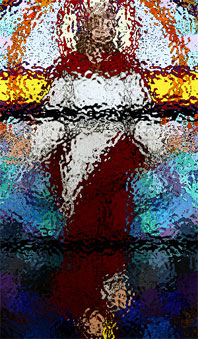
frostedjesusThere are many books on Revelation that draw out some excellent applications. But when it comes to interpreting the finer details, they fluff it.

They are reading Revelation through frosted glass. General shapes can be made out – the “universals” – but their audience ends up with a showbag full of ideology, a religion set adrift from the shore of reality, a Jesus whose feet never quite touch the ground. The Bible speaks in symbols, not ideology, and the symbols are anchored in reality. Joseph and Daniel are historical figures, but they are also symbols.

Joseph and Daniel interpreted the dreams of their kings. Then, as wise men, with the king’s seal of authority, they brought their prophecies about in history. Jesus opened the mystery of the New Covenant at His ascension (the seven-sealed scroll). Then, He measured out its consequences in history.

This is no mere ideology—no fluffy generic truth. It happened in the first century – the seals, the trumpets and the bowls.

No more reading Revelation through frosted glass. Interpretation first, then application.

Share Button