Apr 10 2009

Con or seg. There’s nothing in between

“…Regarding Cephas’ segregation from Gentile believers, Paul says that this is not walking according to the truth of the gospel. That means either separation or gospel, but it can’t be both; (2) In Rom. 3.28-29, Paul says that we reckon that a man is justified by faith without works of law, and he asks in return, “or is God the God of the Jews only?” Notice “or”! In other words, justification by faith and ethnocentrism are mutual exclusives.

Now let me ask, can a person believe in racial segregation and believe in the gospel and justification at the same time? I will say “no”. Now let me say that it is not that such a person has failed to grasp an “implication” of the gospel or of justification. The language is much stronger than that in the NT. Such a stance is a perversion of the gospel and a competing alternative to justification. A person can believe in the gospel partially and grasp justification fallibly. But a person who believes in racial segregation or cultural hegemony does not believe in the true gospel and does not grasp the true meaning of justification.

I will never forget Mark Seifrid telling me that 11.00 a.m. on Sunday morning is the most segregated hour of the week in America. Now let me ask, is there a reason why some of the most rancorous and acidic critiques of the New Perspective derive from certain leaders in certain Southern denominations in the USA? Is it because they are happy to use justification as a stick to bash Catholics for works-righteousness, but object when that same stick is used to bash them for driving for 40 minutes across town to attend a white middle-class church when a perfectly good evangelical black church is 5 minutes around the corner?…”

Michael F. Bird, http://euangelizomai.blogspot.com/2009/01/justification-and-race.html

Share Button

Apr 10 2009

Thief in the Night

archoftitus

“…repent, and do the works you did at first. If not, I will come to you and remove your lampstand from its place, unless you repent.” (Revelation 2:5)

The Lampstand was the seven eyes of God, the flaming tongues of the Law given at Pentecost. Either we are judges or we are judged. An eye for an eye. Adam failed to judge rightly and Satan became the accuser, thieving Adam’s throne at the right hand of God.

Christ promises a future inspection. As prime mover, He sets things in motion then returns to measure Adam’s work on the next Lord’s day. Then we receive plunder, or He plunders us “like a thief.” If, like Adam/Solomon, we steal from Jesus, He will steal from us like Satan/Nebuchadnezzar (Matthew 13:12).

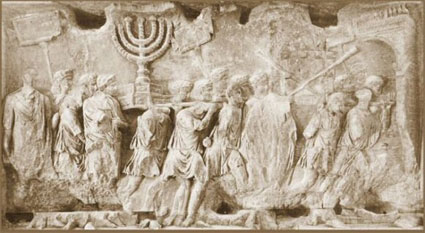
The warnings to the seven churches prefigure the greater judgments that follow in Revelation – upon the eighth church, Judaism. Jesus did come and remove the Lampstand. He came as Titus.

…”and the light of a lamp will shine in you no more…”

Share Button

Apr 10 2009

Assurance

“Nothing makes assurance so sure as knowing that God gets honour by accepting a sinner.”
– Andrew Bonar

Share Button

Apr 10 2009

Human Wrecking Ball

It’s time to reacquaint ourselves with Christ the man. Read your Bible. He’s there! Think of His physical power – a carpenter who worked long days with physical tools. He had “the voice and manner of a leader – the personal magnetism that begets loyalty and commands respect.” Christ plows through the gospels like a wrecking ball, smashing tables, driving people with a whip, devastating the Pharisees with a word, taming the winds with an uplifted hand, toppling a detachment of armed soldiers simply by speaking His name. He never cajoles; He commands! Christ is powerful, dangerous and unpredictable. Teachers, present Christ the man. Men will follow.

David Murrow, Why Men Hate Going to Church, p. 183


Share Button

Apr 10 2009

War Chants

Problems with Church History Studies

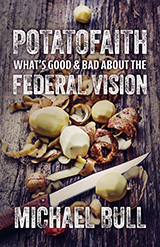
One striking aspect of the recent “Federal Vision” conflict in the various conservative micro-Reformed groups is a debate over what older theologiansreally meant and said. Examining the credentials of various people who speak with great assurance on these matters one sees repeatedly degrees in church/theology history studies. In fact, in Reformed circles, it seems that about the only advanced degrees offered are in historical studies.

I should like to offer what I regard as a considerable caveat. I do not believe that men who sing pop choruses or plodding Trinity Hymnal songs on Sunday can get very far into Luther or Calvin, or for that matter Turretin. Men whose personal opinion is that society can be left to the devil cannot really get into the outlook of the Reformers.

I submit that it is important to have some feel for what people were singing and how they were singing it at various times in history. Is it a coincidence that “Reformed scholasticism” began to develop at the same time that the fiery dance-like chorales and psalms of the Reformation began to die down into slow, plodding, even-note mush? It is a coincidence that the “Puritans” had problems with assurance of salvation, given their destruction of enthusiastic singing? I don’t think so. People who sing the psalms as real war chants, as war dances that precede battle, don’t have problems with assurance and don’t have time for scholasticism. Neither do people with strong, fully-sung liturgies.

Obviously, much can be understood by reading the writings left by various historical personages. But without understanding the songs they sang, from the inside, we will not have the Spirit that they had, and our understanding will be incomplete and flawed.

James B. Jordan, http://biblicalhorizons.wordpress.com

Share Button

Apr 10 2009

Smooth Words, Hard Hearts

We think that it is good simply for a man to love, for example, forgetting that it depends entirely upon what he loves. After all, John told us to love not the world, or the things in it. We believe it is a sin to hate, forgetting that this depends upon whatwe hate. But is the hatred according to the Word or not? We think that it is a virtue to tolerate, forgetting that the Lord Jesus rebuked a church for tolerating that woman Jezebel. Everything hinges on what we are tolerating, and our global love for smooth words indicates that what we are mostly tolerating is our own hardness of heart.

Douglas Wilson www.dougwils.com

Share Button

Apr 10 2009

I don’t know why you’re clapping. I’m talking about you.

“It is impossible, Brother Paul, to have an encounter with something as large as a logging truck and not be changed.”

“I’m not troubled in my heart about your self-esteem. I’m not troubled in my heart about whether or not you feel good about yourself, whether or not life is turning out like you want it to turn out, or whether or not your checkbook is balanced. There’s only one thing that gave me a sleepless night. There’s only one thing that troubled me all throughout the morning, and that is this. Within a hundred years, a great majority of people in this building will possibly be in hell. And many who even profess Jesus Christ as Lord will spend an eternity in hell.

Continue reading

Share Button

Apr 10 2009

Getting A Beautiful Mind

How an Oscar Winning Film Provides an Unforgettable Picture of Sin
“The Diet” | Column by Richard Wagner | www.digitalwalk.net

Sin is crouching at your door. It desires to have you, but you must master it. —Genesis 4:7

…If you’ve ever fought a bout of food poisoning, you know that there’s not much worse until your body has gotten the poison out of its system. Tainted food may look enticing, but once inside, it begins to invade, inhabit, and revolt against you. Sin enters your life much in the same way. It comes wrapped inside of an appealing package, but what lurks underneath is an enemy that aims to overpower every aspect of your life. And while most cases of food poisoning go away on their own in a day, sin never gives up – that is, unless you actively do something to get rid of it.

The nasty effects of sin and temptation can leave you searching for answers. In a most unexpected way, the Oscar-winning A Beautiful Mind offers a vivid picture for how to deal with sin in your life, reinforcing what the Bible teaches about the poisonous stuff.

A Beautiful Mind tells the true life story of John Nash, a math genius who could solve problems that baffled even the greatest thinkers of his day. While in graduate school at Princeton, he makes an amazing discovery that propels him to much fame in the late 1940s. However, behind the scenes, Nash is a desperate man, plagued by schizophrenia that leaves him unable to separate fantasy from reality. Unknown to him consciously, his troubled mind produces imaginary people that become an intimate part of his life. It is only through the selfless love shown by his wife, Alicia, that Nash is eventually able to overcome his battles and, late in life, receive the Nobel Prize.

While A Beautiful Mind is gripping and inspiring drama, the film, quite unintentionally, offers something more for Christians. Watch the film with an eye on his delusions and think of them as representing sin and temptation. If you do so, the story of John Nash paints an unforgettable picture of sin’s damaging effects and the way to successfully conquer temptation in your Christian walk.

Ground Zero

The Bible is says flat out that Satan is going to lose in the end. But, until the day that you can exclaim “hasta la vista”, the master tempter is going to identify and target your weak spots. In particular, he’s going to locate an area of your life in which you have an unmet desire and then offer a cheap imitation as a substitute to fill that hole.

A Beautiful Mind illustrates how this kind of bait-and-switch routine is pulled off inside of a person’s mind. In spite of his arrogance and brilliance, Nash is needy. Very needy. His schizophrenic mind dreams up three make-believe people to fill in these missing pieces of his life.

Continue reading

Share Button

Apr 8 2009

How to live the Christian life

The Eternal Son came to earth and lived the Christian life . . . visibly. But pause for a moment. The Eternal Son is the second member of the Godhead (the Father, the Son, the Holy Spirit). Did it ever occur to you that your Lord . . . the Lord Jesus Christ . . . stated publicly that he could not live the Christian life? Of himself, he could not live the Christian life (John 5:30). Isn’t that amazing! (So, if you’re having a hard time, just consider John 5:30.) Now let us inquire of him, “How did you live the Christian life?”

Was the mainstay of his Christian life prayer and Bible study? He did pray, but was prayer the central pillar of his secret to living the Christian life? That just does not seem to fit, does it? The Son depending on prayer and Bible study to make it through the day?

Continue reading

Share Button