May
21
2013

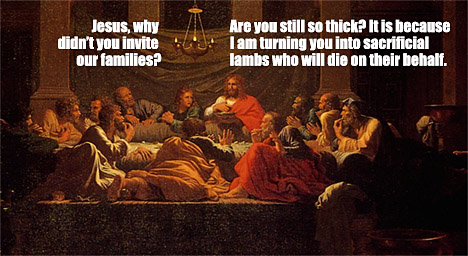
“Matthew understands Jesus to be the rightful heir of the chieftaincy who instead volunteers to become the Victim at the tribe’s feast. But by being the voluntary victim, he becomes the first victim in the world who can speak.”
An excerpt from Eugen Rosenstock-Huessy’s “Fruit of Lips”:
“…as oral as Peter the fisherman must have been and as much as he probably detested ink, Matthew certainly was familiar with paper work and written records, only too well. Since we do not expect him to be employed inside his old activities, where he had used writing for superficial purposes to say the least, we may expect him to fight elsewhere…”
Continue reading

no comments | tags: Communion, Eugen Rosenstock-Huessy, Gospels, Matthew, Sacraments | posted in Biblical Theology, Ethics, Quotes
May
18
2013
or A Ripsnorter Ritual
Ritual is powerful stuff. Much of modern evangelicalism prides itself in rejecting liturgy and being “open to the Spirit,” and then turns this “openness” into an uninspired (and very uninspiring) human formula, in place of the inspired Divine one. Instead of following a pattern found in every part of the Bible (worship is literary architecture), we are stuck with either erroneous traditions or off-the-cuff rambles which, although “open to inspiration,” somehow sound exactly the same each week. Human beings love repetition in every area of life, and ritual is a prime method of teaching truth and holiness.
Continue reading

5 comments | tags: Baptism, Liturgy, Peter Leithart, Revelation, Tabernacle, Temple | posted in Biblical Theology, Quotes
May
15
2013

“He said to him, ‘Bring me a heifer three years old, a female goat three years old, a ram three years old, a turtledove, and a young pigeon.’ And he brought him all these, cut them in half, and laid each half over against the other. But he did not cut the birds in half. And when birds of prey came down on the carcasses, Abram drove them away.” (Genesis 15:9-11)
When Abram asked for a sign concerning the Lord’s promise concerning an heir, the Lord carried it out with animals slain and displayed upon the Land. In the Covenant-literary structure of Genesis 15, the animals were slain and laid out at “Pass-over,” and the Lord’s chariot (as a Head and Body) “passed-through” at Atonement, (matching Pass-over” chiastically) picturing Joshua and Israel entering Canaan. (See Pass-over and Pass-through, and compare the charts on pages 93 and 115 of Bible Matrix.)
What is also interesting is the “architecture” of the sacrifice. We do not know which animals were considered “clean” by the Lord in Noah’s time, but the number of sacrificial animals was now limited to five. They correspond to the architecture of the Tabernacle. If we include Abram in his deep sleep (as a “covering”) and the birds of prey representing the curse of the Law, in the following diagram we have the complete “footprint” of the humaniform house made entirely out of birds and beasts.
Continue reading

no comments | tags: Abraham, Circumcision, Genesis, Literary Structure, Tabernacle | posted in Bible Matrix, Biblical Theology
May
13
2013
The letters to the pastors of the seven churches in Asia are a prophecy of the history of the Church, according to dispensationalist Bible teachers. For interpreters who are committed to a “literal” hermeneutic, this is bending the rules in the direction of a “literary” hermeneutic, which is excellent. However, they apply the letters to the wrong future, and overlook the obvious allusions to the past.
Continue reading

2 comments | tags: Dispensationalism, Lampstand, Literary Structure, Revelation | posted in Bible Matrix, Biblical Theology, The Last Days
May
11
2013

What is the referent of “body of Christ” in 1 Corinthians 11:29?
“For anyone who eats and drinks without discerning the body eats and drinks judgment on himself.”
Continue reading

no comments | tags: Baptism, Communion, Corinthians, Covenant curse, Covenant Theology, Doug Wilson, Literary Structure, Melchizedek, Numbers 5 | posted in Bible Matrix, Biblical Theology, Christian Life, Q&A
May
9
2013
The first verses of 2 Thessalonians 2 have been an unnecessary battle ground. The Day of the Lord would not come until after the Man of Sin had been revealed. This reasoning seems obvious to Paul. It should be obvious to us if we know the early chapters of Genesis and their corporate expression in Israel’s festal calendar.
Continue reading

no comments | tags: AD70, Covenant Theology, Feasts, Firstfruits, Genesis | posted in Bible Matrix, Biblical Theology, The Last Days
Apr
23
2013
James Jordan’s must-have Revelation lecture series

What Is Revelation Really About?
Continue reading

no comments | tags: James Jordan, Revelation | posted in Biblical Theology, The Last Days
Apr
22
2013
Luke Welch writes:
Exodus 4 shows us what happens when you take up the staff God has commanded you to take up. It changes from death into rulership: from a snake into a scepter. Let us see how this works out with the command to “take up the cross, and follow me” (Mt 16.24).
Continue reading

no comments | tags: Luke Welch | posted in Biblical Theology, Quotes