Apr
10
2009
 or ‘How to Raise Monsters’
Peter Leithart points out that the very early verses in John’s gospel can be corresponded with the Creation week:
DAY 1: The Light of the World (1:1-18)
DAY 2: The Baptism of John (1:19-28)
DAY 3: Jesus’ Baptism (1:29-34): dry land emerges from water, “the next day.”
DAY 4: John Points Disciples to Jesus (1:35-39)
DAY 5: Disciples Bring Brothers (1:40-42)
DAY 6: Jesus and Nathanael (1:43-51): “the following day,” the first day
DAY 7: [nothing]: Sabbath; the second day
DAY 8: The Wedding at Cana (2:1-11): “the third day”
More detail here.
It seems to be the case with many Bible books that they start off with a small seven, which is part of a larger one, which is then part of a great seven that structures the book (among other internal structures).
As with Matthew’s gospel, the next level in John covers the first few chapters, and might even solve a textual difficulty:
Continue reading
Comments Off | tags: Creation Week, Daniel, John, Peter Leithart, Priesthood, Typology | posted in Biblical Theology
Apr
10
2009
 “I know your works: you are neither cold nor hot. Would that you were either cold or hot!
So, because you are lukewarm, and neither hot nor cold, I will spit you out of my mouth.” (Revelation 3:15-16)
In the book of Revelation, many sentences contain multiple Old Testament allusions knotted together. Sometimes these are more obvious (the Judaisers as Babylonian locusts from Joel with long hair added to make them ‘bad Nazirites’, for example), but sometimes they only become apparent from their position within the structure of the passage in question.
Continue reading
Comments Off | tags: Acts, Feasts, James Jordan, Joel, Nazirite, Revelation, Solomon, Tabernacle | posted in Biblical Theology, The Last Days
Apr
10
2009
 David Field1 says the Totus Christus, the Whole Christ, is “one and many in federal union = in covenantal oneness.” It is Jesus as head and the church as His body.
Whenever God does something in redemptive history, the Devil produces a counterfeit. Something I have just noticed about the Revelation is another aspect to this ‘evil twin’ pattern. It is a counterfeit Totus Christus.
After the ascension of Christ, Satan was thrown down from heaven to the Land, and took up residence in Herod’s Temple as Jesus predicted (Matthew 12:45). (Notice that Jesus’ ministry as Adam was heaven-garden-heaven, and Satan’s counterfeit usurping was thus garden-heaven-garden.)
Revelation then moves into a description of two warring armies, the saints with lion faces, and the ‘bad Nazirites.’ The Jews and Judaisers as Jezebel, the false church, are finally destroyed; the true church is massacred but ascends to be with Christ “in the air.”
So the church is Christ’s permanent body. Satan’s brief possession of Judah (Land Beast/False Prophet) and Rome (Sea Beast) was the Totus Diabolus in the Land. He will not be able to do such again until he is released for a short season at the end of World history.
I guess this also means that, in response to the marriage supper of the Lamb, and the faithfulness of Christ to His bride, the best Satan could manage was a one night stand.
1 http://davidpfield.blogspot.com/2006/10/totus-christus.html
Comments Off | tags: David Field, In the air, Jezebel, Nazirite, Satan | posted in Biblical Theology, The Last Days, Totus Christus
Apr
10
2009
Counter-FEET
The gospel was on its way to conquering the Roman empire. Jewish persecution had failed (read Acts). A flood of false doctrine had failed (read the later epistles for the fight). So Satan used persecution from a Jew-Gentile conspiracy to persecute the new church.
The thought is this:
The feet of the statue in Daniel 2 became Satan’s answer to the by-now successful “intermarriage” of Jews and Gentiles in one body, the Christian church. As a Jew-Gentile conspiracy, the metal man became an evil twin of Paul’s Jew-Gentile Tabernacle. With unclean feet of Roman iron intermarried with Edomite (red) clay, Judaism became the church of Esau.
(For more, see Esau’s Ladder).
Comments Off | tags: Compromise, Daniel, Genesis, Satan | posted in Biblical Theology, The Last Days, Totus Christus
Apr
10
2009
Beasts and Antichrists
“Scripture describes for us the sin of being antichrist, the Greek word being antichristos. There are four uses of the word in 1 John, and one in 2 John, and that’s it for the Bible. Surprising to many, the antichrist is not found in the book of Revelation at all. The recipients of John’s letter had heard that the antichrist was going to come, and indeed, John says, many antichrists had already come (1 Jn. 2:18). The antichrist is defined as one who denies the Father and the Son (1 Jn. 2:22). And the spirit of antichrist is a refusal to confess that Jesus Christ had come in the flesh (1 Jn. 4:3). The same thing is said again in 2 Jn. 1:7. The spirit of deception and antichrist is a rejection of Jesus come in the flesh.
So what is the sin of being an antichrist. Through long-standing misunderstandings about eschatology, the definition of this sin has gotten almost completely distorted. A common understanding is to see The Antichrist and The Beast as the same character out of poorly written end times novels. But this is not the case at all. In Scripture, a beast is a civil ruler, persecuting the Church. An antichrist is a false teacher from within, one infected with all the latest ideational leprosy. For a beast, think Stalin, Hitler, Nero. For an antichrist, think of a mild, soften-spoken Anglican bishop — one who denies that Jesus was God enfleshed.” www.dougwils.com
The distinction is between fallen Adam and the serpent. Ezekiel sarcastically called the bejewelled high priest the “King of Tyre” and the worship “Queen Sidon” – but they were still human, still “Adam”, still worshippers. In Revelation, however, the fallen priesthood was no longer human, but a beast, ie. political. A dragon with lamb’s horns and a speaking “graven image” picture a very different sort of idolatry.
Comments Off | tags: antichrist, Doug Wilson, Revelation, Tyre | posted in Biblical Theology
Apr
10
2009
Did God replace Judaism or merely put it on hold?
Being a Jew was never a matter of bloodline, but of Covenant. Think of Abraham’s servants circumcised in Genesis 17, the Egyptians at the Exodus, Caleb the Kenizzite, Rahab, Ruth, Uriah, etc. It seems the Old Testament keeps throwing us examples of people “grafted in.” The only actual bloodline of any importance is the one we are given, the family tree from Abraham to Christ.
Israel’s captivity and Restoration gave us a perfect picture of the New Covenant events. The Temple and walls of the old Israel were ‘de-created’ and God Himself (the ark) died in Babylon for the sake of a new Jerusalem with impregnable walls.
Christ was the human ark. Judaism, intermarried with Roman political power, became Babylon.
My point is, the captivity was a death-and-resurrection of first century Israel (the resurrection as predicted in Ezekiel 37) in type. The first century was the antitype. Thus, whatever remains of Judaism today is like exhumed idols from the eras of Jeroboam, Ahab*, Omri and Manasseh.
It is not about blood. It never was. It is about Covenant, and there is only one of those. Despite its various death-and-resurrection renewals, there has only ever really been one covenant. There is no replacement of God’s people, only transfiguration from glory to glory.
*Remember it was Jezebel’s daughter Athaliah that almost DID destroy this single bloodline that mattered. Jehoash was the single son who escaped, an echo of Moses and a type of Christ.
6 comments | tags: Abraham, Ahab, Ark of the Covenant, Athaliah, Babylon, Covenant curse, Dispensationalism, Genesis, Jezebel, Joash, Replacement Theology, Resurrection, Ruth | posted in Biblical Theology
Apr
10
2009
“Danger!” the dispensationalist pundits are shouting. “Watch out for replacement theology!” This specter of “replacement theology,” also masquerading under the pseudo-academic moniker “supersessionism,” looms ominously over Christendom. One blogger blogs, “One of the most dangerous and subversive doctrines held by adherents of Preterism, is the view that in A.D. 70, at the destruction of Jerusalem by the Roman armies, God’s covenant nation of Israel was superseded by the Christian church.” A website adds, “There is a demonic cancer coursing through the life blood of the Church of Jesus Christ and its name is REPLACEMENT THEOLOGY.” Yet another puts it bluntly, “This is a heresy . . .” Joel McDermon, Replacing Replacement Theology
Fight terminology with terminology. Throughout the Bible it is clear that God’s priestly nation went through many death-and-resurrection renewals. No one calls those ‘replacements.’ Can you imagine theologians arguing that Ezra’s Temple and Nehemiah’s new Jerusalem were only a temporary parenthesis, and that God would give Israel back their old kingdom?
The same thing exactly happened in the first century. Israel died and was resurrected anew. So, I propose new jargon – ‘Transformation Theology: don’t stay left behind.’
Comments Off | tags: Dispensationalism, Ezra, Nehemiah, Replacement Theology | posted in Biblical Theology, The Last Days, The Restoration Era
Apr
10
2009
Land.
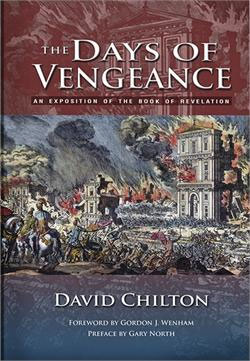
I read David Chilton’s The Days of Vengeance in 1989, and it sure surprised me to learn that the word ‘earth’ in the Bible also means ‘land.’ This simple fact alters the scope of John’s Revelation entirely. It is about God’s ending of the Covenant He restored after the Babylonian captivity, and so first century Judah is the main subject. It was a repeat of events in Jeremiah’s day, so let’s backtrack a little…
Continue reading
15 comments | tags: AD70, Bible history, Compromise, David Chilton, Dispensationalism, Exile, Ezekiel, Noah, Resurrection, Temple | posted in Against Hyperpreterism, Biblical Theology, The Last Days, The Restoration Era
Apr
10
2009
I received horrified reactions for using this phrase. God hates divorce, and yet…
“Then I saw that for all the causes for which backsliding Israel had committed adultery, I had put her away and given her a certificate of divorce; yet her treacherous sister Judah did not fear, but went and played the harlot also.”(Jeremiah 3:8)
Q: How could God divorce and remarry, and yet keep the Law? Marriage is “till death.”
A: Through death and resurrection.
The only way the Lord could make a new covenant was through death and resurrection. Not only did Israel die, but the Covenant died – the Ark was taken by God. Jeremiah predicted the Restoration Covenant, and redeemed some Land to prefigure what God Himself would do after the captivity.
The entire pattern was repeated in the first century. Christ, the Ark, ascended to God as firstfruits, and Israel also died, and was resurrected as the Christian church. There were two feasts in AD70, predicted towards the end of the Revelation. 1 The marriage supper of the Lamb in heaven, and 2 the feast of the unclean birds as Jezebel-Judah was finally destroyed under the Covenant curses.
Comments Off | tags: Ark of the Covenant, Divorce, Jeremiah, Jezebel | posted in Biblical Theology, The Restoration Era
Apr
10
2009
 A comment from David Hagopian on the recent pub debate between atheist Christopher Hitchens and Pastor Doug Wilson:
There was a moment when Hitchens hit Doug with the old, “Jesus didn’t fulfill his words in Mathew 24.” It was an amazing response by Doug. Very authoritative on this section of Scripture being a description of the destruction of the temple in A.D. 70. Really powerful. You could hear multiple pin drops in the room between Christopher and Westminster profs and students. The hair on my arms stood up. Hitchens was stunned. He never again in debates brought up Scripture. Powerful stuff.
Gary DeMar writes:
“Can you imagine how a futurist would attempt to deal with Matthew 24? “Well, Jesus didn’t really mean ‘this generation,’ that is, that first-century generation. He was really referring to a future generation. Yes, ‘this generation’ does always mean the generation to whom Jesus was speaking everywhere else in the gospels, but it doesn’t mean that here. It might mean ‘race’ or ‘a future generation that sees these signs.’” Instead of hearing pins drop, there would have been out-loud laughing and dismissal.”
Full article here.
Comments Off | tags: Apocalyptic, Atheism, Doug Wilson, Gary DeMar | posted in Biblical Theology, Quotes, The Last Days