How will the world judge God
when given the opportunity?
For God does know that in the day you eat thereof, then your eyes shall be opened, and you shall be as gods, knowing good and evil. (Genesis 3:5)
You shall have no other gods before me. (Exodus 20:3)
Jesus answered them, “Is it not written in your Law, ‘I said, you are gods’?” (John 10:34)
The aim of the testing of Adam was to qualify him to be a co-regent with God. Rich Bledsoe argues that the question of God’s existence is not ontological but ethical at heart. History is Man’s attempt to either eradicate God’s rule, or to make God co-regent with Man. Continue reading
Those who “freed science from Moses” rejected true science.
One of the most underrated aspects of theology is the importance to God of legal witness. Not only is it rarely spoken about in evangelical circles but it is rarely mentioned as an answer to the scientistic objections of the day.
[This post has been refined and included in Sweet Counsel: Essays to Brighten the Eyes.] Continue reading
If there is a God, and there is, then atheism did not free our thinking. Atheism has a closed mind concerning anything beyond its own nose. Thus, rather than furthering the cause of science, it is more likely that it has a stranglehold on it.
The gifted minds of the new atheists were gifts from Christianity. As the Spirit of God vacates Western Culture, so does the “Word.” Our children become confused, illiterate, and incapable of logical thought. According to Bojidar Marinov, we are already seeing atheism’s effects in the field of mathematics.
“I am against religion because it teaches us to be satisfied with not understanding the world.” — Richard Dawkins
Well, there’s one statement I don’t understand, unless Mr Dawkins means every religion except Christianity. Modern science was born of a distinctly Christian worldview. This next quote is one I understand to a point, but only because Mr Dawkins has a broken worldview.
“Reports of Christianity’s demise have been greatly exaggerated.”
“If your eschatology sees something other than the progressive growth and universal influence of the Kingdom of God in time and history, the success and triumph of the Great Commission, then you’d better stop drinking the Kool-Aid.” George Shubin
That was my friend George’s comment after reading this article by George Weigel from First Things.
For 27 years, the International Bulletin of Missionary Research has published an annual “Status of Global Mission” report, which attempts to quantify the world Christian reality, comparing Christianity’s circumstances to those of other faiths, and assaying how Christianity’s various expressions are faring when measured against the recent (and not-so-recent) past. The report is unfailingly interesting, sometimes jarring, and occasionally provocative.
(Michael Jensen has published an interesting article:)
Hence are we called atheists. And we confess that we are atheists, so far as gods of this sort are concerned, but not with respect to the most true God, the Father of righteousness and temperance and the other virtues, who is free from all impurity. Justin Martyr (103-165), First Apology VI
I should like to propose a thesis that may seem somewhat unlikely for a Christian theologian: namely, that the atheists are right.
“The entire free world could be shipwrecked by a teleprompter.”
I remember Carl Sagan commenting on the oddness of books, a collation of leaves covered in squiggles, in symbols. This is only odd if you are a godless fool (biblically defined) whose worldview is entirely at odds with reality.
Many atheists think it is their void-given right to make disrespectful, insulting or condescending remarks about religion. One I have heard a number of times is a common atheist response to “Your atheism is a religion”: If religion were a hair colour, then I am bald.
.
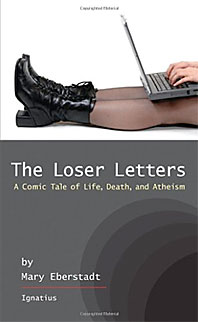
“This book is a gem. Through letters of advice from A.F. Christian, an enthusiastic convert to the cause of the new atheists, Mary Eberstadt deftly exposes the flaws in their views. Using the lingo of pop culture to hilarious effect, she offers a scathing satire of their question-begging arguments and shows with great wit that they are not just wrongheaded but downright laughable. Yet this spirited defense of Christian faith is also a poignant commentary on what it means to be human.”
– Fr. Peter Ryan, SJ, Professor of Moral Theology, Mt. St. Mary’s Seminary
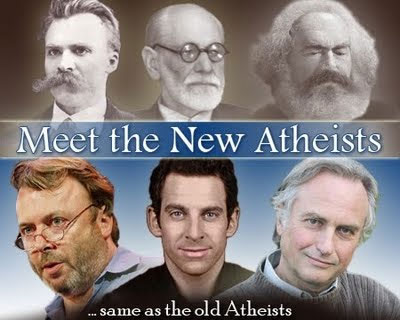
Last night I watched a 2007 debate between Richard Dawkins and John Lennox on 5 of Dawkins’ theses from his book The God Delusion. Lennox (who recently visited Australia to speak at the Easter Convention here in Katoomba) was delightful and made some strong statements. Dawkins was, to me, surprisingly earnest. But I did see in Dawkins’ responses to Lennox support for the observations of David Bently Hart that I read in a recent post by Justin Taylor. The new atheists are not the same as the old atheists:
Mike Bull is a graphic designer who lives and works in the Blue Mountains west of Sydney, Australia. His passion is understanding and teaching the Bible, and he writes occasionally for Theopolis Institute in Birmingham AL, USA.