Apr
10
2009
No Bible commentary is the last word, but James Jordan’s seven-year effort gets the ball through the hoop on Daniel. Here’s an excerpt from David Field’s review:
The approach of the book is marked by
 1. Immersion in and informed reference to the rest of the Hebrew Scriptures. The use of Genesis, Exodus, Leviticus, Ezra-Nehemiah, Esther, Isaiah, Jeremiah, Ezekiel, and Zechariah is astonishing and enriching at every turn. Use of or comment upon other books along the way are unfailingly stimulating and this applies to NT books as well, not least to Revelation which is greatly illumined by this work on Daniel.
2. Confident deployment of redemptive-historical paradigms which have themselves been recognized through close and repeated study of the whole Bible. In particular, theologico-spatial zones, old creation /new creation eras, and prophet /priest /king roles feature heavily and often have real power to unlock or clarify the subject in hand.
3. The closest of close structural analysis of the sort that comes from multiple readings. Chiasms and parallels and other patterning devices are attended to with great care and in such a way as positively informs the interpretation rather than being mere observations along the path.
4. Seriousness about chronology. This is one of the characteristics of Jordan’s work overall, since he sees emphasis on “ideas” at the expense of history as revealing and strengthening the gnosticism of much contemporary Christianity. The detailed chronological work lying behind his interpretation of Jeremiah and Ezekiel and his resolution of some of the Daniel “difficulties” is awesome.
5. Interpretative weight given to what still gets called “inter-testamental” history. Inter-testamental history is redemptive history and Jordan emphasizes that God speaks to and about that period in the patterns of Daniel 1-6 and in the prophecies of Daniel 1-7.
6. Attention to numerics: word-counts, significant numbers, and the meaning of numbers. There is work here to compare with Bauckham’s work on Revelation.
7. Typology. This is not a “typological” commentary as such because although half of Daniel is narrative, half of it is apocalyptic prophecy. But when you attend to redemptive-historical patterns and to literary structures and sequences and to the importance of history as Jordan does, then, in some sense, all your work will be typological. At the macro-historical this means that Daniel is one of God’s major interpretative words for the entire second phase of the first creation. The first creation has a former days and a latter days and then gives way to the new creation. Daniel tells us about the last centuries and decades of the latter days of the old world.
8. Cheerful (and sometimes curmudgeonly) unfashionableness. Early dating, traditional authorship, defense of biblical chronology, unashamed constant reference to Christ (how could it be otherwise?!), impatience with “unbelieving scholarship”, utter lack of interest in being respected and consistent resolve to be useful. This may be a difficult example for young scholars (like those in Daniel 1!) to follow but it is thoroughly refreshing.
9. Theological creativity at level “Genius”. I thought I knew Jordan’s work reasonably well but over and over and over again there are “aha!” moments. In my copy now there are almost more sentences and paragraphs marked than unmarked!”
“The Handwriting on the Wall” is available from www.americanvision.com
Also available as an e-book.
Comments Off | tags: Apocalyptic, Bible Chronology, Bible history, Book Review, Daniel, David Field, James Jordan, Typology | posted in Biblical Theology
Apr
9
2009

or ‘Riding on a donkey’
Why do theologians use the phrase “the Christ event”? Besides depersonalising Christ’s life, is it possibly a symptom of the chronic disease afflicting much of modern theology?
Continue reading
Comments Off | tags: Barth, Gnosticism, James Jordan | posted in Biblical Theology
Apr
9
2009
“The world (which God created from nothing) contains moral and natural evils. God either knew these evils would happen if He created or He did not. To say that He did not is to depart from Christian orthodoxy, being a functional denial of omniscience. But if God knew what would follow, and He decided to create anyway, this amounts to an ordaining of what would therefore happen. It is that simple.
The openness guys try to get around this by departing from Christian orthodoxy, and they deny God’s knowledge of the future. But this just makes Him guilty of reckless endangerment instead of premeditated carnage. But as Paul would say, I am out of my mind to talk like this…”
Doug Wilson, Narratival Calvinism and Storyless Readers (Comments) www.dougwils.com
Comments Off | tags: Doug Wilson, Open Theism, Orthodoxy | posted in Biblical Theology
Apr
9
2009
And the LORD said, “Arise, anoint him, for this is he.” Then Samuel took the horn of oil and anointed him in the midst of his brothers. And the Spirit of the LORD rushed upon David from that day forward. And Samuel rose up and went to Ramah.
Now the Spirit of the LORD departed from Saul, and a harmful spirit from the LORD tormented him. And Saul’s servants said to him, “Behold now, a harmful spirit from God is tormenting you. Let our lord now command your servants who are before you to seek out a man who is skillful in playing the lyre, and when the harmful spirit from God is upon you, he will play it, and you will be well.” (1 Sam. 16:12-16)
Does God send evil spirits? …
Continue reading
Comments Off | tags: Babylon, Covenant curse, David, Herod, Jeff Meyers, Pharaoh, Satan, Saul, Temple | posted in Biblical Theology
Apr
8
2009

God calls His people to represent Him to others who don’t know Him. When, through unbelief, these mediators forget that God is in charge, not them, they become ‘squatters’ in God’s house. They act like they own the place and mistreat God’s true children.
Continue reading
Comments Off | tags: Ahab, Apostasy, Babylon, Jezebel | posted in Biblical Theology
Apr
8
2009
In Hebrew, vindication and redemption are one word. When Job was confident that his redeemer lived, he was looking forward to his vindication against his “comforters.”
Jesus’ words against the Temple hung over Jerusalem for a generation, and would be vindicated despite Herod’s obsessive glorification of his graven image. Its completion in AD64 was taken as proof that Jesus was indeed a false prophet.
Christ came in judgment as He promised and the Temple was destroyed. Vindication and redemption came in one event, and new worship would be born through the death of the old.
“The pagan view of law is that justice is a balancing of the scales. The biblical view of law is that justice is transformational.”1
The death and resurrection of Israel in Christ as the head would be measured out in the people of God as the body. God’s Word brings division that leads totransfiguration. His justice always has one eye on the future.
1 James B. Jordan, Preterism vs. Gnosticism [lecture]. Available from www.wordmp3.com
Comments Off | tags: James Jordan, Job, Justice, Temple, Vindication | posted in Biblical Theology, Ethics
Apr
8
2009
A sample of the new ESV Study Bible was recently made available.
I liked this observation in the notes:
“Jonah’s rescue from death provides an analogy for the resurrection of Christ… The repentance of the Ninevites anticipates the wide-scale repentance of Gentiles in the messianic era.”
But not this one: “Humor, as Jonah’s behavior is not only ignominious but also ridiculous.”
When the prophets (like Elijah, Elisha and Jonah) were sent to Gentiles, it was to provoke Israel to jealousy because they would not listen to these prophets. Jonah understood his ministry meant condemnation would come upon his own people:
James B. Jordan said,
“I don’t think Jonah was some loyal nationalistic prophet. Jonah was in there every day complaining, criticising, prophesying, and denouncing the kingdom of northern Israel. It won’t do to say that Jonah didn’t want to take the Gospel to another nation. No, Jonah has something more profound in mind. Jonah was thinking about Deuteronomy 32:21. He didn’t want to take the Gospel to the Gentiles, because to do so was to bring about a curse on the Israelites. ”1
Paul was a more faithful Jonah, understanding this curse but obeying it nonetheless (Romans 9:3; Acts 28:28)
The study Bible looks good though.
1 Lectures on Jonah, available from www.wordmp3.com
[Originally posted 21 August 08]
Comments Off | tags: ESV, James Jordan, Jonah, Paul, Resurrection | posted in Biblical Theology
Apr
8
2009
“Typology is a philosophy of history.
It is also a theory of meaning.
Typology is a historical theory of meaning, a theory of historical meaning.
That Matthew can say “Out of Egypt I called My Son” is fulfilled in Jesus isn’t evidence that Matthew was a midrashist. It’s not merely a hint about how to read the Old Testament. It’s a pointer to the character of history and the nature of meaning. Texts mean the way Matthew says Hosea’s text means; history’s contours are the contours that Matthew discerns in Hosea’s reference to the exodus.
Typology is the beginning of wisdom.”
–Peter J. Leithart, www.leithart.com
Comments Off | tags: Peter Leithart, Typology | posted in Biblical Theology, Quotes
Apr
8
2009
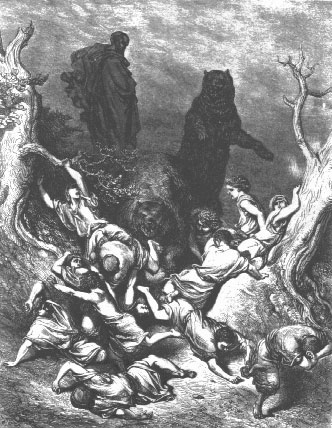
Here is a comment I posted on another blog. The blog accuses God (and the Bible) of cruelty as a basis to reject the Scriptures:
And he [Elisha] went up from thence unto Bethel: and as he was going up by the way, there came forth little children out of the city, and mocked him, and said unto him, Go up, thou bald head; go up, thou bald head. And he turned back, and looked on them, and cursed them in the name of the LORD. And there came forth two she bears out of the wood, and tare forty and two children of them. 2 Kings 2:23-24
Continue reading
Comments Off | tags: AD70, Creation Week, Elijah, Elisha, Joshua, Moses, Remnant | posted in Apologetics, Bible Matrix, Biblical Theology, The Last Days
Apr
8
2009
When were the gospels written?
Matthew is the first of the gospels; there can be little doubt of this. The notion that Mark was first because Mark is shorter is nonsensical. Matthew was one of the disciples and was a man of letters. Who better to take notes during Jesus’ lifetime?
Moreover, immediately after Pentecost there would have been a demand for a book containing the teaching and works of Jesus.
The Jews were a people of the book. Each time God did a great work, a new part of Scripture was written to tell about it. The 3000 converts on the day of Pentecost would have expected such a book, and we can be pretty sure that Matthew set right down to write it. Doubtless he spoke with the other disciples, and perhaps Matthew’s gospel is to some extent a joint work. It is perfectly reasonable to assume that within a month after Pentecost copies of Matthew’s gospel were in circulation.
from BIBLICAL Horizons, No. 94 and 95.
Toward a Chiastic Understanding of the Gospel According to Matthew, Parts 1 & 2
© 1997 Biblical Horizons | www.biblicalhorizons.com
2 comments | tags: Bible Chronology, Bible history, Gospels, James Jordan | posted in Biblical Theology