Apr
8
2009
Christians buy books to tell them what’s in the Bible. Why this need? What are they hearing at church?
I teach the Bible in a public high school. It’s not just “Scripture lessons.” We actually let the Bible stand on its own. We get through more Bible in one week in a class of un-churched teenagers than many local churches get in months. Why is this?
Christians aren’t dumb. Are we starving the sheep because we are afraid of offending outsiders? We need churches that teach all of the Bible to all of the people. It really isn’t that hard. People are so hungry for it that Hollywood has filled the gap. The Bible isn’t much more complex than a long-running prime-time show if we spend the time on it. But most Christians don’t even have a basic framework so they get sucked into subtle heresy like The Shack. Church is so dumbed down.
The Bible only seems irrelevant because we don’t teach it. When we actually teach its narratives (and not just systematic theology), it creates its own relevance.
The narratives themselves (obviously with some helpful exposition) communicate the systematics in context, memorably, and very powerfully.
I love watching my students put the pieces together. Just teach the Book and watch people change. As we teach it, they learn how to read it, and then interpret the world by it.
Comments Off | posted in Biblical Theology
Apr
8
2009
The golden Lampstand, with seven flames, corresponds to the sun, moon and five planets (those visible to the naked eye) that govern the firmament. These are the seven “eagle-eyes” of God. The Lampstand was a stylised almond tree. In Hebrew, the word translated “almond” is also the word for “watcher, overseer.” An almond tree is a shepherd who grows out of the earth and reaches heaven–a Tree of Life.
Stephen defended himself with a speech recounting the history of Israel, culminating in their murder of prophets before the exile.
“You stiff-necked people, uncircumcised in heart and ears, you always resist the Holy Spirit. As your fathers did, so do you. Which of the prophets did your fathers not persecute? And they killed those who announced beforehand the coming of the Righteous One, whom you have now betrayed and murdered, you who received the law as delivered by angels and did not keep it.” (Acts 7:51-53)
 They would be exiled, like their fathers, but into outer darkness grinding their teeth in agony (Matthew 8:12). They were already grinding their teeth, but against Stephen. He saw the heavenly veil opened and Jesus standing at the right hand of God, the Watcher Tree, the Lampstand, measuring the first martyr of the New Covenant Table of Showbread. Like Jesus, Stephen was ejected from the city and executed. Like Jesus, he asked the Lord to receive his spirit, and prayed for forgiveness for his murderers. He was “one like the Son of Man.”
Continue reading
Comments Off | tags: Elijah, Lampstand, Stephen | posted in Biblical Theology, Totus Christus
Apr
8
2009
“…Here we see the third Babylon in all its horror. Both city (Nimrod: Herod + Pilate-Caesar) and tower (priests and Jews) join in putting Jesus to death. Together, they intend that their city and tower will endure, no matter what the God of Heaven says or does. Judgment comes, however. As God came  down on the first two Babylons, the Spirit comes down at Pentecost. Immediately there is a confusion of tongues. Jews of every nation hear the gospel in every language except Hebrew-Aramaic. This time, however, instead of a scattering of lips (religions), there is a unification of lips around the praise of the Father of Jesus Christ. As we shall see below, however, there is another sense in which there is a scattering of different “lips.” The “gift of tongues” continues on and off throughout the Apostolic Age until Jerusalem (the whole circumcision) is destroyed in the destruction of Mystery Babylon in ad 70. The Jews are brought into consternation (1 Corinthians 14:21–22; compare Acts 18:7). Continue reading
Comments Off | tags: Babel, baby, hero, Pilate, Tongues | posted in Biblical Theology, The Last Days
Apr
8
2009
“God’s creation of Israel was like his creation of the world. The cosmos has an order that will someday be undone. Israel had an order that was undone. And so the un-creation of Israel is sometimes described in the analogous cosmic terms.
Jeremiah was the prophet on duty when Jerusalem fell to the Babylonians and the temple was destroyed. Israel was de-created. No more son of David on the throne. No more temple in Jerusalem. No more people in the land. Jeremiah describes this coming cataclysm in terms of cosmic creation: 4:23 “I looked upon the earth and behold it was formless and void; and to the heavens, and they had no light.”
Jeremiah is not the only prophet to talk like this. And unless we understand that this is part of the prophetic vocabulary, we will come to the book of Revelation and read about stars falling from heaven and other cosmic disasters, and we will not immediately think, “Oh, so Jerusalem and the temple are going to be destroyed and the people removed from the land again. Ah.”
(This is not a new thought here, at all. But American evangelicals have a very persistent misunderstanding in this matter.)”
Keith Ghormley, http://presbyteer.blogspot.com
Comments Off | tags: Creation Week, Eschatology, Jeremiah | posted in Biblical Theology, Quotes, The Last Days
Apr
8
2009
The book of Daniel begins with the captured vessels from Solomon’s Temple being carried off to Babylon. We assume the ark, with its solid gold lid, was melted down. The golden lampstand, however, shows up at Belshazzar’s feast just before the fall of Babylon to Persia. Cyrus decrees that the Jews can return and rebuild the Temple. They carry the vessels, minus the Ark, across the Great River Euphrates.
Zechariah later sees a flying scroll with the dimensions of the Tabernacle (10 x 20 cubits). These are also the dimensions of the Ark plus cherubim in Solomon’s Temple. The Ark had been offered as an ascension and created a new heaven – unrolled a new scroll. The Restoration Covenant cost the Ark its “life.”
Now to Acts. The human Ark, Jesus, had ascended to heaven and left the “seven churches”, the New Covenant Lampstands with tongues of fire, to rule and conquer Babylon (Jerusalem). The church did so, and we see the firstfruits church army, the “kings from the sunrising” crossing the Great River in Revelation 16, entering a new earth like Joshua over Jordan.
Comments Off | tags: Ark of the Covenant, Babylon, Daniel, Exile, Lampstand, Revelation, Stephen, Tabernacle, Temple, Zechariah | posted in Biblical Theology, The Last Days
Apr
8
2009
The Bible is a complex book. Consisting of sixty-six books written over several millennia, it describes a bewildering array of characters and events. The Bible seems especially complex and difficult to modern Christians, because, however hard we try to think biblically, we have been subtly but deeply influenced by modern philosophy and science. Often, even when we have rejected the explicit conclusions of science, we unconsciously adopt a scientistic mind-set. One example of this is our tendency to operate on the modern assumption that all ideas can be defined with infinite, scientific precision, and that concepts can and should be distinguished very sharply.
The more you study the Bible, the more you will find that it cannot be forced into this mold. Ideas and symbols in the Bible meld together, overlap, and stretch out in a thousand different directions. This is not to say that the Bible is irrational or unscientific, or that we cannot make any meaningful distinctions. But a modern reader cannot escape the sense that the Bible speaks a very different language than he learned in “Chem. Lab” or Philosophy 101. As theologian Vern S. Poythress has noted, the biblical world view acknowledges the reality of “fuzzy boundaries.”
–Peter Leithart, The Kingdom and the Power, p. 93.
Comments Off | tags: Peter Leithart | posted in Biblical Theology
Apr
8
2009
or The Knowledge of Good and Evil is Always a Two-Edged Sword
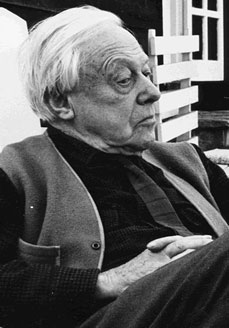
“Nobody has the power to bless or be blessed who has lost the vigor to curse. Our society is so polite that it cannot curse social evils and prefers to blaspheme God instead.”
- Eugen Rosenstock-Huessy
Judgment is not destruction. Judgment is assessment. For every beast rejected and sent to outer darkness, there is a redeemed beast that ascends to God. AD70 was the ultimate Yom Kippur, the outworking of the cross. Passover always leads to the Day of Atonement, the Day of the Lord when the flaming sword turns to and fro.
Comments Off | tags: Atonement, Eugen Rosenstock-Huessy | posted in Biblical Theology
Apr
8
2009
“Union Card”
E. Miner wrote, that “the ability to declare typology absent is a kind of proof of sound modern critical method.”
Which translated means, “Skepticism about typology is the union card of serious biblical scholarship.”
Peter J. Leithart, www.leithart.com
Comments Off | tags: Peter Leithart, Typology | posted in Biblical Theology
Apr
8
2009
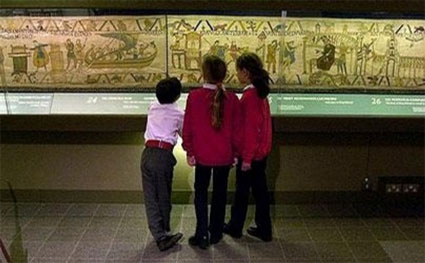
The rejection of typology by modern conservative interpreters renders them unable to make any sense of the “oddities” in the New Testament, which are not vestigial organs but references to repeated themes.
These scholars limit themselves to the mechanics, when full interpretation requires a musician. They insist upon only ever studying the tapestry of Biblical revelation from the back. They miss many things that are obvious to Bible-taught children.
Comments Off | tags: Typology | posted in Biblical Theology
Apr
8
2009
“As you saw iron mixed with ceramic clay, they will mingle (intermarry) with the seed of men; but they will not adhere to one another, just as iron does not mix with clay.” Dan 2:43
I think the key to Genesis 6 is that this pattern is repeated many times in the Bible. It was the sin of INTERMARRIAGE, of compromise between the priesthood and unbelieving women. Adultery and idolatry have a close connection. Continue reading
Comments Off | tags: Babylon, Compromise, Genesis, Herod, Temple, The flood | posted in Biblical Theology, The Last Days