A recent post by Jeff Meyers, reproduced in full here with his permission.
I see that the Gospel reading in the lectionary this week is Mark 12: 38-44. I’m preaching through the 10 commandments, so I won’t be commenting on this passage on Sunday. But I would like to give a different perspective on this passage than what is normally heard.
Pushing something to its logical conclusions is most often a wise thing to do. If you have good data to start with (unlike those pushing global warming) the resulting “computer model” can be very helpful. This is also the case with biblical doctrine. It is very helpful to push hyperpreterism to its logical conclusions, which damn it entirely. It is also very helpful to push biblical typology to its logical conclusions. This may sound harebrained to some, but if done within the constraints the Bible itself gives us, false doctrine should stand out like blood stains under ultraviolet light.
“Israel’s ministry was to purchase every single day with blameless blood. Every morning and evening enjoyed by the nations was paid for in Yahweh’s name.”
After the spectacular stories of Balaam and Phinehas, it is no wonder the modern mind has problems when the Torah suddenly crunches its gears to speak once again in detail about offerings. To the higher critic, this is simply evidence of a hodgepodge of scrolls gathered together by an ignorant and hurried scribe. For the believer, it adds to the niggling sense that the Bible has an internal logic which neither your pastor nor any Christian book you have read so far seems to be able to solve, despite many valiant attempts.
“The Sabbatarian vision is too small. This is why Paul chides the Galatians for observing ‘days and months and seasons and years.’ The Sabbath, along with the Torah administration as a whole, belonged to the stoicheia, the “elements of the world,” the things that constituted the first creation.”
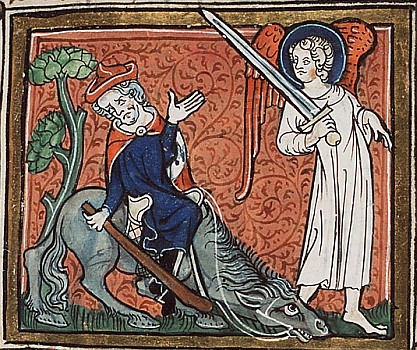
We’ve reach the central “cycle” of the book of Numbers, the attempt by Balak to destroy Israel. To the unbeliever, it is a story about a talking donkey. For believers, it is a story about a wicked prophet and a carnal people. For those with a wide angle “Bible Matrix” lens, the entire landscape suddenly comes into focus as something familiar and terrifying.
Mike Bull is a graphic designer who lives and works in the Blue Mountains west of Sydney, Australia. His passion is understanding and teaching the Bible, and he writes occasionally for Theopolis Institute in Birmingham AL, USA.