Dec
7
2011
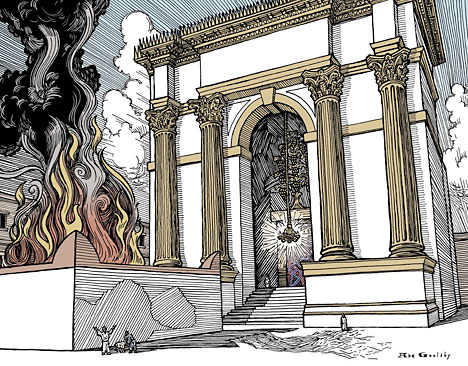
This post concerns the Covenant-literary structure of 2 Thessalonians 2. The context and audience are first century, but it amazes me how willing we modern Christians are to do intricate hermeneutical acrobatics to avoid the obvious conclusion that the particular “coming” of Christ referred to here was also a first century event – the end of the Old Covenant in AD70.
A reasonably close look at the text makes it inescapable. A very close analysis makes it inexcusable, especially once we are versed in the literary mechanics of the Bible Matrix. Continue reading
1 comment | tags: AD70, Atonement, Circumcision, Covenant curse, Covenant Theology, Hermeneutics, Herod, High Priest, Jericho, Paul, Thessalonians, Urim and Thummim | posted in Bible Matrix, Biblical Theology, Ethics, The Last Days
Dec
6
2011
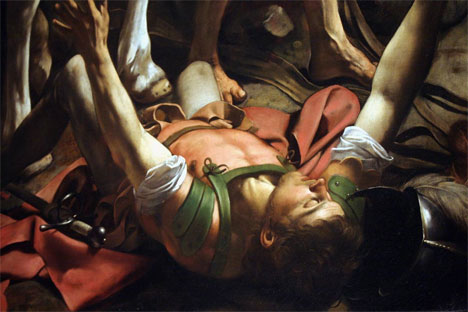
I posted this cycle in response to a comment/suggestion by Steven Opp. It’s from Totus Christus. I’ve learnt since 2009 that the texts contain much more precise structures than I was aware of at the time, but do believe this one still holds water at a general level. And speaking of water, look where Paul’s baptism occurs in the passage.
Continue reading
7 comments | tags: Acts, Baptism, Covenant Theology, Literary Structure, Totus Christus | posted in Bible Matrix, Biblical Theology
Dec
3
2011
1 Peter 2:4-10 | Sermon Notes
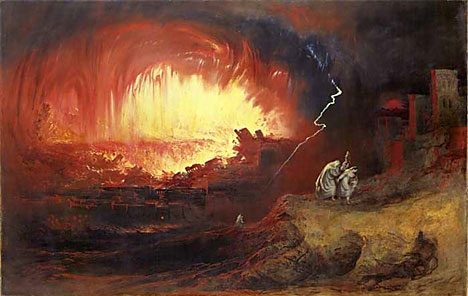
The Stoning of Israel
I think it’s worth looking at the literary structure of this passage. Here’s a revised version of the sheet I handed out after the sermon.
As I’ve written before, modern readers (and commentators) only look at the content of the text, but the authors of Scripture also communicate to us through where they place that content within that text, i.e. how it is arranged.
Continue reading
1 comment | tags: Baptism, Covenant curse, Covenant Theology, Literary Structure, Lot, Moses, Peter, Ruth, Systematic typology, Tabernacle, The Law, Typology | posted in Bible Matrix, Biblical Theology
Nov
30
2011
1 Peter 2:4-10 | Sermon Notes
Unfinished Business
6 For in Scripture it says: “See, I lay a stone in Zion, a chosen and precious cornerstone, and the one who trusts in him will never be put to shame.”
The first mention of a cornerstone is in Job 38. The Lord sees the Land as the foundation of His Temple. The entire structure reflects the Covenantal nature of the act of Creation.
Continue reading
1 comment | tags: Atonement, Hosea, Job, Justice, Justification, Peter, Solomon, Temple, Urim and Thummim | posted in Bible Matrix, Biblical Theology
Nov
28
2011
1 Peter 2:4-10 | Sermon Notes
Cut and Uncut Stones
4 As you come to him, the living Stone—rejected by humans but chosen by God and precious to him—
Peter’s use of the stone image should bring many Old Testament images to mind:
- the precious stones of Havilah, intended to be mined from the Land to glorify the sanctuary [1]
- the false stones of Babel (they had brick for stone)
- Jacob’s head on the altar stone, in a deep sleep
- Jacob’s raising of an altar stone in Bethel: “And this stone which I have set as a pillar shall be God’s house, and of all that You give me I will surely give a tenth to You.”
- Zipporah’s sharp stone of circumcision
- Moses enthroned on a stone at the defeat of Amalek
- Israel’s altars of stone (one stone for each tribe) at Sinai and Carmel
- The precious stones on the breastplate of the High Priest
- The tablets of stone carrying the ten words
- The stones of the “Levitical” house in the city filled with plague
- The stones of judgment, the ground itself as a witness executing transgressors outside the camp
- The black and white stones in the ephod
We have two types of stones: uncut stones (altar, judgment – the Law) and cut, or precious, stones (glory and riches – Grace).
Continue reading
1 comment | tags: Circumcision, Exodus, Ezekiel, Genesis, Havilah, Hebrews, High Priest, Peter, Satan, Sinai, Solomon, Tabernacle, Temple | posted in Bible Matrix, Biblical Theology
Nov
25
2011
Comments Off | posted in Biblical Theology
Nov
24
2011
In a universe of types and symbols, everything is self-effacing. Everything created points to, speaks of, something else in creation, and all creation ultimately points us back to the Trinity, the Perfect Unself.
Comments Off | tags: Trinity, Typology | posted in Biblical Theology, Creation
Nov
22
2011
 -
-
Here’s the radio interview I did recently with Jerry Bowyer. It’s a run down on the Genesis one “matrix” and how it structures existence, economics and empire.
Click here to listen
3 comments | posted in Bible Matrix, Biblical Theology
Nov
18
2011
In Deep Comedy, Peter Leithart compares the Bible’s essentially comic and hopeful view of history with the Greco-Roman view, which is essentially and irredeemably tragic.
In Paul’s estimation, anyone who thought that the new life through Jesus pertained to some realm outside this history was simply an unbeliever. For the gospel says otherwise.
Continue reading
1 comment | tags: Church Fathers, Church History, David, Ecclesiastes, Faith, Gnosticism, Job, Literary Structure, Peter Leithart, Postmillennialism, Solomon | posted in Against Hyperpreterism, Biblical Theology, Quotes
Nov
16
2011
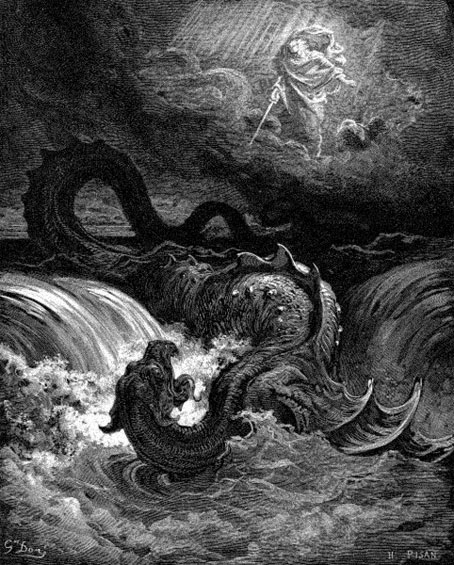
Remy Wilkins recently proposed a thesis about serpents and dragons in the Bible. Is there a difference? Are the words interchangeable? And even if they aren’t, how are these animals–and the spiritual truths they were created to represent–related?
This post has been slain and resurrected for inclusion in my 2015 book of essays, Inquietude.
Continue reading
1 comment | tags: Dominion Theology, Genesis, Noah, Remy Wilkins, Revelation 20, Satan, Totus Christus, Totus Diabolus | posted in Against Hyperpreterism, Biblical Theology, Creation, Quotes, The Last Days